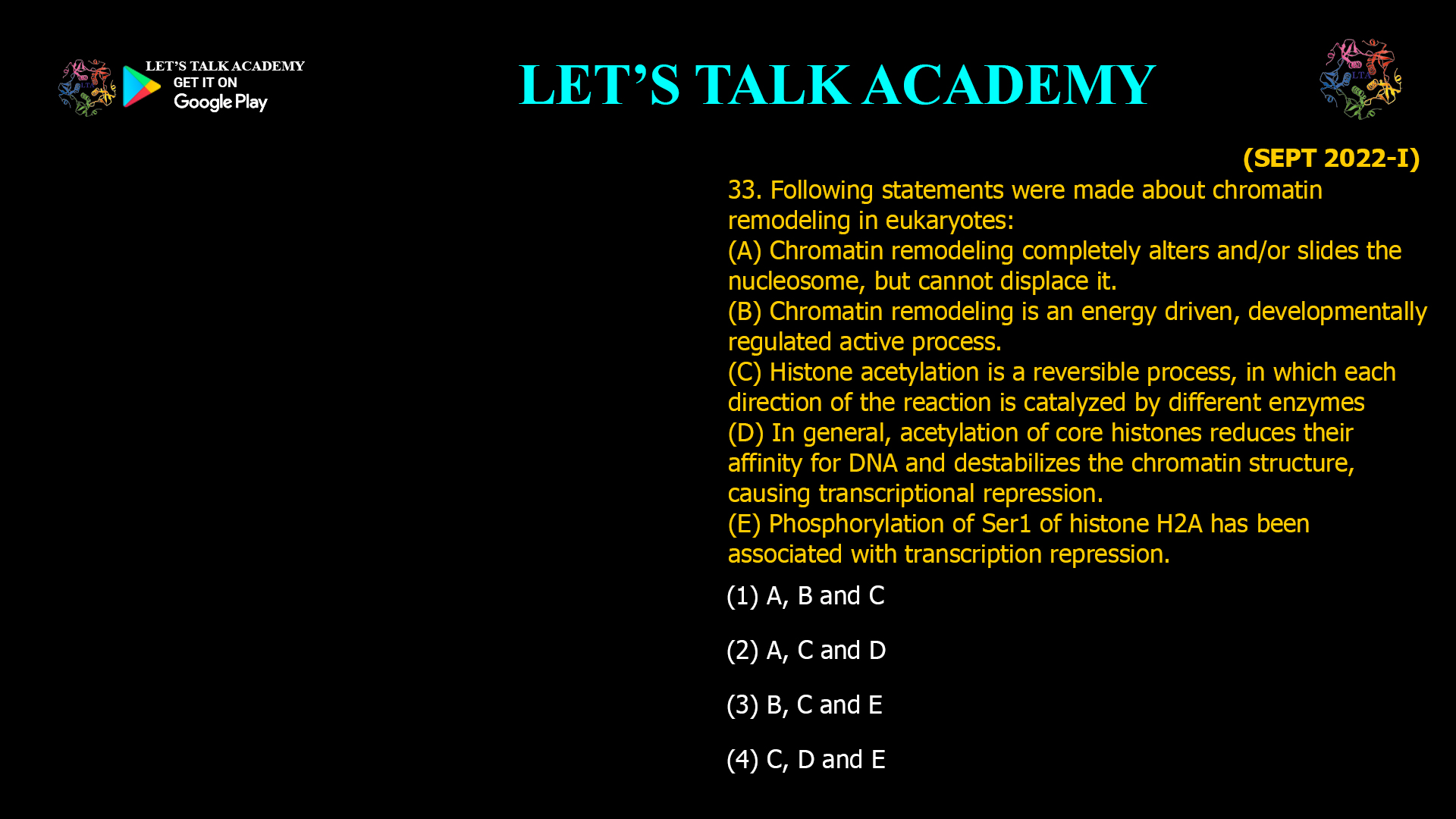
33. Following statements were made about chromatin remodeling in eukaryotes:
(A) Chromatin remodeling completely alters and/or slides the nucleosome, but cannot displace it.
(B) Chromatin remodeling is an energy driven, developmentally regulated active process.
(C) Histone acetylation is a reversible process, inwhich each direction of the reaction is catalyzed by different enzymes
(D) In general, acetylation of core histones reduces their affinity for DNA and destabilizes the chromatin structure, causing transcriptional repression.
(E) Phosphorylation of Ser1 of histone H2A has been associated with transcription repression.
(1) A, B and C (2) A, C and D
(3) B, C and E (4) C, D and E
Introduction
Chromatin remodeling is a fundamental process in eukaryotic cells that dynamically alters chromatin structure to regulate DNA accessibility. This remodeling is crucial for controlling gene expression, DNA replication, repair, and other vital cellular functions. Understanding the mechanisms and consequences of chromatin remodeling provides insight into how cells manage their genetic information in response to developmental and environmental cues.
What Is Chromatin Remodeling?
Chromatin remodeling refers to the enzyme-driven modification of nucleosome positioning, composition, or structure to expose or occlude DNA regions. In eukaryotic nuclei, DNA is tightly wrapped around histone octamers, forming nucleosomes—the basic units of chromatin. This packaging restricts access to DNA-binding proteins such as transcription factors and RNA polymerase. Remodeling processes “open” chromatin to permit gene activation or “close” it to repress transcription.
Mechanisms of Chromatin Remodeling
1. Nucleosome Sliding and Restructuring
ATP-dependent chromatin remodeling complexes use energy from ATP hydrolysis to slide nucleosomes along DNA or restructure nucleosome components. This repositioning exposes DNA sequences previously buried within nucleosomes, facilitating transcription factor binding and initiation of transcription.
Importantly, chromatin remodeling can involve:
-
Sliding nucleosomes: Moving nucleosomes along DNA to reveal promoter regions.
-
Partial unwrapping or restructuring: Altering histone-DNA contacts without complete nucleosome displacement.
-
Nucleosome eviction: Removing histones to create nucleosome-free regions.
Contrary to some misconceptions, remodeling complexes can displace nucleosomes, not just slide them.
2. Histone Modifications
Covalent post-translational modifications (PTMs) of histones, such as acetylation, methylation, phosphorylation, and ubiquitination, regulate chromatin dynamics by altering histone-DNA interactions and recruiting remodeling factors.
-
Histone acetylation by histone acetyltransferases (HATs) neutralizes positive charges on lysines, reducing histone affinity for DNA and loosening chromatin.
-
Histone deacetylation by histone deacetylases (HDACs) restores positive charges, promoting chromatin compaction.
-
These modifications are reversible and catalyzed by distinct enzymes, allowing dynamic regulation.
3. Energy-Driven and Developmentally Regulated Process
Chromatin remodeling is an active, ATP-dependent process tightly regulated during development and in response to cellular signals. Remodelers are recruited to specific genomic loci by transcription factors and co-activators, ensuring precise control of gene expression patterns.
Biological Significance of Chromatin Remodeling
-
Gene Expression Regulation: Remodeling exposes promoter and enhancer regions for transcriptional activation or conceals them for repression.
-
DNA Repair: Chromatin remodeling facilitates access of repair proteins to damaged DNA sites.
-
Replication and Cell Cycle: Remodelers ensure proper chromatin structure during DNA replication and mitosis.
-
Development and Differentiation: Dynamic chromatin changes underpin cell fate decisions and tissue-specific gene expression.
Clarifying Common Misconceptions
-
Chromatin remodeling can displace nucleosomes, not just slide them.
-
Histone acetylation generally promotes transcriptional activation by loosening chromatin, not repression.
-
Phosphorylation of histone H2A at Ser1 is typically associated with transcriptional activation or DNA damage response, not repression.
Summary of Statements
| Statement | Correctness | Explanation |
|---|---|---|
| (A) Chromatin remodeling completely alters and/or slides the nucleosome, but cannot displace it | Incorrect | Remodeling complexes can displace nucleosomes as well as slide them. |
| (B) Chromatin remodeling is an energy driven, developmentally regulated active process | Correct | Remodelers use ATP and are regulated during development. |
| (C) Histone acetylation is a reversible process, in which each direction of the reaction is catalyzed by different enzymes | Correct | HATs add acetyl groups; HDACs remove them. |
| (D) Acetylation of core histones reduces their affinity for DNA and destabilizes chromatin, causing transcriptional repression | Incorrect | Acetylation promotes chromatin relaxation and transcriptional activation. |
| (E) Phosphorylation of Ser1 of histone H2A has been associated with transcription repression | Incorrect | This modification is linked to activation or DNA damage response. |
Correct Combination of Statements
The correct set of true statements is:
(1) B, C, and E
Conclusion
Chromatin remodeling is a complex, ATP-dependent process essential for regulating DNA accessibility in eukaryotic cells. It involves nucleosome sliding, eviction, and histone modifications, which together orchestrate gene expression, DNA repair, and other critical cellular functions. Understanding these mechanisms clarifies how cells dynamically control their genomes in response to internal and external cues.


