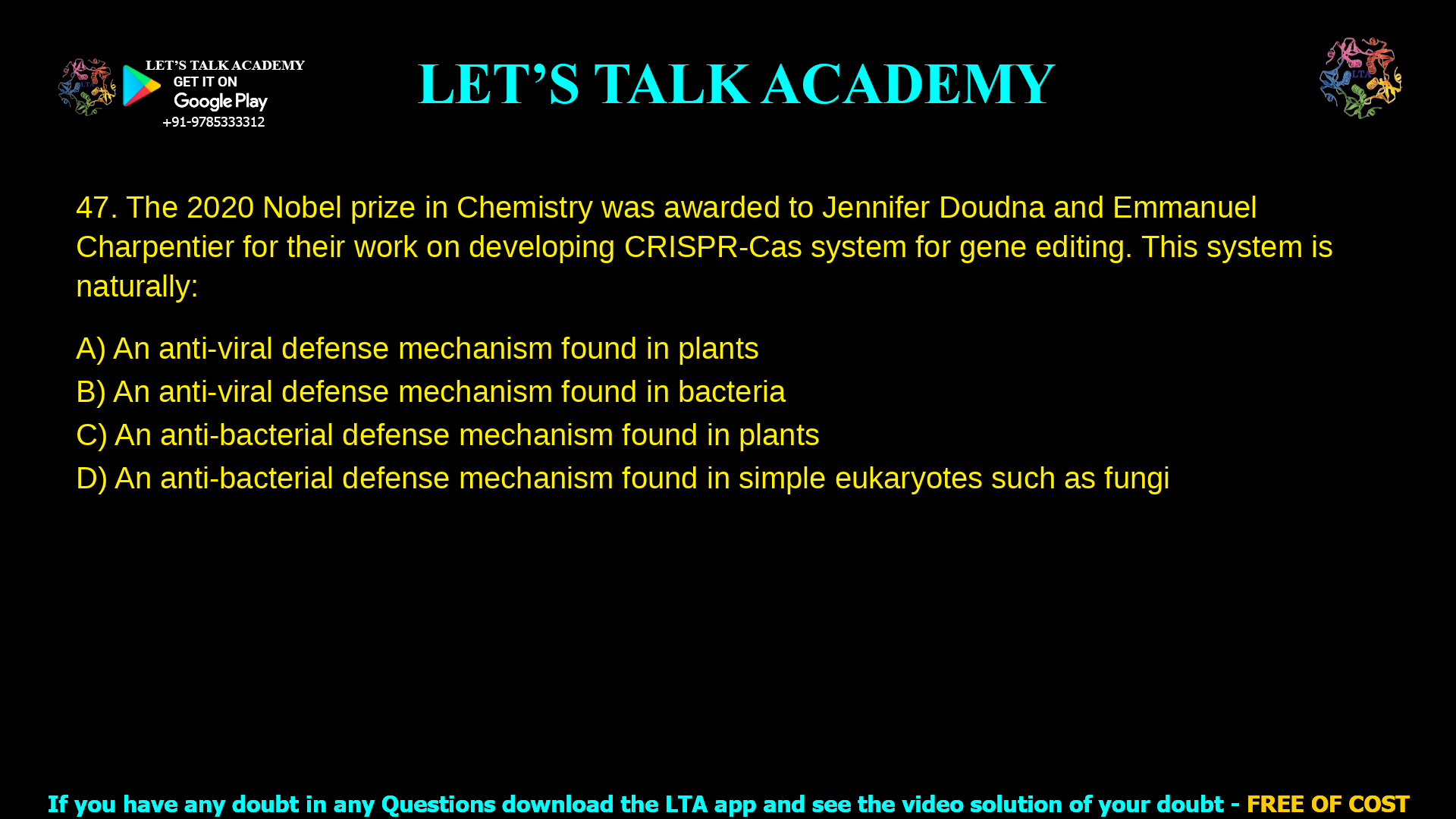
2. The 2020 Nobel prize in Chemistry was awarded to Jennifer Doudna and Emmanuel
Charpentier for their work on developing CRISPR-Cas system for gene editing. This
system is naturally:
a. An anti-viral defense mechanism found in plants
b. An anti-viral defense mechanism found in bacteria
c. An anti-bacterial defense mechanism found in plants
d. An anti-bacterial defense mechanism found in simple eukaryotes such as
fungi
The correct answer is b. An anti-viral defense mechanism found in bacteria.
Option Analysis
CRISPR-Cas naturally functions as an adaptive immune system in prokaryotes, primarily targeting invading viral DNA or RNA from bacteriophages.
-
a. An anti-viral defense mechanism found in plants: Incorrect, as plants lack native CRISPR-Cas systems; their defenses rely on RNA interference (RNAi) and other pathways like R-genes.
-
b. An anti-viral defense mechanism found in bacteria: Correct, since bacteria and archaea use CRISPR-Cas to acquire viral DNA spacers, transcribe guide RNAs, and deploy Cas nucleases to cleave matching phage genomes during reinfection.
-
c. An anti-bacterial defense mechanism found in plants: Incorrect on both counts—plants do not have CRISPR-Cas, and the system defends bacteria against viruses, not bacteria.
-
d. An anti-bacterial defense mechanism found in simple eukaryotes such as fungi: Incorrect, as fungi employ other defenses like RNAi; CRISPR-Cas is prokaryotic and anti-viral, not anti-bacterial.
The CRISPR-Cas system natural anti-viral defense mechanism in bacteria revolutionized gene editing, earning Jennifer Doudna and Emmanuelle Charpentier the 2020 Nobel Prize in Chemistry. This bacterial immune tool combats viruses by storing invader DNA snippets as spacers in CRISPR arrays.
How CRISPR-Cas Works Naturally
Bacteria integrate phage DNA fragments into CRISPR loci during adaptation, forming guide crRNAs that direct Cas proteins to cleave matching viral genomes in interference stages. This process prevents bacteriophage replication, showcasing adaptive immunity unique to prokaryotes.
Beyond Bacteria: Gene Editing Impact
Doudna and Charpentier’s 2012 work repurposed CRISPR-Cas9 into programmable scissors for precise DNA cuts in any organism. Applications span crop engineering, disease modeling, and therapies, though ethical concerns like germline editing persist.


