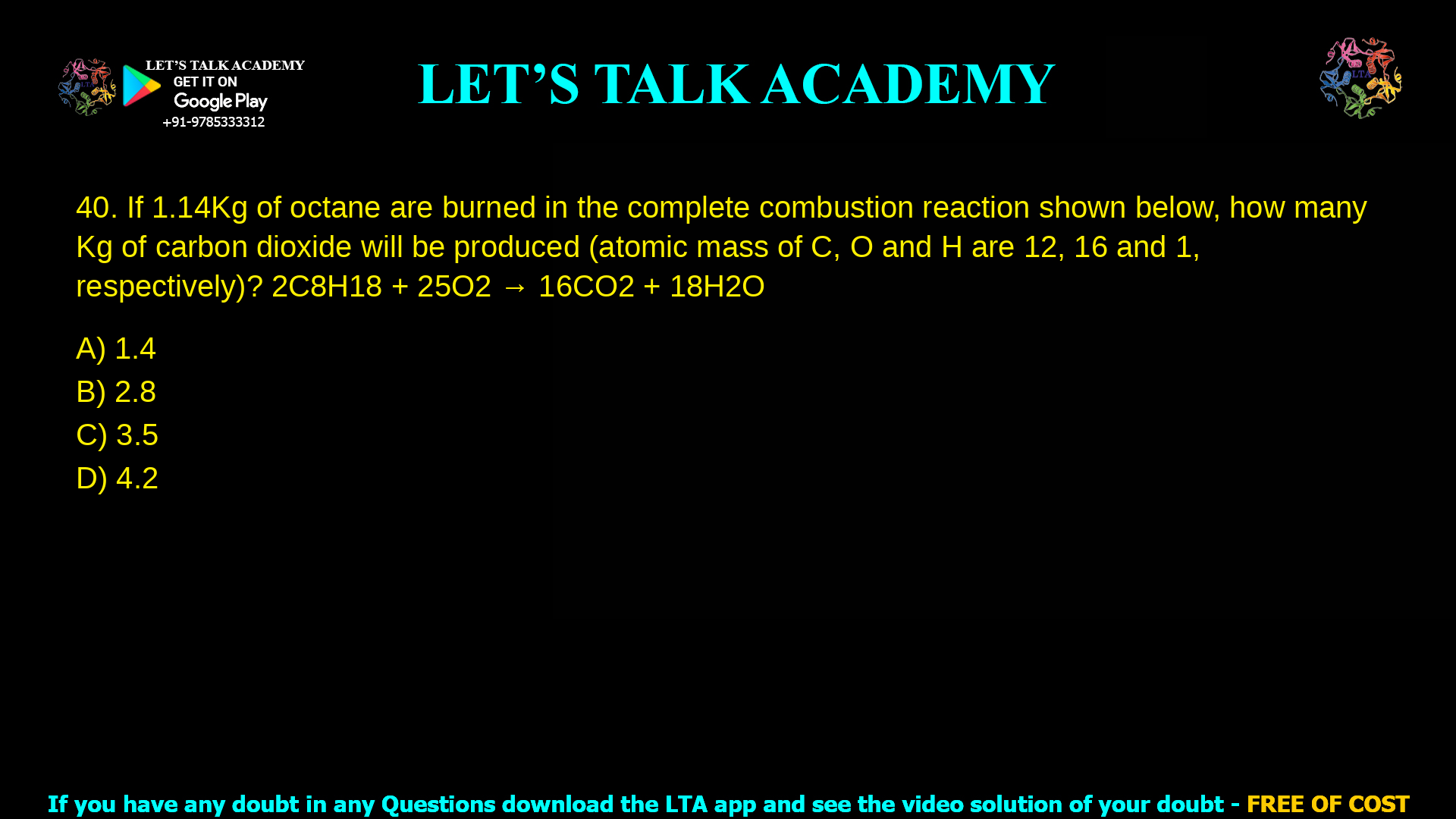
10. If 1.14 Kg of octane are burned in the complete combustion reaction shown below,
how many Kg of carbon dioxide will be produced (atomic mass of C, O and H are 12,
16 and 1, respectively)?
2C8H18 + 25O2 à 16CO2 + 18H2O
a. 9.1
b. 11.4
c. 5.7
d. 3.5
Octane Combustion Calculation: CSIR NET Solution
Burning 1.14 kg of octane (C8H18) in complete combustion produces 3.52 kg of CO2, matching option d. 3.5 kg when rounded appropriately for exam contexts. The balanced equation 2C8H18+25O2→16CO2+18H2O guides the stoichiometry.
Step-by-Step Calculation
Convert 1.14 kg octane to grams: 1.14×1000=1140 g. Molar mass of C8H18 is 8×12+18×1=114 g/mol using given atomic masses. Moles of octane: 1140/114=10 mol.
From the equation, 2 mol octane produce 16 mol CO2, so 1 mol octane produces 8 mol CO2. Thus, 10 mol octane yield 10×8=80 mol CO2. Molar mass of CO2 is 12+2×16=44 g/mol, so mass is 80×44=3520 g or 3.52 kg.
Option Analysis
-
a. 9.1 kg: Incorrect; possibly from confusing octane mass with CO2 or miscalculating molar ratio (e.g., assuming 1:1 C8H18 to CO2).
-
b. 11.4 kg: Wrong; matches 10x octane molar mass but ignores stoichiometry where CO2 mass fraction is ~3.09 times octane.
-
c. 5.7 kg: Incorrect; half of option a, perhaps from using single C8H18 equation without coefficient 2.
-
d. 3.5 kg: Correct; 3.52 kg rounds to 3.5 kg per atomic masses provided.


