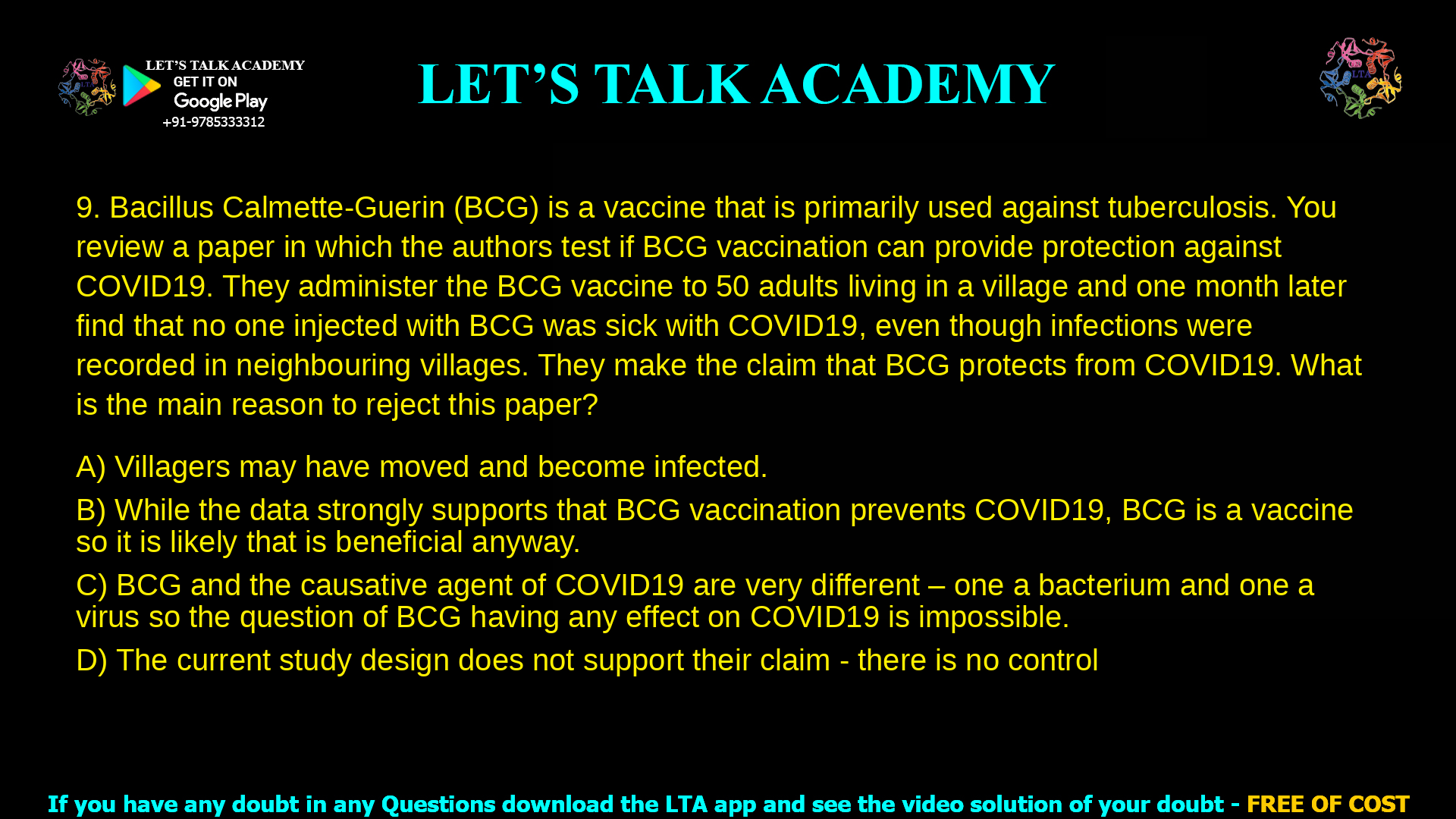
9. Bacillus Calmette-Guerin (BCG) is a vaccine that is primarily used against
tuberculosis. You review a paper in which the authors test if BCG vaccination can
provide protection against COVID19. They administer the BCG vaccine to 50 adults
living in a village and one month later find that no one injected with BCG was sick
with COVID19, even though infections were recorded in neighbouring villages. They
make the claim that BCG protects from COVID19. What is the main reason to reject
this paper?
a. Villagers may have moved and become infected.
b. While the data strongly supports that BCG vaccination prevents COVID19,
BCG is a vaccine so it is likely that is beneficial anyway.
c. BCG and the causative agent of COVID19 are very different – one a
bacterium and one a virus so the question of BCG having any effect on
COVID19 is impossible.
d. The current study design does not support their claim – there is no control
group.
The correct answer is d. The current study design does not support their claim – there is no control group.
Option Analysis
a. Villagers may have moved and become infected.
This suggests potential loss to follow-up but fails as the main flaw. Without baseline infection rates or comparable exposure data from unvaccinated peers, movement alone does not undermine the core design issue. Proper trials track such variables, yet the study lacks any comparison group entirely.
b. While the data strongly supports that BCG vaccination prevents COVID19, BCG is a vaccine so it is likely that is beneficial anyway.
This option concedes the data supports the claim while vaguely appealing to BCG’s known benefits against tuberculosis. However, it ignores scientific rigor; vaccines require controlled evidence for new indications like viral protection, not assumptions. BCG’s trained immunity effects remain unproven for COVID-19 without trials showing statistical superiority over placebo.
c. BCG and the causative agent of COVID19 are very different – one a bacterium and one a virus so the question of BCG having any effect on COVID19 is impossible.
Cross-protection via trained immunity is biologically plausible despite etiological differences; BCG (attenuated Mycobacterium bovis) modulates innate responses against unrelated pathogens, including viruses. Multiple trials tested this hypothesis, though results conflicted due to design variations, not impossibility.
d. The current study design does not support their claim – there is no control group.
Without an unvaccinated control group matched for age, exposure, and location, zero cases prove nothing beyond chance, low exposure, or surveillance bias. Control groups establish baseline incidence, enabling attribution of outcomes to the intervention; their absence violates RCT standards fundamental to vaccine trials.
Study Design Principles
Control groups provide baselines to isolate treatment effects from confounders like village isolation or seasonal factors. In BCG-COVID trials, placebo arms revealed inconsistent protection, often null due to insufficient power or short follow-up. This MCQ tests experimental design comprehension, critical for CSIR NET Life Sciences.


