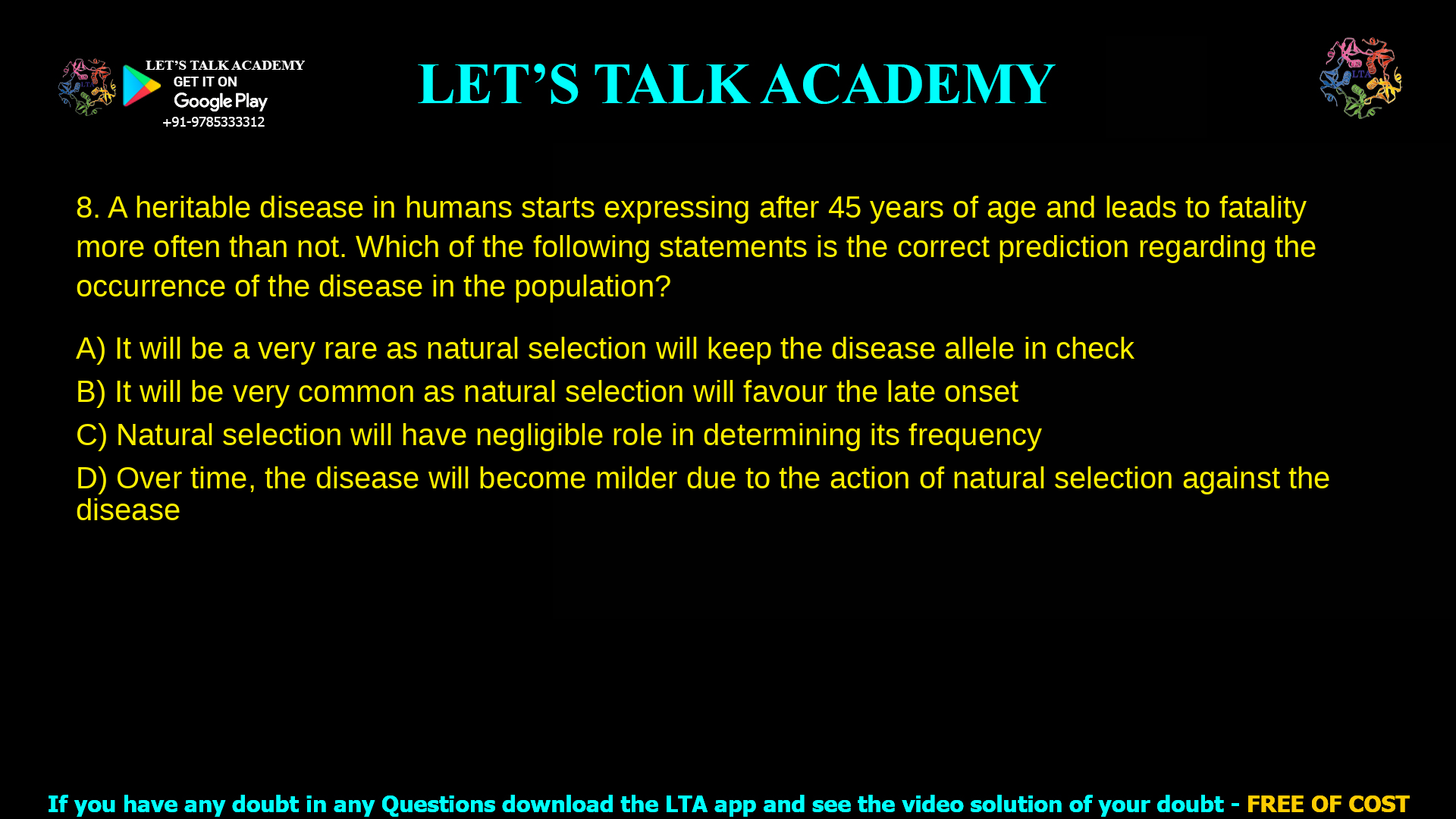
8. A heritable disease in humans starts expressing after 45 years of age and leads to
fatality more often than not. Which of the following statements is the correct
prediction regarding the occurrence of the disease in the population?
a. It will be a very rare as natural selection will keep the disease allele in check
b. It will be very common as natural selection will favour the late onset
c. Natural selection will have negligible role in determining its frequency
d. Over time, the disease will become milder due to the action of natural
selection against the disease
Correct option: c. Natural selection will have negligible role in determining its frequency.
Introduction
A classic question in evolutionary biology is why serious, even fatal, late-onset heritable diseases still exist in human populations despite millions of years of evolution. Late-onset genetic diseases, such as Huntington’s disease, often manifest after the main reproductive years, so their deleterious alleles largely escape the purifying action of natural selection. Because selection intensity declines steeply with age, mutations that act mainly after reproduction can accumulate or remain in the gene pool with relatively little evolutionary penalty.
Core evolutionary concept
Natural selection acts most strongly on traits that affect survival and reproduction during the reproductive years; its power declines with age, especially in the post‑reproductive period. For diseases that begin after ~45 years, most carriers have already had children, so the disease allele has usually been transmitted before the phenotype appears, making it “almost invisible” to selection, as well illustrated by Huntington’s disease.
Therefore, for a disease whose effects start after 45 and are often fatal, natural selection has only a weak or negligible impact on its allele frequency, which is why option (c) is correct.
Option-by-option explanation
Option (a): “It will be very rare as natural selection will keep the disease allele in check”
This option assumes that natural selection efficiently removes the allele because it is strongly deleterious. In reality, selection can only “see” the allele if it reduces the carrier’s reproductive success before or during reproductive age, or strongly reduces the number of surviving offspring. Since expression begins after 45, most individuals will already have reproduced, so purifying selection is very weak, and the allele is not necessarily driven to very low frequency.
➡️ Conclusion: Option (a) is incorrect.
Option (b): “It will be very common as natural selection will favour the late onset”
This suggests that natural selection actively favours the disease allele because of its late onset, which is not implied in the question. For natural selection to favour an allele, it must increase reproductive success, for example via antagonistic pleiotropy, where a mutation boosts early reproduction but harms late-life survival. Here, there is no information that the disease allele increases fertility or early survival, only that it causes a fatal disease after 45, so there is no basis to say it will be “favoured” and become very common.
➡️ Conclusion: Option (b) is incorrect.
Option (c): “Natural selection will have negligible role in determining its frequency”
This reflects the standard theory of ageing and late‑acting mutations: the efficacy of natural selection declines with age, so strongly deleterious mutations that act mainly in late life experience weak purifying selection and can persist by drift or mutation–selection balance. For a disease that starts after 45 years and is usually fatal, most carriers already passed their genes to the next generation before symptoms appear, so natural selection has a negligible role in shaping the allele’s frequency.
➡️ Conclusion: Option (c) is correct.
Option (d): “Over time, the disease will become milder due to the action of natural selection against the disease”
This option assumes that selection will steadily “soften” the disease, making it milder over time by removing severe alleles and retaining milder ones. While this can happen for early-onset lethal conditions under strong selection, it is unlikely for a disease that manifests after reproduction, because selection against late-life severity is weak. Empirically, late‑onset diseases like Huntington’s disease have persisted for many generations without an evident trend towards universally milder forms, consistent with the idea of weak selection at late ages.
➡️ Conclusion: Option (d) is incorrect.
Key takeaways for exam preparation
-
Key principle: The strength of natural selection declines with age; traits expressed after reproduction are under weak selection.
-
Late-onset fatal disease (>45 years): Most carriers reproduce before onset, so the allele’s frequency is shaped mainly by genetic drift and mutation, not by strong natural selection.
-
Correct prediction: Natural selection has negligible role in determining the frequency of such a disease in the population → option (c).


