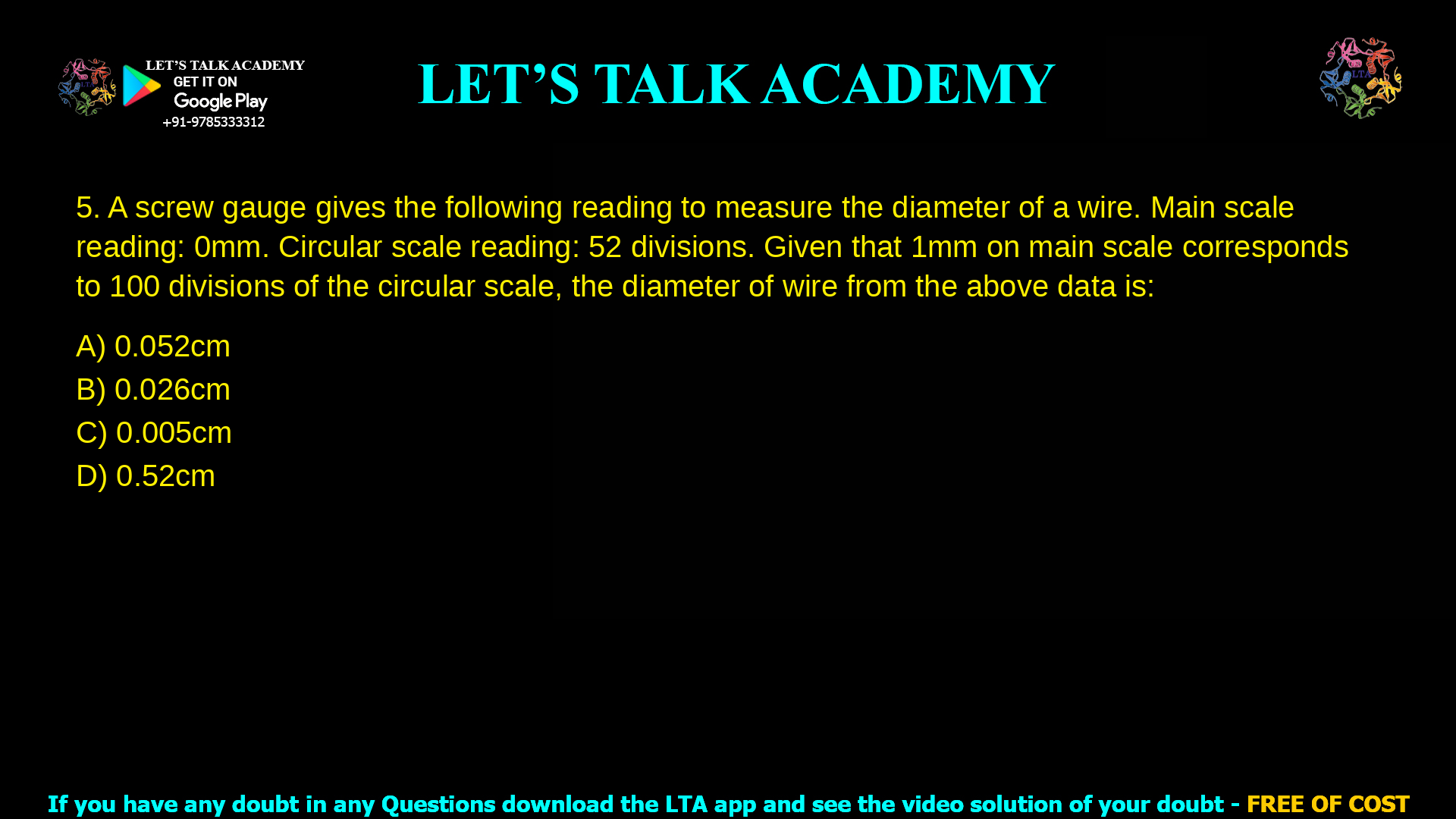
5. A screw gauge gives the following reading to measure the diameter of a wire.
Main scale reading: 0 mm
Circular scale reading: 52 divisions.
Given that 1 mm on main scale corresponds to 100 divisions of the circular scale,
the diameter of wire from the above data is:
a. 0.052 cm
b. 0.026 cm
c. 0.005 cm
d. 0.52 cm
The diameter of the wire measures 0.052 cm (option a).
Screw Gauge Basics
Screw gauges measure thin wire diameters precisely. The least count (LC), smallest readable value, calculates as pitch divided by circular scale divisions. Here, 1 mm pitch equals 100 circular divisions, so LC=1100=0.01 mm or 0.001 cm.
Total reading uses Diameter=MSR+(CSR×LC), where MSR is main scale reading (0 mm) and CSR is circular scale reading (52 divisions). Substituting gives 0+(52×0.01)=0.52 mm, or 0.52÷10=0.052 cm since options are in cm. No zero error applies.
Option Analysis
-
a. 0.052 cm: Correct. Matches 52×0.001 cm directly or 0.52 mm converted.
-
b. 0.026 cm: Wrong. Halves correct value, possibly assuming radius instead of diameter.
-
c. 0.005 cm: Wrong. Uses 5 divisions or miscalculates LC as 0.0001 cm.
-
d. 0.52 cm: Wrong. Forgets mm-to-cm conversion (0.52 mm = 0.052 cm).
This MCQ tests units, LC, and formula application, common in CSIR NET Life Sciences (instrumentation) and physics sections.


