A series of alkanes is shown below. Which one has the lowest melting point
2
3
1
4
The cyclic alkane with the lowest melting point among the given options is cyclopropane, represented by structure (1).
Question and options explained
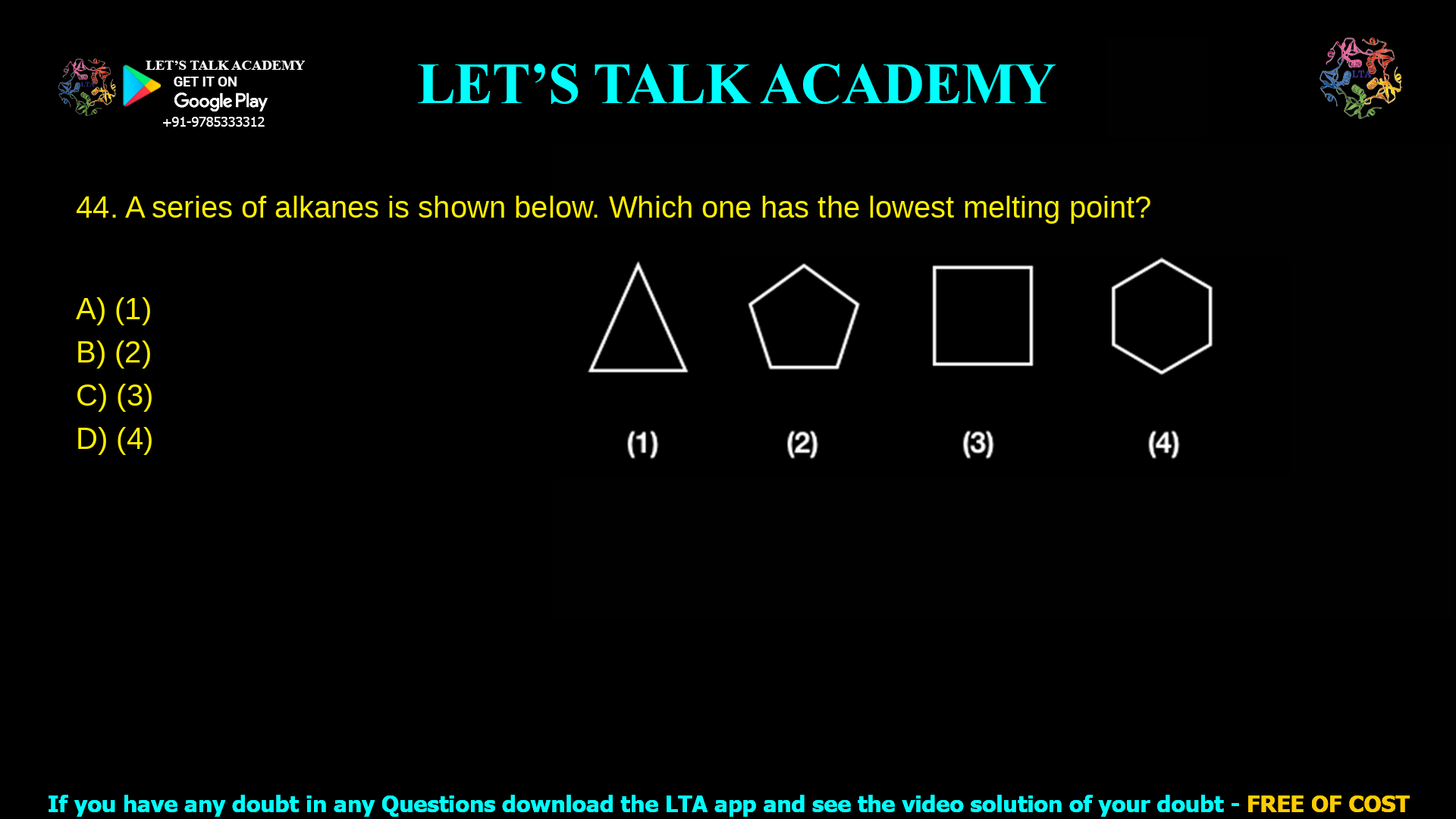
The question shows a series of cycloalkanes as simple polygons:
-
(1) triangle → cyclopropane, C₃H₆
-
(2) pentagon → cyclopentane, C₅H₁₀
-
(3) square → cyclobutane, C₄H₈
-
(4) hexagon → cyclohexane, C₆H₁₂
The task is to find which one has the lowest melting point.
In cycloalkanes, melting point is influenced by:
-
molecular mass and surface area (more CH₂ units → stronger London dispersion forces → generally higher melting point)
-
crystal packing efficiency (how well molecules fit into a solid lattice; even‑membered rings often pack better and have higher melting points than odd‑membered rings)
Overall, as the ring size increases from C₃ to C₆, the melting point tends to increase because of stronger intermolecular attractions, with some odd–even alternation.
Why option (1) is correct: cyclopropane
Cyclopropane has only three carbon atoms, the smallest ring and lowest molecular mass in the series.
With fewer electrons and the smallest surface area, it has the weakest London dispersion forces, so its solid lattice is held together least strongly and it melts at the lowest temperature (around −127 °C, lower than the others).
Therefore, structure (1), cyclopropane, has the lowest melting point among the four cyclic alkanes.
Analysis of the other options
Option (2): cyclopentane
Cyclopentane has five carbons and is an odd‑membered ring.
Its higher molecular mass and better dispersion forces give it a higher melting point than cyclopropane, but because odd‑membered rings pack less efficiently, its melting point is not the highest in the series and is still well above that of cyclopropane (about −94 °C).
Option (3): cyclobutane
Cyclobutane is a four‑membered even ring with larger molecular mass than cyclopropane.
Even rings usually pack more efficiently in the crystal, so despite ring strain, cyclobutane has a melting point higher than cyclopropane (about −91 °C), again eliminating it as the lowest.
Option (4): cyclohexane
Cyclohexane has six carbons, the greatest molecular mass and minimal ring strain due to its stable chair conformation.
The strong dispersion forces and efficient packing make its melting point highest in this set, actually positive (about 6.5–7 °C), clearly not the lowest.
Short exam‑oriented takeaway
In a series of cycloalkanes drawn as triangle, square, pentagon and hexagon, the lowest melting point corresponds to the smallest ring, cyclopropane (option 1), because it has the smallest molecular size and weakest London dispersion forces, giving the least stable crystal lattice and the lowest melting temperature.


