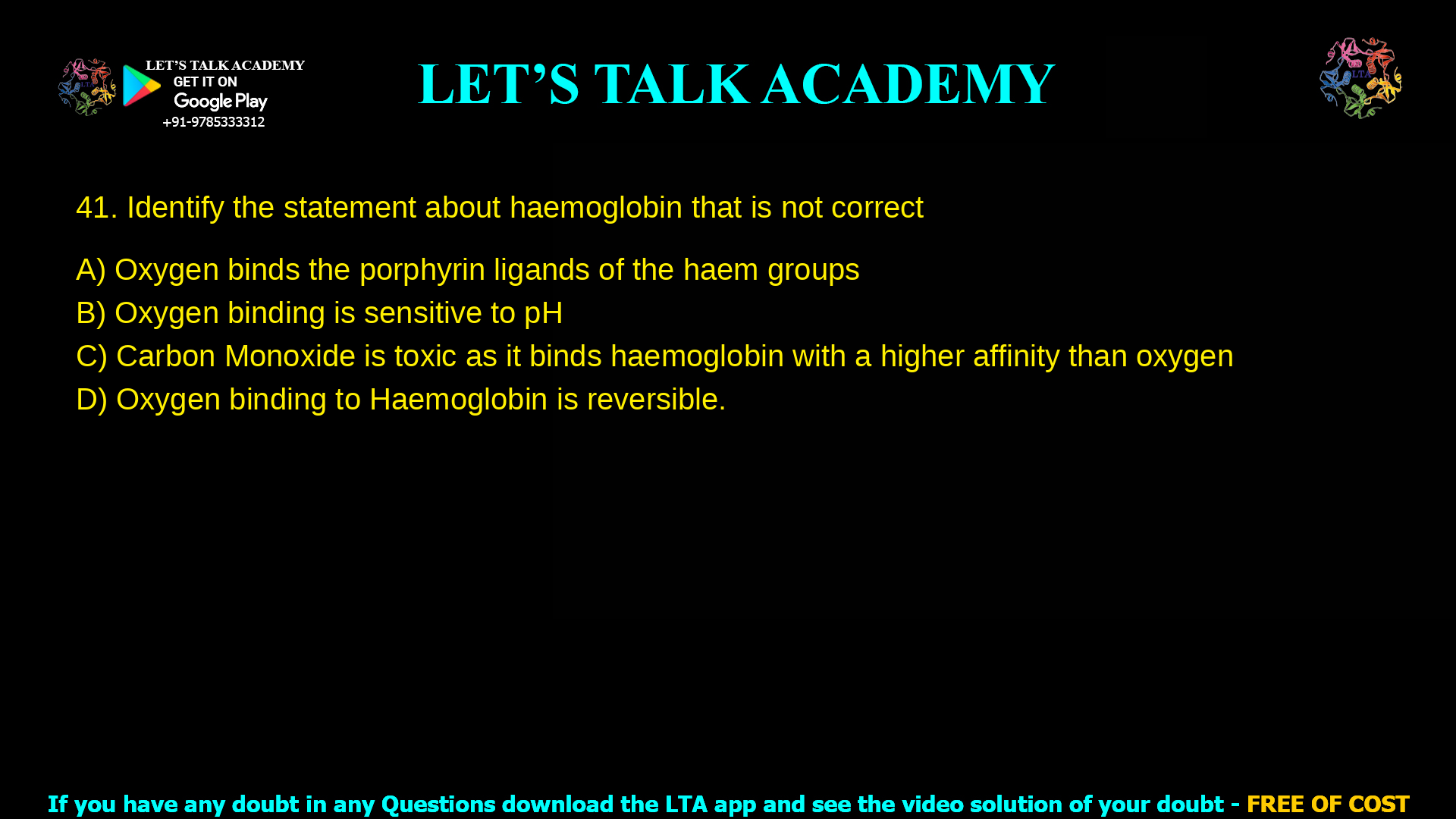
Identify the statement about haemoglobin that is not correct
Oxygen binds the porphyrin ligands of the haem groups
Oxygen binding is sensitive to pH
Carbon Monoxide is toxic as it binds haemoglobin with a higher affinity
than oxygen
Oxygen binding to Haemoglobin is reversible.
The incorrect statement is: “Oxygen binds the porphyrin ligands of the haem groups.” Oxygen actually binds to the ferrous iron (Fe²⁺) atom of the haem, not to the porphyrin ring itself.
Introduction
Haemoglobin is the central protein for oxygen transport in blood, and exam questions often test conceptual clarity about how oxygen and other gases interact with it. To identify the incorrect statement, it is essential to understand where oxygen binds on haem, how pH affects affinity, why carbon monoxide is toxic, and why oxygen binding must be reversible for effective gas exchange.
The question provides four statements:
-
Oxygen binds the porphyrin ligands of the haem groups
-
Oxygen binding is sensitive to pH
-
Carbon Monoxide is toxic as it binds haemoglobin with a higher affinity than oxygen
-
Oxygen binding to Haemoglobin is reversible
Option 1: Oxygen binds the porphyrin ligands of the haem groups
This statement is not correct.
-
Each haem group consists of a protoporphyrin IX ring with a central Fe²⁺ ion; oxygen binds directly to this ferrous iron, not to the porphyrin nitrogens (the “porphyrin ligands”).
-
The four nitrogen atoms of the porphyrin ring and a proximal histidine from globin form the primary coordination to Fe²⁺; O₂ occupies the sixth coordination site on Fe²⁺, forming oxyhaemoglobin.
So, the error in the statement is the site of oxygen binding: the binding site is Fe²⁺ in haem, not the porphyrin ligands themselves.
Option 2: Oxygen binding is sensitive to pH
This statement is correct.
-
Haemoglobin shows the Bohr effect: a decrease in pH (increase in H⁺) lowers haemoglobin’s affinity for oxygen, promoting oxygen release in metabolically active, acidic tissues.
-
Increased pH in the lungs shifts haemoglobin toward the high-affinity “relaxed” (R) state, enhancing oxygen loading, while lower pH in tissues stabilizes the “tense” (T) state, facilitating unloading.
Thus, oxygen binding affinity is clearly pH-dependent, making this a true statement.
Option 3: Carbon Monoxide is toxic as it binds haemoglobin with a higher affinity than oxygen
This statement is correct.
-
Carbon monoxide (CO) binds to the same Fe²⁺ of haem as oxygen but with about 200–250 times higher affinity, forming carboxyhaemoglobin.
-
Because of this very high affinity, CO competes with and displaces O₂ from haemoglobin, drastically reducing oxygen-carrying capacity and also causing a leftward shift of the oxyhaemoglobin dissociation curve, which impairs oxygen unloading to tissues.
Therefore, CO is toxic precisely because it binds haemoglobin much more tightly than oxygen, so this statement is correct.
Option 4: Oxygen binding to Haemoglobin is reversible
This statement is correct.
-
Haemoglobin’s physiological role depends on reversible binding of O₂: loading in the lungs where PO2 is high, and unloading in tissues where PO2 is lower.
-
The oxyhaemoglobin dissociation curve and cooperative binding behaviour of haemoglobin both reflect this reversible, dynamic association of O₂ with haem groups.
Thus, oxygen binding to haemoglobin is reversible, not permanent, making this statement true.
Summary table for quick revision
| Statement | Correct/Incorrect | Reason (concept focus) |
|---|---|---|
| Oxygen binds the porphyrin ligands of the haem groups | Incorrect | O₂ binds to Fe²⁺ of haem, not to porphyrin ligands themselves. |
| Oxygen binding is sensitive to pH | Correct | Bohr effect: pH changes alter haemoglobin’s O₂ affinity. |
| CO is toxic as it binds haemoglobin with a higher affinity than oxygen | Correct | CO has ~200–250× higher affinity, forming carboxyhaemoglobin. |
| Oxygen binding to haemoglobin is reversible | Correct | Reversible binding allows loading in lungs and unloading in tissues. |
The incorrect statement and therefore the answer to the question is: “Oxygen binds the porphyrin ligands of the haem groups.”


