Our skin is easy to pinch, but very hard to pull apart. Based on this property,
which of these curves most likely represents the mechanical properties of skin?
A
B
C
B and C
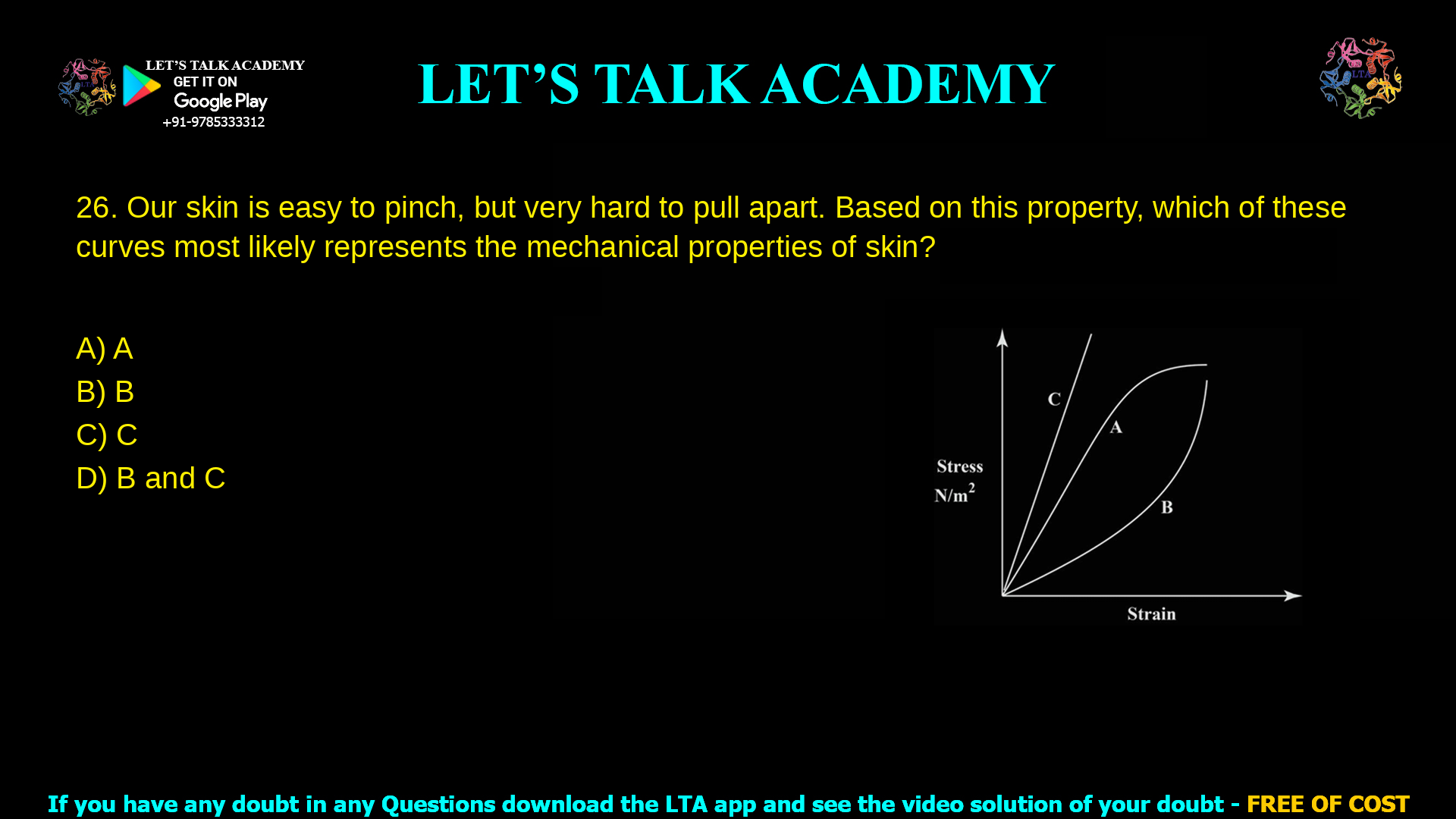
The correct curve representing the mechanical properties of human skin is curve A. Skin shows a J‑shaped stress–strain curve: it is very compliant at low stress (easy to pinch) and becomes rapidly stiffer at higher strain (hard to pull apart).
Our skin is easy to pinch, but very hard to pull apart. Based on this property, which of the stress–strain curves A, B or C most likely represents the mechanical properties of skin?
Options:
A) A
B) B
C) C
D) B and C
Answer: A
Understanding skin’s mechanical behavior
Biological tissues such as skin, blood vessels and ligaments typically show a J‑shaped stress–strain curve. In this curve, small increases in stress initially produce relatively large strains, but as strain increases the tissue becomes much stiffer and resists further elongation strongly. This behavior explains why skin is easy to pinch or stretch slightly, yet very hard to tear or pull apart at larger extensions.
In skin, this non‑linear response arises from the gradual straightening and recruitment of wavy collagen fibers in the dermis. At low strain, mostly elastin and a few collagen fibers bear load, giving low stiffness, whereas at higher strain more collagen fibers align and stretch, sharply increasing the effective modulus and tear resistance.
Interpreting curves A, B and C
From the figure in the question, the three curves can be interpreted as follows (stress on y‑axis, strain on x‑axis):
-
Curve A (J‑shaped, initially shallow then steep):
-
Shows low slope (low stiffness) at the beginning and then rapidly increasing slope at higher strain.
-
This matches the typical J‑shaped stress–strain behavior of soft tissues like skin and arteries.
-
-
Curve B (initially steep then flattening / large hysteresis‑like path):
-
Appears to require relatively high stress even at low strains and then does not stiffen dramatically at larger strains.
-
Such a curve suggests a material that is relatively stiff from the beginning and less strongly strain‑stiffening, unlike real skin.
-
-
Curve C (almost straight line with high slope):
-
Nearly linear with a large constant slope, characteristic of a Hookean, elastic material such as many metals, with Young’s modulus essentially constant over the range.
-
This does not match the non‑linear, highly compliant‑then‑stiff behavior of skin.
-
Because human skin exhibits a strongly non‑linear, J‑shaped, strain‑stiffening curve, the best match among A, B and C is curve A.
Option‑wise explanation
Option A: Curve A
-
Curve A shows a J‑shape: low stiffness at small strain and rapidly increasing stiffness at higher strain.
-
This directly corresponds to the observation that skin is easy to pinch (low stress needed for small deformation) but very difficult to pull apart once significantly stretched (high stress for further strain).
-
Therefore, Option A is correct.
Option B: Curve B
-
Curve B requires relatively high stress even at low strain, indicating a material that is not very compliant initially.
-
Such a material would not feel “easy to pinch,” because even small deformations would demand considerable force, contrary to the everyday experience with skin.
-
Hence Option B is incorrect.
Option C: Curve C
-
Curve C is almost straight with a constant high slope, typical of linear elastic materials where stress is proportional to strain throughout.
-
This means stiffness does not increase markedly with strain, so it does not capture the strong strain‑stiffening that gives skin its high tear resistance at large deformations.
-
Thus Option C is incorrect.
Option D: B and C
-
Since neither B nor C alone correctly describes the compliant‑then‑stiff behavior of skin, choosing both together still fails to represent the true J‑shaped curve.
-
Therefore Option D is also incorrect.
Short conceptual takeaway for exams
Skin and many other soft biological tissues show a J‑shaped stress–strain curve, with an initially low slope and later high slope due to progressive recruitment and stretching of collagen fibers. This explains why they are easily deformed at low forces but become extremely resistant to tearing at high strains, matching curve A in the given figure.


