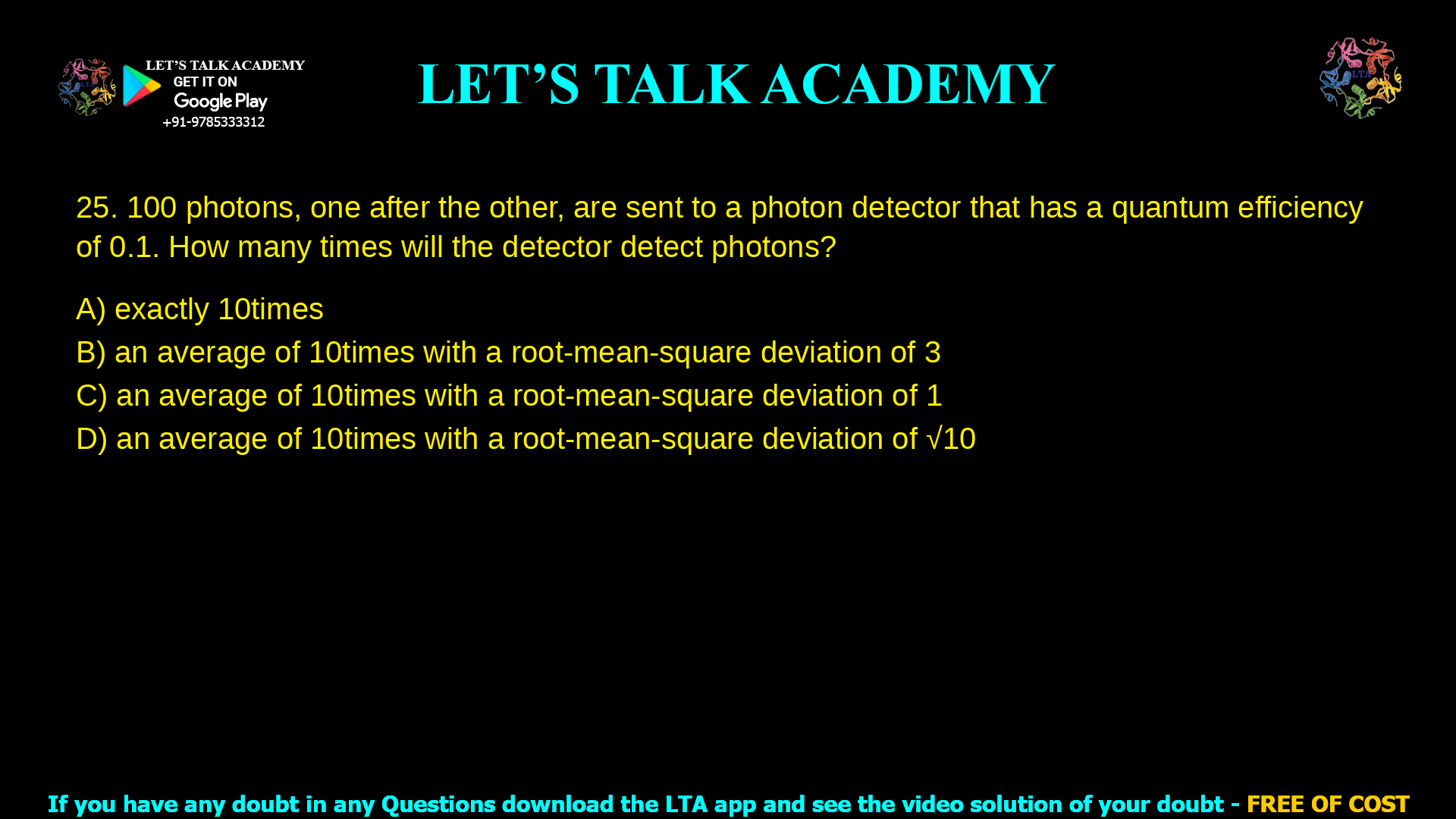
100 photons, one after the other, are sent to a photon detector that has a
quantum efficiency of 0.1. How many times will the detector detect photons?
exactly 10 times
an average of 10 times with a root-mean-square deviation of 3
an average of 10 times with a root-mean-square deviation of 1
an average of 10 times with a root-mean-square deviation of 0.1
Quantum efficiency of 0.1 means each of the 100 incident photons has a 10% independent probability of detection, yielding an average of 10 detections following Poisson statistics . The root-mean-square (RMS) deviation, equivalent to the standard deviation, equals the square root of the mean (√10 ≈ 3.16), so the detector registers an average of 10 times with an RMS deviation of 3 .
Quantum Efficiency Defined
Quantum efficiency measures the fraction of incident photons producing a detectable count, here 0.1 or 10% . For 100 photons sent sequentially, the expected detections equal 100 × 0.1 = 10 . Each trial remains a Bernoulli process (success probability p=0.1), summing to a binomial distribution approximated by Poisson for large n .
Poisson Statistics in Photon Detection
Photon arrivals and detections follow Poisson statistics for independent events, where mean μ = np = 10 and variance σ² = μ, so σ = √10 ≈ 3.16 . RMS deviation matches this standard deviation, quantifying typical fluctuations around the mean. Simulations confirm ~68% of trials yield 7-13 detections (within 1σ) .
Detailed Option Analysis
Exactly 10 times
Incorrect: Probabilistic nature prevents deterministic outcomes despite average of 10 .
Average of 10 times with RMS deviation of 0.1
Incorrect: Deviation √10 ≈ 3, not 0.1 (which implies near-perfect certainty).
Average of 10 times with RMS deviation of 1
Incorrect: Underestimates; √10 > 3, not 1 .
Average of 10 times with RMS deviation of 3
Correct: Matches √10 ≈ 3.16, standard for Poisson distribution .


