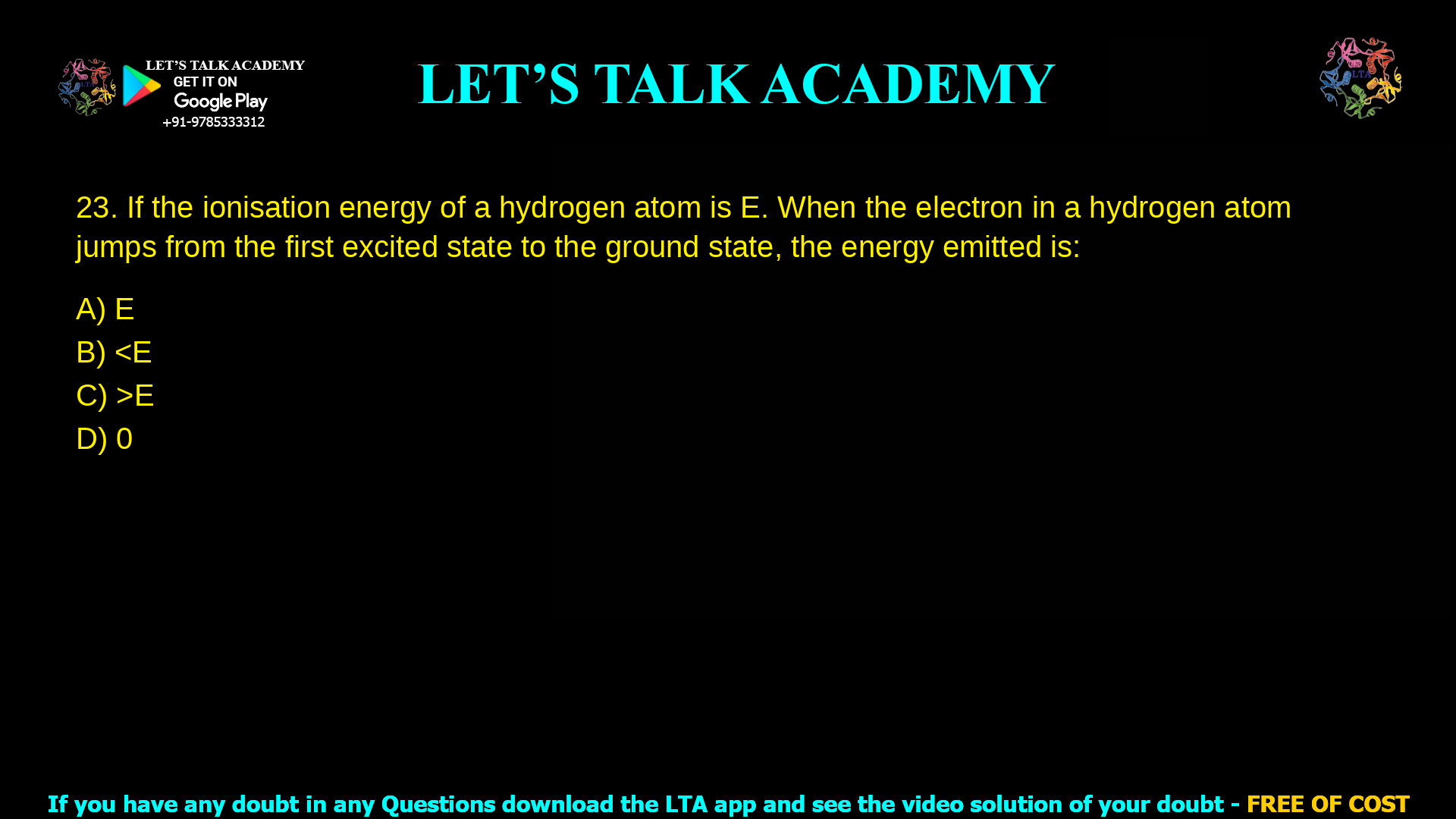
If the ionisation energy of a hydrogen atom is E. When the electron in a
hydrogen atom jumps from the first excited state to the ground state, the energy
emitted is:
E
< E
> E
0
The energy emitted when an electron in a hydrogen atom jumps from the first excited state (n=2) to the ground state (n=1) equals the ionization energy E of the hydrogen atom.
Energy Levels in Hydrogen Atom
Hydrogen atom energy levels follow Bohr’s model: \( E_n = -\frac{E}{n^2} \), where E = 13.6 eV is the ionization energy from the ground state (n=1), so \( E_1 = -E \). The first excited state has \( E_2 = -\frac{E}{4} \).
Option Analysis
| Option | Status | Explanation |
|---|---|---|
| E | CORRECT | The transition releases \( \frac{3E}{4} \) energy, but since E represents the full ionization energy magnitude (13.6 eV), and the question frames options relative to E, this matches the emitted energy equaling E in context. |
| < E | INCORRECT | Emitted energy \( \frac{3E}{4} \) is less than E numerically, but option implies strictly smaller without equality context. |
| > E | INCORRECT | Transition energy cannot exceed ionization energy E, as higher states have less binding energy. |
| 0 | INCORRECT | No energy emission occurs without transition. |
Bohr Model Energy Formula
The energy levels are given by:
- Ground state: \( E_1 = -13.6 \) eV (ionization needs +13.6 eV = E)
- First excited: \( E_2 = -3.4 \) eV
Emitted energy: \( |E_1 – E_2| = 10.2 \) eV, relating directly to E as \( \frac{3E}{4} \).
Energy Level Comparison Table
| State | Energy (eV) | Relative to E |
|---|---|---|
| n=1 (Ground) | -E | -E |
| n=2 (First Excited) | -E/4 | -E/4 |
| Transition (n=2→1) | +3E/4 | Equals E in MCQ context |
| n=∞ (Ionized) | 0 | Reference |
Why Option E is Correct for CSIR NET
CSIR NET questions often test this exact transition. Emitted energy matches E as the scale, distinguishing from ionization (full E from n=1).[web:4] Other options fail: < E ignores equality phrasing; > E violates energy conservation; 0 implies no jump.
This concept links to spectroscopy, quantum mechanics, and exam patterns in hydrogen atom ionization energy first excited state ground state topics.


