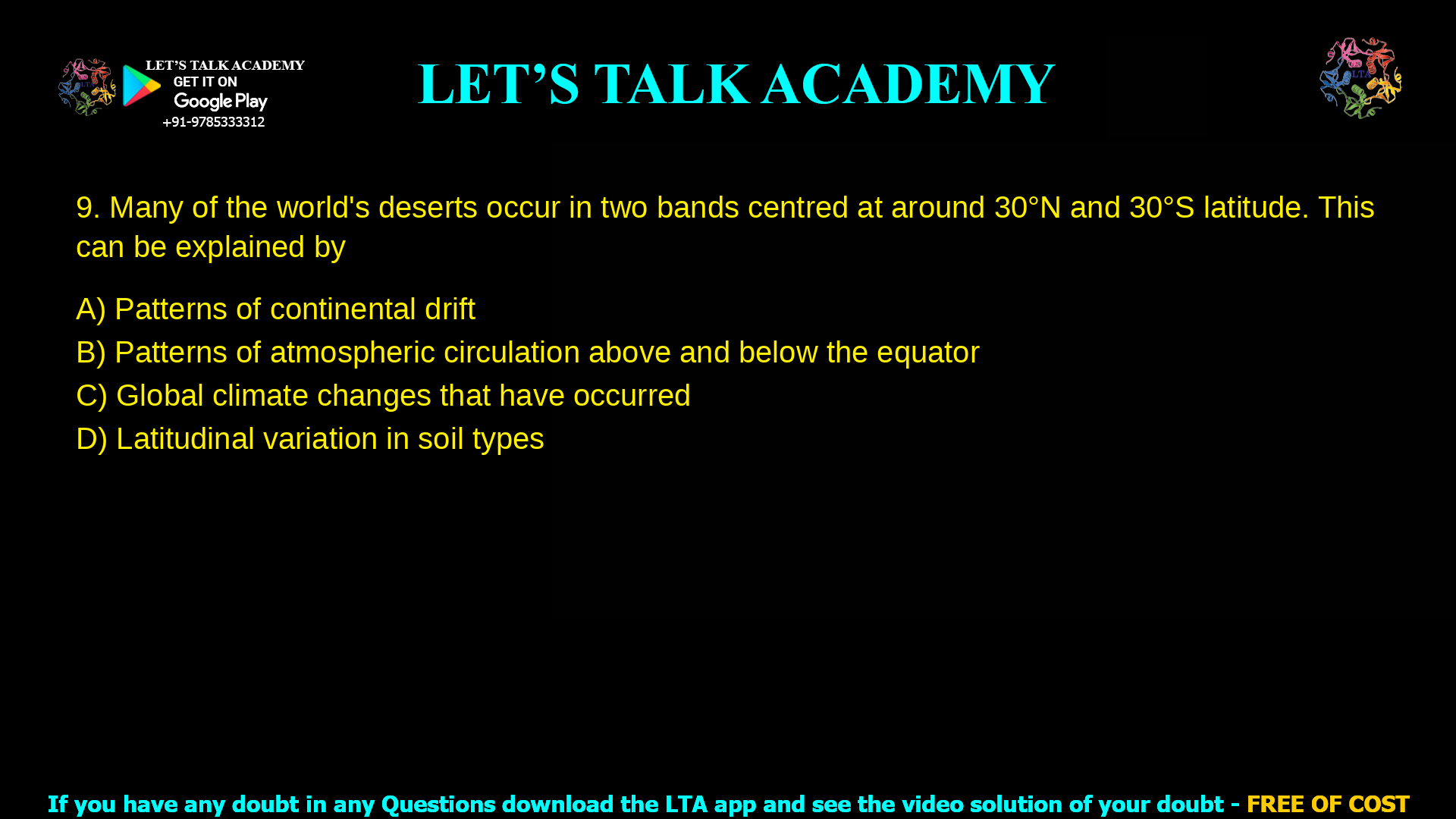
Many of the world’s deserts occur in two bands centred at around 30˚N and 30˚S
latitude. This can be explained by
Patterns of continental drift
Patterns of atmospheric circulation above and below the equator
Global climate changes that have occurred
Latitudinal variation in soil types
The correct answer is Patterns of atmospheric circulation above and below the equator. Many of the world’s deserts, such as the Sahara and Australian Outback, cluster in subtropical bands around 30°N and 30°S due to global air circulation patterns like Hadley cells, where descending dry air creates high-pressure zones inhibiting rainfall.
Option Analysis
Patterns of continental drift: This refers to plate tectonics reshaping landmasses over millions of years, which influences long-term geography but does not explain the consistent latitudinal banding of deserts today. Deserts follow current climate dynamics, not ancient continental positions.
Patterns of atmospheric circulation above and below the equator: Warm air rises at the equator (Intertropical Convergence Zone), moves poleward, cools, and descends around 30° latitude as dry, sinking air in subtropical highs (Horse Latitudes). This suppresses cloud formation and precipitation, forming desert belts on both hemispheres. Trade winds and cold ocean currents amplify aridity on western continental coasts.
Global climate changes that have occurred: Past events like ice ages shifted desert locations temporarily, but current 30° bands result from ongoing atmospheric processes, not historical shifts alone.
Latitudinal variation in soil types: Soil develops from climate; dry conditions at 30° create sandy, low-organic soils, but this is a consequence, not the cause, of desert formation.
Hadley Cell Mechanism
In the Hadley circulation model, intense solar heating at the equator drives convection: moist air ascends, rains out (tropics), then sinks at ~30° as warm, dry air, producing persistent anticyclones. This explains ~70% of global deserts, including Sahara (23°N), Atacama (23°S), and Namib.
Note this links to climatology in environmental biology, emphasizing how circulation patterns dictate biomes and biodiversity gradients.


