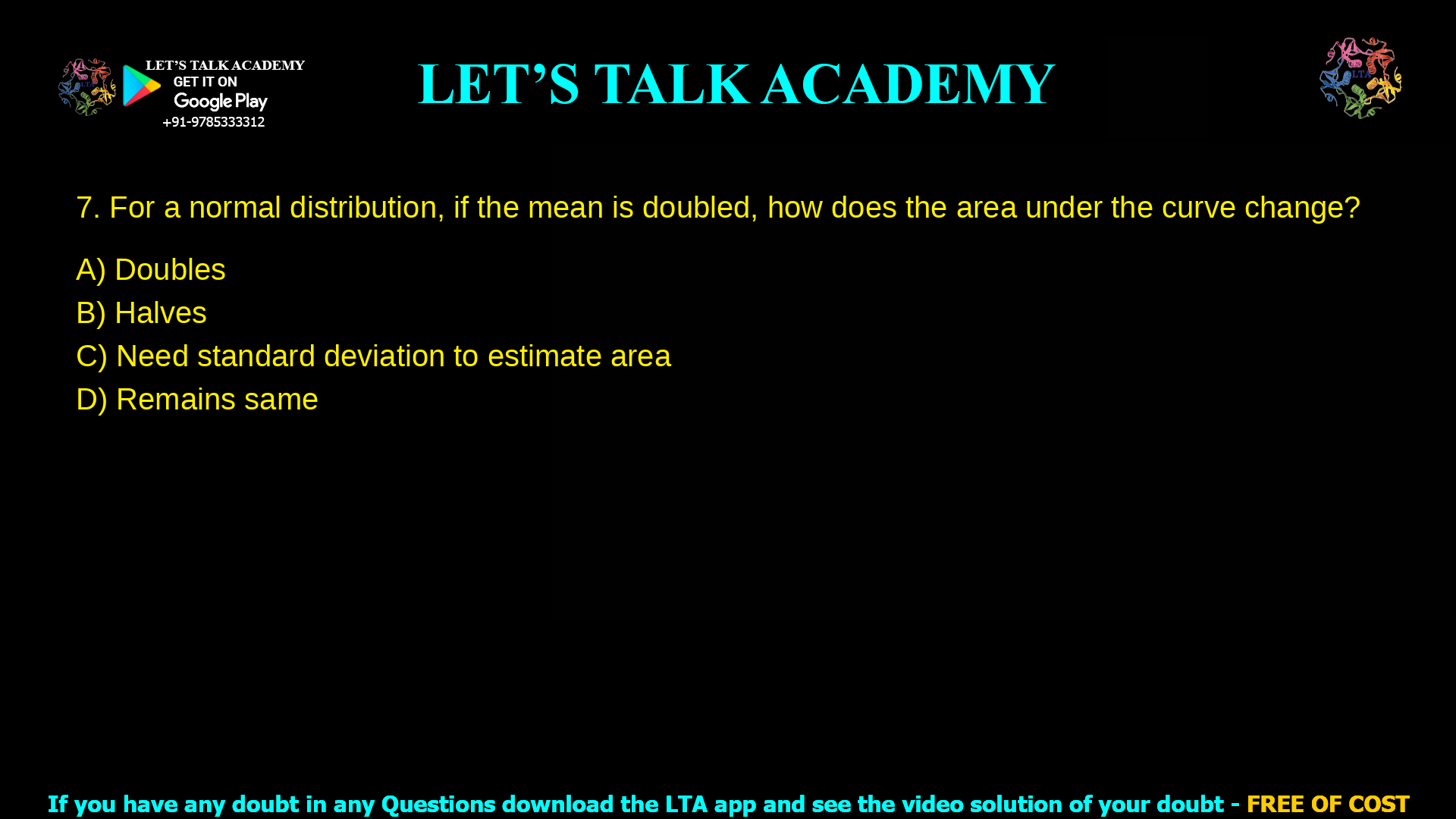
For a normal distribution, if the mean is doubled, how does the area under the
curve change?
Doubles
Halves
Need standard deviation to estimate area
Remains same
Correct Answer Explanation
The normal distribution represents a probability density function where the total area under the curve equals 1, corresponding to 100% probability. Doubling the mean shifts the bell-shaped curve rightward along the x-axis without altering its height, width, or total area, as the standard deviation stays unchanged. Numerical integration confirms this: for mean μ=0 and μ=2 (both σ=1), areas approximate 0.9999 over sufficient ranges, converging to exactly 1.
Option Analysis
- Doubles: Incorrect. Area scaling requires changing standard deviation, not mean; doubling mean only translates the curve.
- Halves: Incorrect. No reduction occurs; total probability stays fixed at 1 regardless of mean shift.
- Need standard deviation to estimate area: Incorrect. Total area is always 1 for any valid normal distribution, independent of mean or standard deviation values.
- Remains same: Correct. The defining property ensures invariance to parameter shifts like mean doubling.
Key Properties of Normal Distribution
The probability density function is f(x) = (1/(σ√(2π))) exp(−((x−μ)^2)/(2σ^2)), with ∫−∞∞ f(x) dx = 1.
- Mean (μ) controls horizontal position.
- Standard deviation (σ) affects spread and peak height to preserve area=1.
- Symmetry persists around new mean post-shift.


