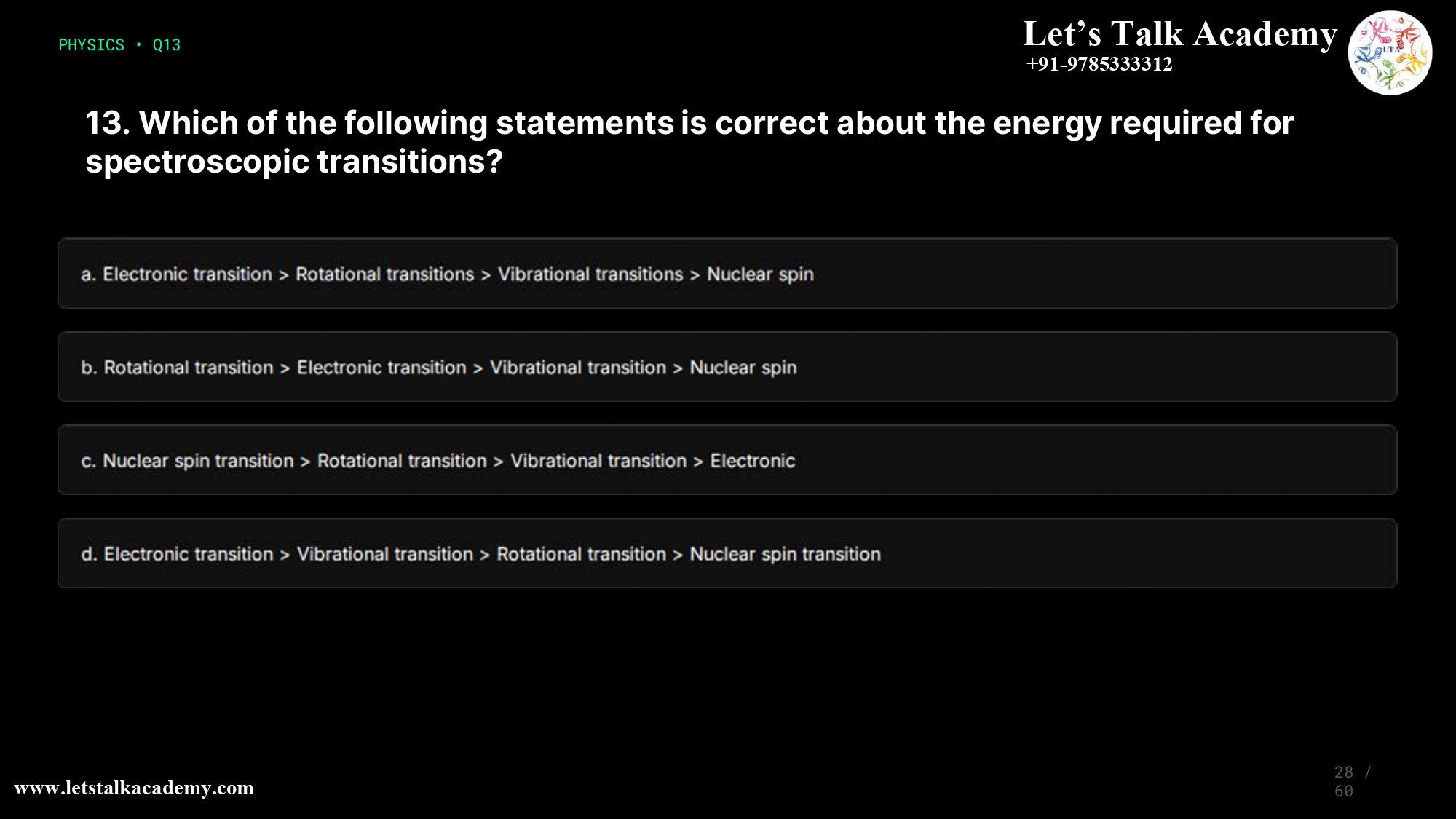
13. Which of the following statements is correct about the energy required for spectroscopic
transitions?
a. Electronic transition>Rotational transitions>Vibrational transitions> Nuclear spin transition
b. Rotational transition>Electronic transition>Vibrational transition>Nuclear spin transition
c. Nuclear spin transition>Rotational transition>Vibrational transition>Electronic transition
d. Electronic transition>Vibrational transition>Rotational transition>Nuclear spin
transition
Electronic transitions require the highest energy, followed by vibrational, rotational, and nuclear spin transitions in decreasing order, making option d. Electronic transition > Vibrational transition > Rotational transition > Nuclear spin transition correct. This hierarchy arises from the energy scales of molecular motions: electronic changes involve valence electrons (~eV, UV-Vis range), vibrational modes stretch bonds (~0.1 eV, IR range), rotational tumbling adds minimal energy (~0.001 eV, microwave range), and nuclear spin flips need the least (~10^{-5} eV, radio frequency range). The order reflects decreasing photon energies and increasing wavelengths across the electromagnetic spectrum.
Option Analysis
Each option proposes a sequence of energy demands for these transitions.
-
Option a incorrectly places rotational above vibrational, ignoring that bond vibrations demand far more energy than molecular rotations.
-
Option b wrongly ranks rotational highest and electronic second, contradicting the dominance of electronic excitation energies.
-
Option c reverses the actual scale by starting with nuclear spin as highest, which requires radio waves of lowest energy.
-
Option d accurately sequences from highest (electronic) to lowest (nuclear spin) based on spectroscopic principles.
Energy Scales Overview
| Transition Type | Typical Energy (eV) | Spectral Region | Key Feature |
|---|---|---|---|
| Electronic | 1–10 | UV-Vis | Electron promotion between orbitals |
| Vibrational | 0.01–0.5 | IR | Bond stretching/compression |
| Rotational | 0.0001–0.01 | Microwave | Molecular tumbling |
| Nuclear Spin | 10^{-6}–10^{-4} | Radio | Spin reorientation |
This table highlights why electronic transitions demand the most energy, essential for exam questions in molecular spectroscopy.


