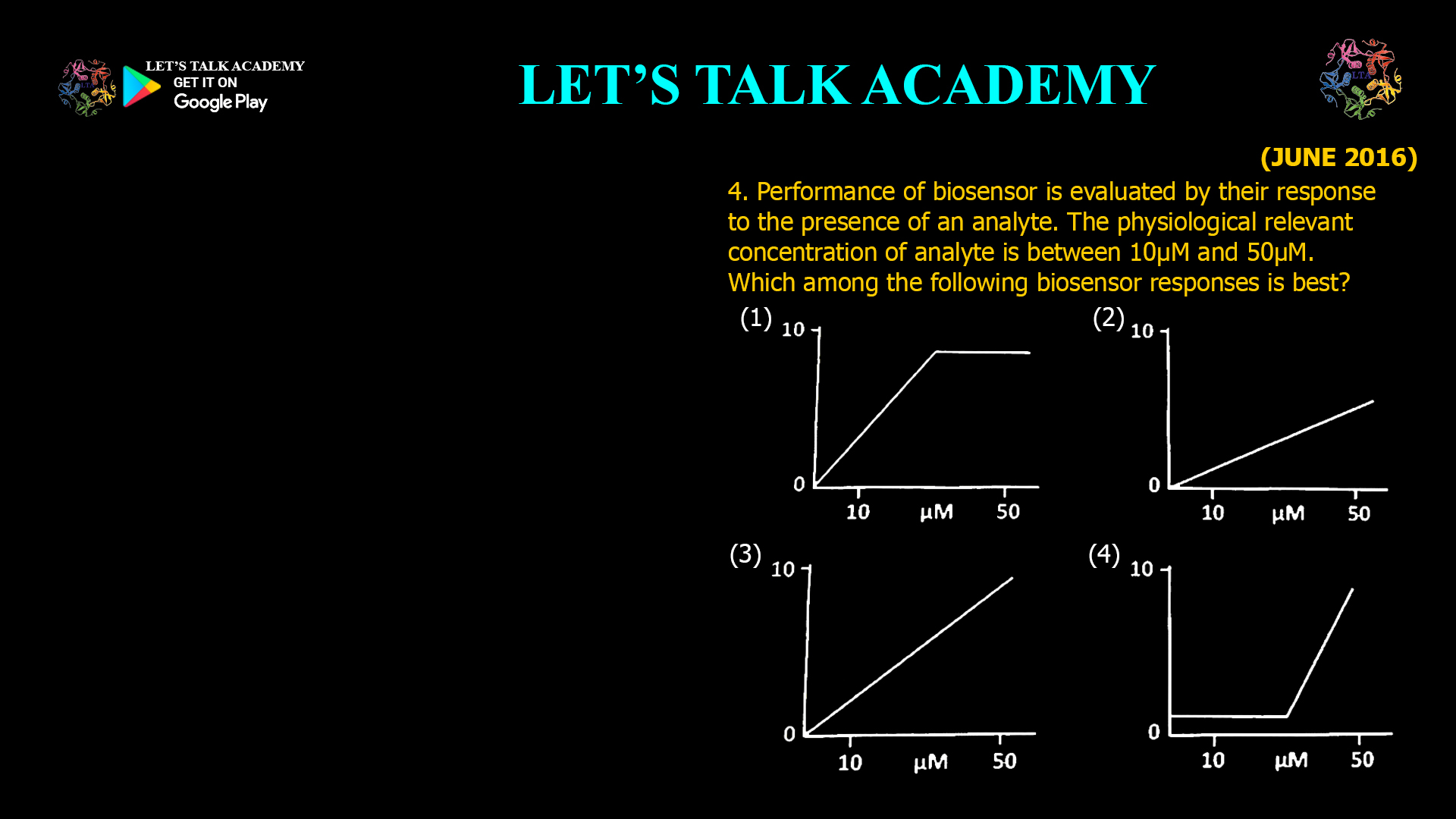
- Performance of biosensor is evaluated by their response to the presence of an analyte. The
physiological relevant concentration of analyte is between 10µM and 50µM. Which among the following biosensor responses is best?Concept: what “best response” means
-
Physiologically relevant analyte range: 10–50 μM.
-
An ideal biosensor should show a linear, unsaturated response through this range so that small changes in concentration give proportional changes in signal.
Option-wise explanation of the graphs
-
Graph (1):
-
Response rises with concentration but plateaus (saturates) before 50 μM.
-
Within the 10–50 μM range, the upper part is flat; sensitivity is lost for higher physiological values.
-
Not ideal.
-
-
Graph (2):
-
Linear response but very low slope (shallow line), meaning poor sensitivity over the range.
-
Small changes in concentration cause only tiny changes in signal.
-
-
Graph (3) – correct:
-
Shows a straight line with good slope from 0–50 μM, so the full 10–50 μM range lies in the linear dynamic range with high sensitivity.
-
This gives accurate quantification across all physiological concentrations.
-
-
Graph (4):
-
Signal is almost zero up to near 40 μM, then rises sharply.
-
Within most of the 10–50 μM range the sensor is essentially unresponsive, so it is unsuitable for physiological monitoring.
-
Therefore, the biosensor with the best performance for an analyte whose physiological concentration is 10–50 μM is represented by graph (3).
-


1 Comment
Muskan Yadav
December 8, 2025Graph (3) – correct