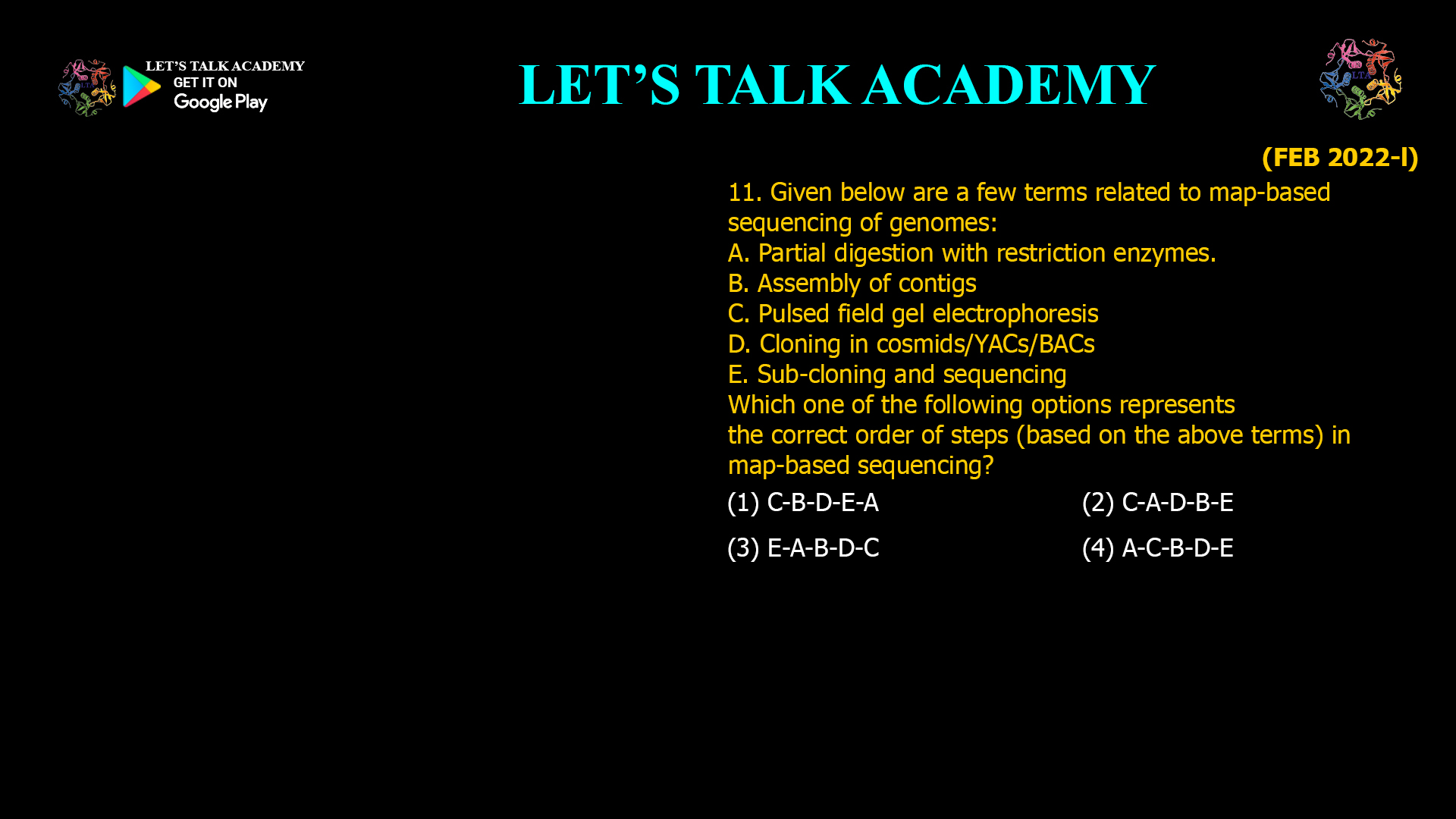
- Given below are a few terms related to map-based sequencing of genomes:
A. Partial digestion with restriction enzymes.
B. Assembly of contigs
C. Pulsed field gel electrophoresis
D. Cloning in cosmids/YACs/BACs
E. Sub-cloning and sequencing
Which one of the following options represents the correct order of steps (based on the above terms) in map-based sequencing?
(1) C-B-D-E-A (2) C-A-D-B-E
(3) E-A-B-D-C (4) A-C-B-D-EThe correct order of steps is (2) C → A → D → B → E.
Understanding each step
-
C. Pulsed field gel electrophoresis
-
Used early to separate very large DNA fragments or entire chromosomes and to generate a physical map framework.
-
-
A. Partial digestion with restriction enzymes
-
Genomic DNA is partially digested (not cut at every site) to give overlapping large fragments.
-
-
D. Cloning in cosmids/YACs/BACs
-
These large fragments are cloned into large‑insert vectors to create an ordered clone library.
-
-
B. Assembly of contigs
-
Overlaps between clones are analyzed to order them into contiguous sets (contigs) that map along the chromosome.
-
-
E. Sub‑cloning and sequencing
-
Each large clone is then sub‑cloned into smaller fragments and sequenced; sequences are assembled using the contig map as a scaffold.
-
Putting that in order:
C→A→D→B→E
Why other options are incorrect
-
C–B–D–E–A – Assembles contigs (B) before the large‑insert clones (D) exist; also puts partial digestion (A) last.
-
E–A–B–D–C – Starts with sequencing (E) before any mapping or cloning; order is reversed relative to the logical workflow.
-
A–C–B–D–E – Uses pulsed‑field gels after partial digestion and before cloning, and assembles contigs (B) before a proper large‑clone library (D) is built.
Therefore, the correct sequence of steps in map-based sequencing is C → A → D → B → E (option 2).
-