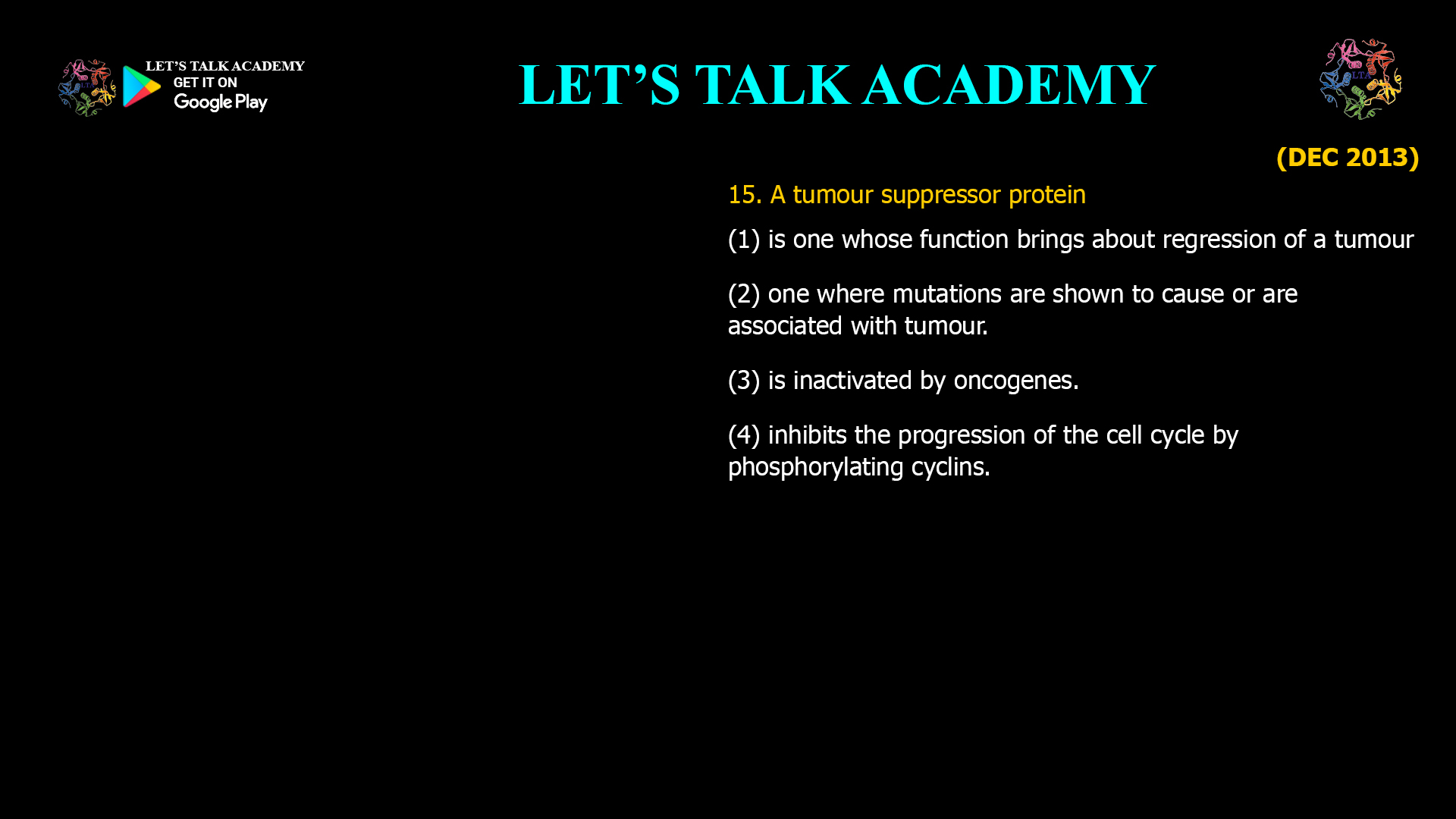
- A tumour suppressor protein
(1) is one whose function brings about regression of a tumour
(2) one where mutations are shown to cause or are associated with tumour.
(3) is inactivated by oncogenes.
(4) inhibits the progression of the cell cycle by phosphorylating cyclins.
Final Answer
The correct description of a tumor suppressor protein is:
(2) one where mutations are shown to cause or are associated with tumor.
Explanation
-
Tumor suppressor proteins are encoded by tumor suppressor genes, which normally act as negative regulators of cell growth. They function to inhibit cell proliferation, promote DNA repair, or induce apoptosis to prevent damaged or abnormal cells from dividing.
-
When tumor suppressor genes are mutated or inactivated, their protein products lose this inhibitory function, which allows uncontrolled cell division and tumor development. Thus, mutations in these genes are directly associated with cancer progression.
-
Option (1), “function brings about regression of a tumor,” is not entirely accurate; tumor suppressors prevent tumor formation but do not directly cause tumor regression.
-
Option (3), “inactivated by oncogenes,” is an oversimplification and not a defining feature of tumor suppressor proteins. Tumor suppressor genes are typically inactivated by mutations, deletions, or epigenetic silencing.
-
Option (4), “inhibits the progression of the cell cycle by phosphorylating cyclins,” is incorrect. Tumor suppressor proteins generally inhibit the cell cycle progression by different mechanisms, such as preventing cyclin-dependent kinase activity, but they do not phosphorylate cyclins.
Summary
Tumor suppressor proteins play critical roles in preventing cell proliferation and maintaining genomic integrity. Their mutation or loss leads to tumor development, marking them as key elements in cancer biology and therapeutic targets.


6 Comments
Kirti Agarwal
October 29, 2025One where mutation is cause cancer
Kajal
November 6, 2025Option 2
Komal Sharma
November 7, 2025Tumor suppressor proteins play critical roles in preventing cell proliferation and maintaining genomic integrity. Their mutation or loss leads to tumor development, marking them as key elements in cancer biology and therapeutic targets.
Sonal Nagar
November 9, 2025Option 2nd
Santosh Saini
November 12, 2025One where mutations are shown to cause or associated with tumor
Sakshi Kanwar
November 17, 2025one where mutations are shown to cause or are associated with tumour