- With reference to the graph given below, identity the optimal territory size.
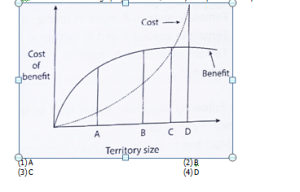
(1) A (2) B
(3) C (4) DWhat Is Optimal Territory Size?
Optimal territory size refers to the area that provides an animal with the greatest net benefit—usually measured as the difference between the resources gained (such as food, mates, and nesting sites) and the costs incurred (such as energy spent on defense, time, and risk of injury). If a territory is too small, it may not provide enough resources. If it is too large, the costs of defending it may outweigh the benefits.
The Cost-Benefit Model of Territory Size
Behavioral ecologists use cost-benefit models to predict the optimal territory size for animals. These models typically plot two curves:
-
Benefits curve: Shows the cumulative gain in resources as territory size increases. This curve usually rises quickly at first and then levels off, reflecting diminishing returns as more area is added.
-
Costs curve: Represents the cumulative costs (energy, time, risk) of defending a larger area. This curve generally rises steadily or even accelerates as territory size increases.
The optimal territory size is found where the difference between the benefits and costs is greatest, or where the net benefit (benefits minus costs) reaches its maximum.
Interpreting the Graph
When presented with a graph showing benefits and costs as functions of territory size, look for the following:
-
The optimal point is not where benefits are highest, nor where costs are lowest, but where the gap between the two is largest.
-
This point often appears where the slope of the benefit curve starts to level off and the cost curve begins to rise more steeply.
-
On a graph with points labeled A, B, C, and D, the optimal territory size is at the point where the vertical distance between the benefit and cost curves is maximized.
Scientific Evidence for Optimal Territory Size
Research and models confirm that animals adjust their territory sizes based on this cost-benefit principle. For example:
-
An energy-based model predicts that the optimal territory size is where the territory holder’s net energy intake is maximized, accounting for daily or seasonal needs.
-
Animals are adapted to select territories economically, maximizing benefits (such as food resources) and minimizing costs (like competition and travel).
-
Empirical studies show that changes in resource density, competitor presence, and predation risk can all shift the optimal territory size, but the underlying principle remains the same: maximize net benefit.
Ecological and Evolutionary Implications
Optimal territory size is not fixed. It varies with:
-
Resource abundance: When resources are plentiful, territories tend to be smaller because less space is needed to meet needs.
-
Population density: Higher density often leads to smaller, more fiercely defended territories.
-
Seasonal changes: Territory size can expand or contract based on breeding seasons or food availability.
-
Individual differences: Age, experience, and competitive ability can influence the size an individual can successfully defend.
Practical Example: Identifying the Optimal Point
Suppose you are given a graph with four points—A, B, C, and D—along the x-axis representing increasing territory size. The benefit curve rises quickly, then levels off, while the cost curve rises slowly at first but then accelerates. The optimal territory size is at the point where the vertical gap between the benefit and cost curves is greatest—typically at an intermediate territory size, not at the extremes.
Why Not the Largest or Smallest Territory?
-
Too small: Insufficient resources, leading to poor survival or reproductive success.
-
Too large: Excessive costs in time, energy, and risk, reducing overall fitness.
Conclusion
The optimal territory size for an animal is the area where the net benefit—resources gained minus costs incurred—is maximized. This principle is supported by both theoretical models and empirical studies across a wide range of species. When interpreting a cost-benefit graph, the optimal point is where the difference between the benefit and cost curves is greatest, usually at an intermediate territory size. This balance allows animals to thrive in their environments, efficiently utilizing resources while minimizing unnecessary risks and energy expenditure.
-


