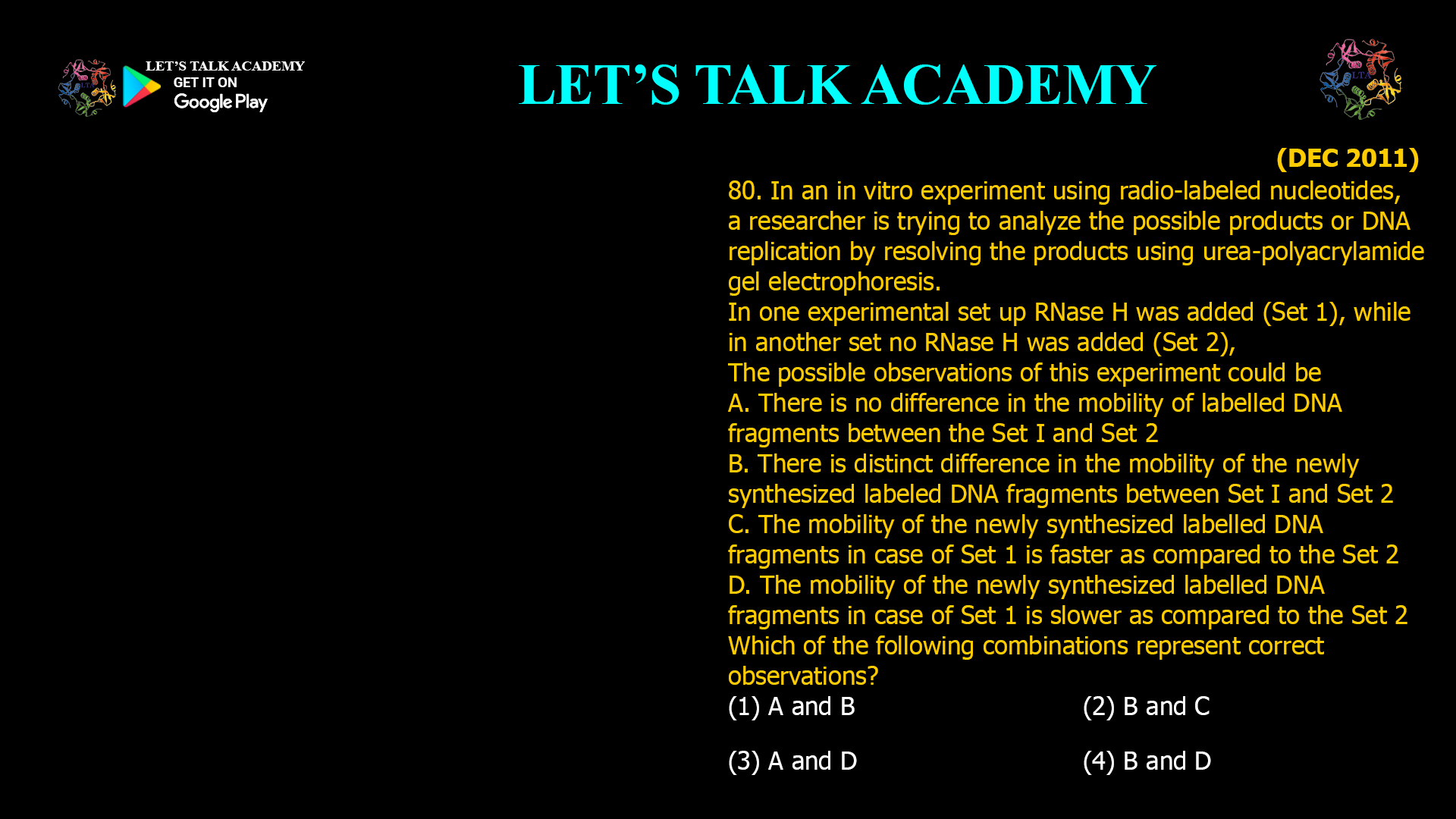
- In an in vitro experiment using radio-labeled nucleotides, a researcher is trying to analyze the possible products or DNA replication by resolving the products using urea-polyacrylamide gel electrophoresis.
In one experimental set up RNase H was added (Set 1), while in another set no RNase H was added (Set 2),
The possible observations of this experiment could be
- There is no difference in the mobility of labelled DNA fragments between the Set I and Set 2
B. There is distinct difference in the mobility of the newly synthesized labeled DNA fragments between Set I and Set 2 - The mobility of the newly synthesized labelled DNA fragments in case of Set 1 is faster as compared to the Set 2
- The mobility of the newly synthesized labelled DNA fragments in case of Set 1 is slower as compared to the Set 2
Which of the following combinations represent correct observations?
(1) A and B (2) B and C
(3) A and D (4) B and D
Background
During DNA replication, especially on the lagging strand, short RNA primers are incorporated and later removed. RNase H specifically degrades the RNA strand in RNA-DNA hybrids, playing a critical role in primer removal. In vitro, when replication products are analyzed by urea-polyacrylamide gel electrophoresis (urea-PAGE), the presence or absence of RNase H affects the structure and size of labeled DNA fragments.
Expected Observations in the Experiment
-
Set 1 (with RNase H):
RNase H removes RNA primers from RNA-DNA hybrids, resulting in pure DNA fragments without RNA segments. These DNA fragments are shorter and more uniform, leading to faster migration on the gel due to smaller size and more compact structure. -
Set 2 (without RNase H):
RNA primers remain attached to the newly synthesized DNA, producing RNA-DNA hybrid fragments that are larger and structurally different, causing slower migration on the gel.
Analysis of the Statements
-
A. No difference in mobility between Set 1 and Set 2
-
Incorrect. Presence or absence of RNA primers affects fragment size and structure, altering mobility.
-
-
B. Distinct difference in mobility between Set 1 and Set 2
-
Correct. RNase H treatment changes fragment composition, resulting in different migration patterns.
-
-
C. Mobility of labeled DNA fragments in Set 1 is faster than in Set 2
-
Correct. Removal of RNA primers produces smaller DNA fragments that migrate faster.
-
-
D. Mobility of labeled DNA fragments in Set 1 is slower than in Set 2
-
Incorrect. RNase H-treated fragments migrate faster, not slower.
-
Correct Combination of Observations
(2) B and C
Keywords
RNase H, DNA replication, RNA-DNA hybrids, urea-polyacrylamide gel electrophoresis, DNA fragment mobility, RNA primer removal, replication products, gel electrophoresis analysis
Conclusion
In an in vitro DNA replication assay analyzed by urea-PAGE, treatment with RNase H removes RNA primers from DNA fragments, resulting in smaller, faster-migrating DNA products. Without RNase H, RNA-DNA hybrids remain, causing slower migration. Therefore, a distinct difference in mobility is observed, with RNase H-treated DNA fragments migrating faster.
Final answer:
(2) B and C


27 Comments
Priya khandal
July 27, 2025Done sir
Surbhi Rajawat
July 29, 2025The primary role of RNase H is to degrade the RNA part of the RNA-DNA intermediate therefore it will shorten some strands in our experiment and we’ll observe what is given in option B and C
Soniya Shekhawat
July 29, 2025In above experiment is clearly see that in first set in which rnaseH is degard part of RNA in RNA and DNA hybrid if RNA is remove so then short fragment of DNA are produced which is the easily and fastly migrate in a page but in second set rnaseH H is absent in which RNA DNA hybrid is not cut so long fragment so slowly migrate so that’s why option are show in B and C
Pratibha
July 29, 2025Correct option is option (2)
In set 1
RNase H removes RNA primers resulting in pure DNA fragments . These DNA fragments length became shorter , by this their molecular weight will be low they migrated faster. in comparison of set (2) in which RNAse H activity is absent
anurag giri
July 29, 2025Rnase H remove rna primer .in first set rna is removed so only pure dna and its moleculer weight is less then set 2 set 1 is migrate fast and set 2 migrate slow bcz it have dna with rna primer so mw is more
Kajal
July 29, 2025Option B and C is correct
Because in the difference in their size of bands
Anisha jakhar
July 29, 2025Correct option is 2. RNase H is involved in degradation of RNA primer during eukaryotic replication. In case 1- RNase H removes primer which makes the DNA fragments short and light so it migrates faster while in case 2 the DNA remains heavy so it migrates slowly. Therefore there is difference in their mobility.
shruti sharma
July 29, 2025b and c
Dipti Sharma
July 29, 2025Correct answer: (2) b and c
Rnase H degrade RNA strand from set 1 which made it more lighter and faster in electrophoresis while in set 2 rna primer is present ,making strand heavier and slow moving .
That’s an easy one .
Suraj sir made it super easy by explaining banding pattern and bcz of that I got correct answer within 30 sec.
Deepshikha choudhary
July 30, 2025Option 2 is correct: because RNase H removes RNA primers from DNA fragments, resulting in smaller, faster-migrating DNA , Without RNase H, RNA-DNA hybrids remain, causing slower migration. Therefore, difference in mobility is observed
Juber Khan
July 30, 2025Option b is right bcz in set -1 Rnase H remove the primer ~ pure Dna fragments ~ faster migration but set 2 without Rnase H not remove primar producing rna – dna fragments larger and defferent ~ slow migration
Asha gurzzar
July 30, 2025Yes,the rna will degrade the primers so ,lenght will be shortened,and set 1 fragments are more mobile then set 2
Shivani panwar
July 30, 20252-👍
Payal Gaur
July 30, 20252. B and C RNase H present -pure DNA fragments and faster migration because remove rna primer by RNase H enzyme
Niti tanwar
July 30, 2025Answer is b and c bcz set 1 m rnase H present degradation of RNA primer form dna fragment than fast migration set 2 m rnase activity not present showly migration
Khushi Vaishnav
July 31, 2025treatment with RNase H removes RNA primers from DNA fragments, resulting in smaller, faster-migrating DNA products.
Without RNase H, RNA-DNA hybrids remain, causing slower migration
Varsha tatla
August 2, 2025Correct option is b,c
Dharmpal Swami
August 1, 2025Rnase H degrade rna-dna interaction
Shivani
August 1, 2025Rnase H removed rna primer form set 1 that makes dna smaller leading to fast migration .
In set 2 no Rnase H added so rna primer remain associated to newly synthesized dna leading to slower migration
So option 2 (b&c ) is correct
Deepika sheoran
August 2, 2025Set 1 Rna H removes Rna primers resulting in pure DNA fragments
Their molecular weight will be low they migrated fast.set 2 Rnase H Activity is Absent.
Varsha tatla
August 2, 2025RNase H degrades dna rna in rna dna hybrid
When rna remove from hybrid then only pure dna obtain so ,in 1st set rna migrate faster then set b bcz set b RNase H less
Varsha tatla
August 2, 2025RNase H degrades dna
rna in rna dna hybrid
When rna remove from hybrid then only pure dna obtain so ,in 1st set rna migrate faster then set b bcz set b RNase H less
Khushi Vaishnav
August 17, 2025B and C
Komal Sharma
August 23, 2025Set 1 (with RNase H):
In set 1. RNase H removes RNA primers from RNA-DNA hybrids, resulting in pure DNA fragments without RNA segments. These DNA fragments are shorter and more uniform, leading to faster migration on the gel due to smaller size and more compact structure. Set 2 RNA primers remain attached to the newly synthesized DNA, producing RNA-DNA hybrid fragments that are larger and structurally different, causing slower migration on the gel so option B and C is correct
Aafreen Khan
August 23, 2025RNase H treatment changes fragment composition, resulting in different migration patterns
Removal of RNA primers produces smaller DNA fragments that migrate faster
Hence B and C are correct answer
Ajay Sharma
September 4, 2025If rnase h is present attached rna primers will be removed and migration of that dna will be fast
Deepika Sheoran
November 7, 2025RNA H present pure DNA fragments and faster migration because remove RNA primer by Rnase H enzyme.