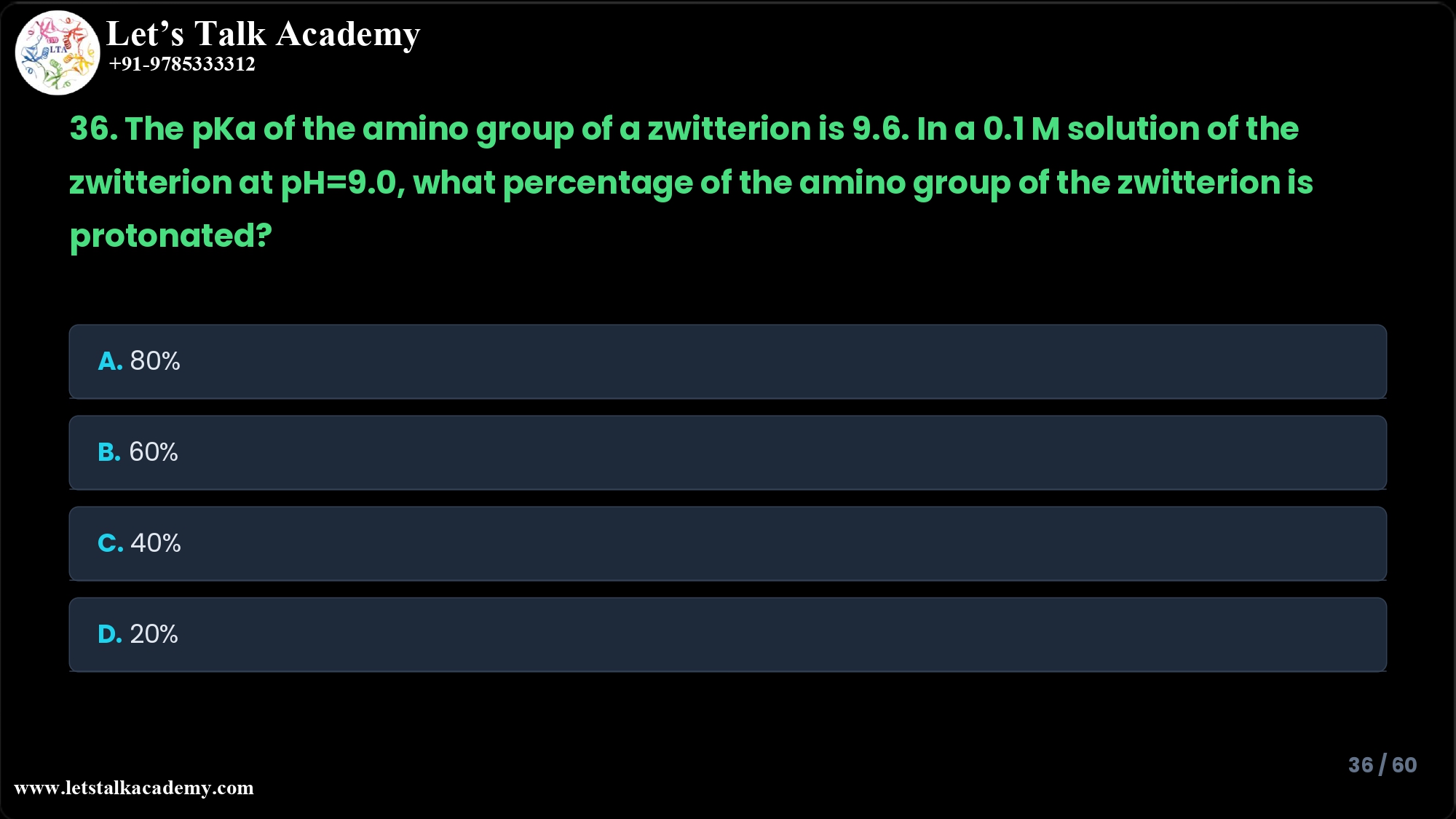
36. The pKa of the amino group of a zwitterion is 9.6. In a 0.1 M solution of the
zwitterion at pH=9.0, what percentage of the amino group of the zwitterion is
protonated?
A. 80%
B. 60%
C. 40%
D. 20%
In a 0.1 M zwitterion solution at pH 9.0 with amino group pKa 9.6, the protonated form (-NH₃⁺) predominates because pH < pKa for this basic group. The Henderson-Hasselbalch equation for the equilibrium ⁻NH₂ + H⁺ ⇌ ⁻NH₃⁺ gives pH = pKa + log([⁻NH₂]/[⁻NH₃⁺]), so [⁻NH₃⁺]/[⁻NH₂] = 10^(pKa – pH) = 10^(0.6) ≈ 4.
Fraction protonated = [⁻NH₃⁺]/([⁻NH₃⁺] + [⁻NH₂]) = 4/(4+1) = 0.8 or 80%. Concentration (0.1 M) does not affect the ratio, as it cancels in equilibrium expressions for weak acids/bases. Thus, option A (80%) matches this calculation precisely.
Option Analysis
-
A. 80%: Correct, as 10^(9.6-9.0) = 3.98 yields ~79.9% protonated, rounding to 80%—standard for exam precision.
-
B. 60%: Incorrect; implies ratio ~1.5 (10^0.176), but actual ΔpH=0.6 requires higher protonation.
-
C. 40%: Wrong; matches deprotonated fraction (1/(1+4)=20% protonated would be if reversed, but pH < pKa favors protonated).
-
D. 20%: Incorrect; this is the deprotonated fraction (1/(1+4)), confusing protonated vs. deprotonated or pKa/pH swap.
This CSIR NET-style question tests acid-base equilibria in amino acids, where zwitterion amino pKa (~9-10) means protonation until pH ≈ pKa.


