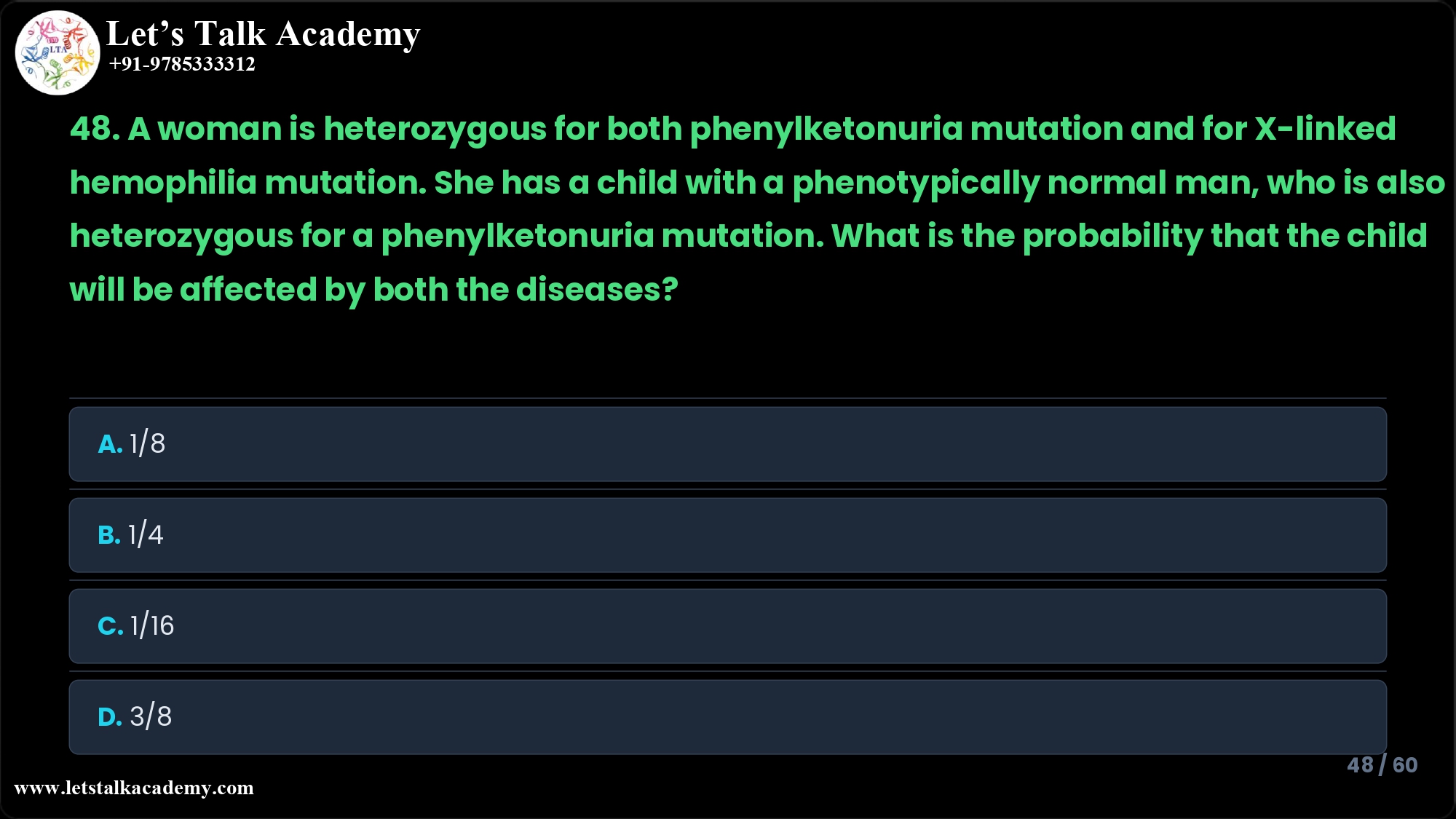
48. A woman is heterozygous for both phenylketonuria mutation and for X-linked
hemophilia mutation. She has a child with a phenotypically normal man, who is
also heterozygous for a phenylketonuria mutation. What is the probability that the
child will be affected by both the diseases?
A. 1/8
B. 1/4
C. 1/16
D. 3/8
Combined Inheritance of PKU and Hemophilia
The probability that a child will be affected by both phenylketonuria (PKU, autosomal recessive) and X-linked hemophilia is:
PKU requires a homozygous recessive genotype (pk/pk) inherited from both parents. Hemophilia affects males (XhY) who inherit the mutant X from a carrier mother, since fathers do not transmit the X chromosome to sons. These two events are independent, so their probabilities multiply.
Inheritance Patterns
Phenylketonuria (PKU): Follows autosomal recessive inheritance. Both heterozygous parents (Pk/pk) pass the recessive allele with a probability of 1/2, producing:
Hemophilia: Being X-linked recessive, a carrier mother (XHXh) passes the defective X (Xh) to half her offspring. Sons receive their Y chromosome from the father and an X from the mother; thus:
Therefore, the combined probability for a male child affected by both conditions is:
Option Analysis
- A. 1/8: Incorrect. Assumes heterozygosity for PKU instead of homozygous recessive requirement.
- B. 1/4: Incorrect. Matches PKU probability alone, ignoring sex-linked hemophilia inheritance.
- C. 1/16: Correct. Derived from (1/4 PKU) × (1/2 male) × (1/2 Xh) = 1/16.
- D. 3/8: Invalid. Overestimates by ignoring independent segregation and homozygosity requirement.
Punnett Square Breakdown
For PKU: Mother Pk/pk × Father Pk/pk → 1/4 pk/pk (affected).
For Hemophilia: Mother XHXh × Father XHY →
- Sons (XY): 1/2 XHY normal, 1/2 XhY affected.
- Daughters (XX): All normal or carriers depending on inherited Xs.
Combined result: Only affected sons with pk/pk genotype exhibit both disorders:
Note: Females are unaffected in this scenario as they require two mutant Xs to express hemophilia recessively.
CSIR NET Tip: Draw separate Punnett squares for autosomal and sex-linked traits, then multiply probabilities for combined inheritance.


