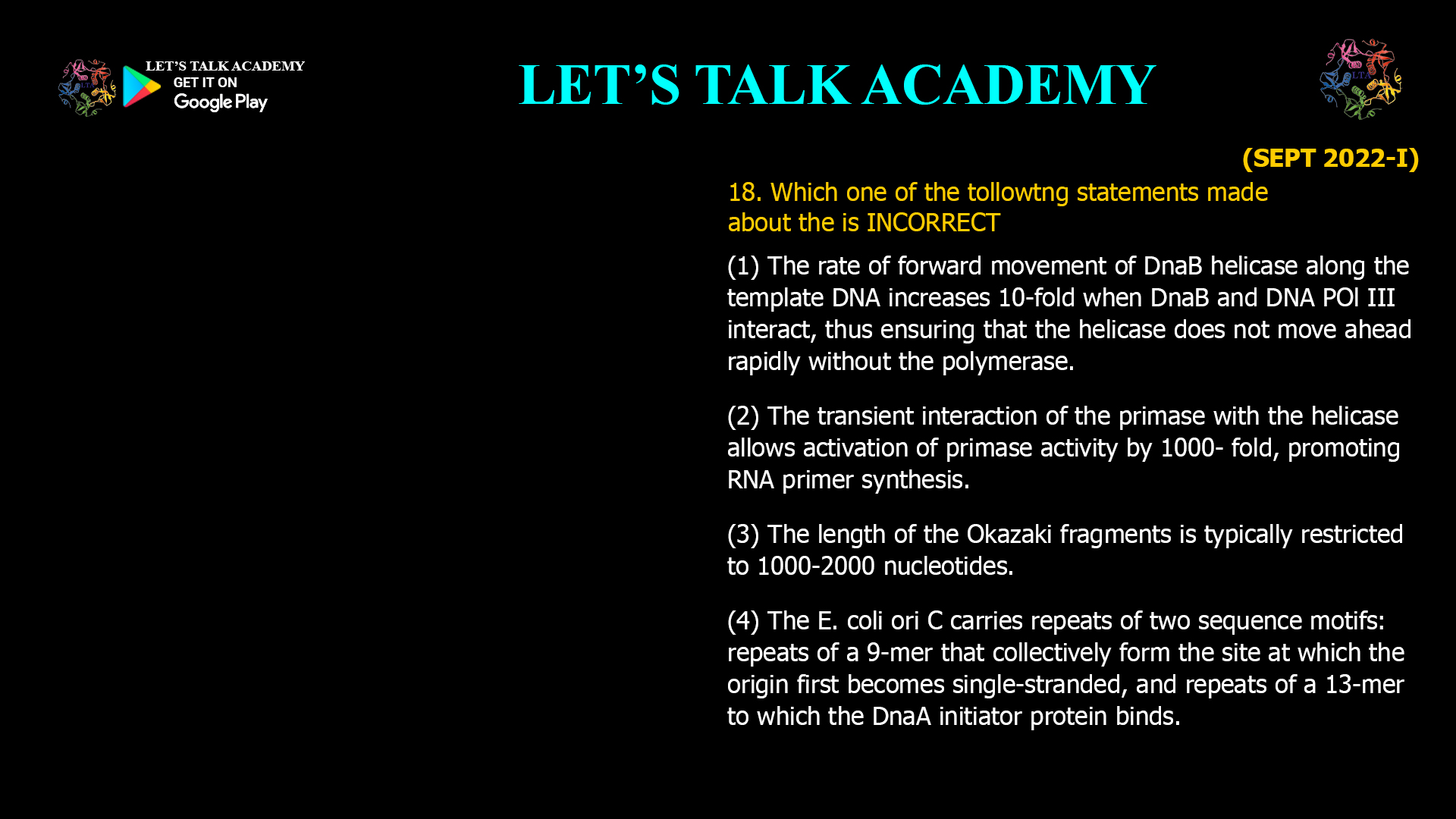
- Which one of the tollowtng statements made about the is INCORRECT
(1) The rate of forward movement otDnaB helicase along the template DNA increases 10-fold when DnaBand DNA POI III interact, thus ensuring that the helicase does not move ahead rapidly without the polymerase.
(2) The transient interaction of the primase with the helicase allows activation of primase activity by 1000- fold, promoting RNA primer synthesis.
(3) The length of the Okazaki fragments is typically restricted to 1000-2000 nucleotides.
(4) The E. coli ori C carries repeats of two sequence motifs: repeats of a 9-mer that collectively form the site at which the origin first becomes single-stranded, and repeats of a 13-mer to which the DnaA initiator protein
binds.
Introduction
Bacterial DNA replication is a highly coordinated process involving multiple proteins and DNA sequence elements. DNAB helicase unwinds the DNA, primase synthesizes RNA primers, Okazaki fragments form during lagging strand synthesis, and the origin of replication (oriC) contains specific sequence motifs critical for initiation. Understanding the interactions and functions of these components is essential for grasping bacterial replication mechanisms.
Statement Analysis
-
Statement (1): The rate of forward movement of DNAB helicase along the template DNA increases 10-fold when DNAB and DNA Pol III interact, thus ensuring that the helicase does not move ahead rapidly without the polymerase.
-
This is true. The interaction between DNAB helicase and DNA polymerase III holoenzyme coordinates helicase unwinding with DNA synthesis, preventing helicase from moving too far ahead of the polymerase.
-
-
Statement (2): The transient interaction of the primase with the helicase allows activation of primase activity by 1000-fold, promoting RNA primer synthesis.
-
This is true. Primase activity is greatly stimulated by its interaction with DNA helicase, enabling efficient primer synthesis at the replication fork.
-
-
Statement (3): The length of the Okazaki fragments is typically restricted to 1000-2000 nucleotides.
-
This is true for E. coli. Okazaki fragments in bacteria generally range from 1000 to 2000 nucleotides, reflecting the coordination between primase activity and lagging strand synthesis.
-
-
Statement (4): The E. coli oriC carries repeats of two sequence motifs: repeats of a 9-mer that collectively form the site at which the origin first becomes single-stranded, and repeats of a 13-mer to which the DnaA initiator protein binds.
-
This is incorrect.
-
In reality, DnaA binds to 9-mer repeats (DnaA boxes) within oriC, while the 13-mer repeats are AT-rich sequences that become unwound (duplex unwinding element, DUE) during initiation. The 13-mer repeats are not the binding sites for DnaA but are the region that melts to allow replication to begin.
-
Correct Identification of the Incorrect Statement
(4) is incorrect because it reverses the roles of the 9-mer and 13-mer repeats in oriC:
-
9-mer repeats (DnaA boxes): Binding sites for DnaA initiator protein.
-
13-mer repeats: AT-rich region that unwinds to form single-stranded DNA, not DnaA binding sites.
Summary Table
| Statement | Description | True/False | Explanation |
|---|---|---|---|
| (1) | DNAB helicase rate increases 10-fold upon interaction with DNA Pol III | True | Ensures coordinated helicase and polymerase activity |
| (2) | Primase activity activated 1000-fold by transient interaction with helicase | True | Enhances RNA primer synthesis at replication fork |
| (3) | Okazaki fragments length typically 1000-2000 nucleotides | True | Reflects bacterial lagging strand synthesis |
| (4) | oriC carries 9-mer repeats forming single-stranded site and 13-mer repeats binding DnaA initiator | False | 9-mer are DnaA binding sites; 13-mer are unwinding sites (DUE) |
Conclusion
Among the statements about bacterial DNA replication, statement (4) is incorrect. The E. coli oriC contains 9-mer repeats (DnaA boxes) that bind the DnaA initiator protein and 13-mer AT-rich repeats that form the unwound single-stranded region, but the 13-mer repeats are not DnaA binding sites. The other statements about DNAB helicase activity, primase activation, and Okazaki fragment length are accurate and reflect current understanding of bacterial DNA replication.


23 Comments
Manisha choudhary
July 25, 2025🔥🔥🔥🔥🔥
Vanshika Sharma
July 29, 2025Ans is 4 bcz dna A binds with 9 mer and melt the 13 bp boxes
Surbhi Rajawat
July 29, 2025All the statements are true except for the 4th one. Hence 4th is the answer
Mansukh Kapoor
July 29, 2025Statment 4th is incorrect because at the 9mer sites DNA A binds and 13mer sites help in melting
Priti Khandal
July 29, 2025Option 4 is incorrect because 9 mer site per dna a bind hota h aur 13 bp melt hmona start hota h
Diksha Chhipa
July 29, 2025On 13 mer seq dna a is not bind on this it is only site ofmelting of dna
anurag giri
July 29, 20254th statement is incorrect dnaA binds on 9 bp site and its help to melt 13 bp site
Khushi Vaishnav
July 29, 2025Option 4 , because DNA A binds with 9 mer and melted in 13 mer
Aman Choudhary
July 29, 2025Option 4 is correct answer bcz Dna A binds on 9 mer and 13 mer help in melting to initiate replication
Priya Khandal
July 29, 20254th option is wrong and three option is absolutely rights
Priya Dhakad
July 30, 2025Option is 4 DNa A binds on 9mer and melted at 13mer
Payal Gaur
July 30, 2025(4) statement is incorrect because Dna A binds on 9 mer and helicase binds on 13 base pair side(melting of DNA).
Aafreen
July 30, 2025Ans 4 is incorrect bcoz 9 mer are the DNA A binding site and 13 mer are Unwinding site
Aafreen
July 30, 2025Ans-4 is incorrect bcoz 9 mer are the DNA A binding site and 13 mer are the unwinding site
Deepika Sheoran
July 30, 2025Option 4 is incorrect because at the Dna A binds with 9 mer and 13 mer sites help in melting.
Swati Choudhary
July 31, 2025OPTION 4th is incorrect as understood by given expanation.
Dipti Sharma
July 31, 2025correct answer is 4 bcz,
9-mer are DnaA binding sites and 13-mer are unwinding sites , where melting occurs.
Khushi Mehra
August 1, 2025Answer is 4
Dna A binds to 9 -mer and Helicase binds at 13 – mer site where melting of DNA occurs
Santosh Saini
August 1, 20254th statement is incorrect because DnaA bind on 9 mer and DnaA of 13bp boxes has helicase domain then DNA will be melt
Soniya Shekhawat
August 3, 20254th is incorrect bcz dna A bind at 9 mer and at 13 mer is melting happen bcz it is AT is rich .
Anjani sharma
August 5, 2025Option 4th is incorrect as DNA A binds with 9 mer and 13 mer help in melting
Anita Choudhary
August 28, 2025Option 4 is incorrect because Dna-A binds on 9 mer and 13 mer help in melting
Deepika Sheoran
November 6, 2025Because at the DNA A binds with 9 mer and 13 mer sites help in melting.