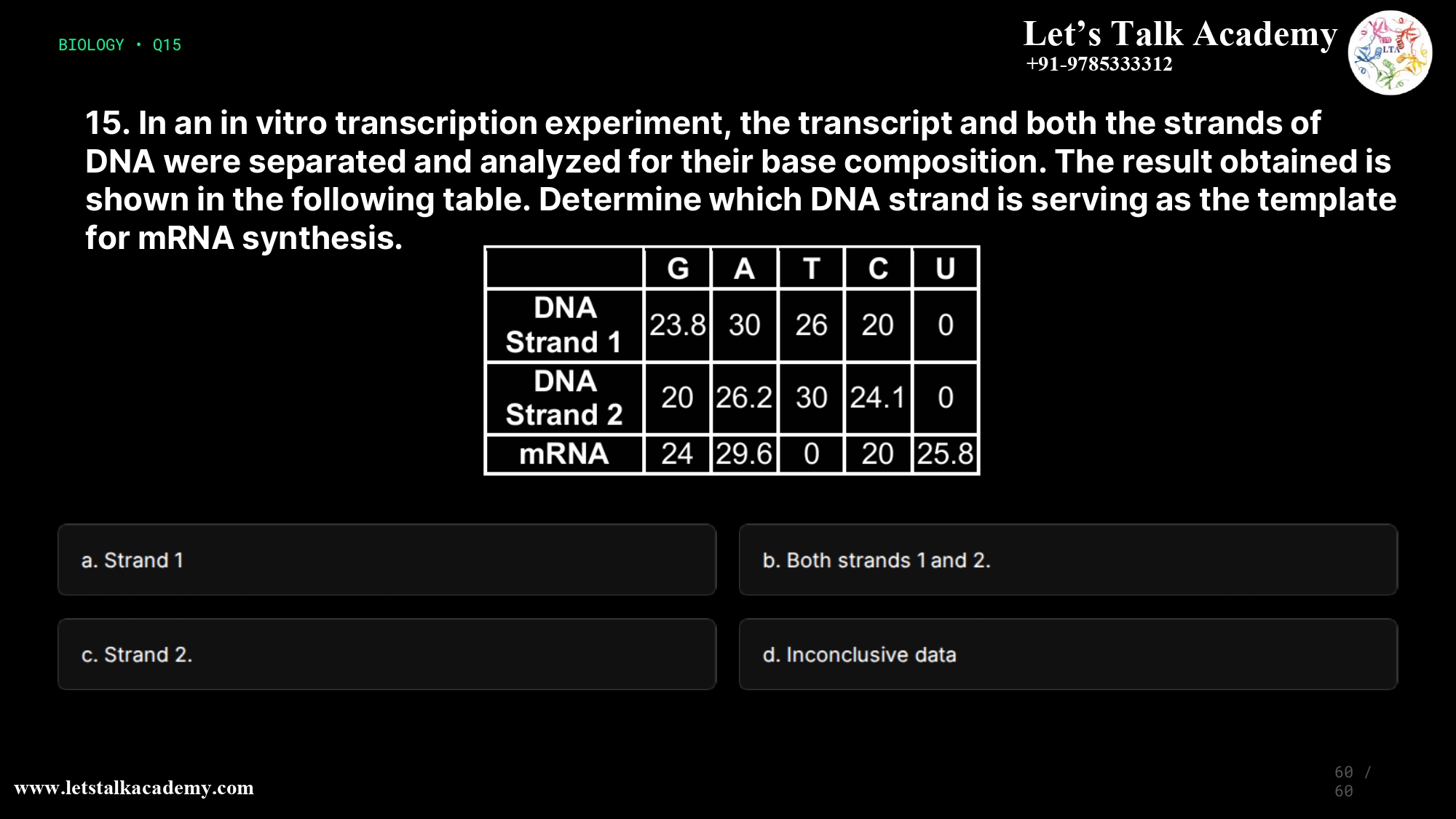
15. In an in vitro transcription experiment, the transcript and both the strands of DNA were separated
and analyzed for their base composition. The result obtained is shown in the following table.
Determine which DNA strand is serving as the template for mRNA synthesis.
a. Strand 1
b. Both strands 1 and 2.
c. Strand 2.
d. Inconclusive data
The DNA strand serving as the template for mRNA synthesis is DNA strand 2.
Understanding the base‑composition table
The table in the question shows percentage composition of bases in two DNA strands and the mRNA: G, A, T, C in DNA, and G, A, C, U in mRNA. In transcription, RNA is synthesized complementary to the template DNA strand, and the mRNA sequence (except for U in place of T) is identical to the coding strand of DNA.
Key complementarity rules in transcription:
-
DNA A pairs with RNA U
-
DNA T pairs with RNA A
-
DNA G pairs with RNA C
-
DNA C pairs with RNA G
So, for the template strand, the % of A, T, G, C must be approximately complementary to % of U, A, C, G in mRNA, respectively, while the other DNA strand should match the mRNA in G, A, C content (T in DNA ≈ U in RNA).
Checking strand 1 vs strand 2
From the figure:
-
DNA strand 1:
-
G ≈ 23.8, A ≈ 30, T ≈ 26, C ≈ 20
-
-
DNA strand 2:
-
G ≈ 20, A ≈ 26.2, T ≈ 30, C ≈ 24.1
-
-
mRNA:
-
G ≈ 24, A ≈ 29.6, C ≈ 20, U ≈ 25.8
-
Compare mRNA with each DNA strand:
-
For strand 1 vs mRNA:
-
mRNA G (24) is close to DNA strand 1 G (23.8).
-
mRNA A (29.6) is close to DNA strand 1 A (30).
-
mRNA C (20) is close to DNA strand 1 C (20).
-
mRNA U (25.8) is close to DNA strand 1 T (26).
The base percentages of strand 1 match those of mRNA (substituting T with U), indicating strand 1 behaves as the coding (non‑template) strand.
-
-
For strand 2 vs mRNA (complementarity):
-
mRNA G (24) should pair with DNA C; strand 2 C is 24.1 (very close).
-
mRNA A (29.6) should pair with DNA T; strand 2 T is 30.
-
mRNA C (20) should pair with DNA G; strand 2 G is 20.
-
mRNA U (25.8) should pair with DNA A; strand 2 A is 26.2.
These complementary relationships show that strand 2 is the template strand for transcription.
-
Therefore, the correct option is c. Strand 2.
Explanation of all options
Option a: Strand 1
This is incorrect. Strand 1’s base composition almost exactly mirrors that of mRNA (with T in DNA corresponding to U in RNA), which is the hallmark of the coding (sense) strand, not the template strand. The template must be complementary, not identical, to mRNA.
Option b: Both strands 1 and 2
This is incorrect. In any one transcription event for a given gene, only one strand functions as template, while the opposite strand acts as coding strand. Though different genes along the chromosome may use different strands as template, for the mRNA analyzed here the pattern clearly singles out strand 2 alone as complementary.
Option c: Strand 2 (correct)
This is correct because the base percentages of DNA strand 2 are complementary to those of the mRNA: its A content matches mRNA U, its T matches mRNA A, its G matches mRNA C, and its C matches mRNA G. This complementary relationship defines the template (antisense) DNA strand.
Option d: Inconclusive data
This is incorrect. The data are sufficient: the close identity between strand 1 and mRNA, and the complementary relationship between strand 2 and mRNA, allow unambiguous identification of strand 2 as the template.
SEO‑optimized introduction
In molecular biology exams, questions on template DNA strand in vitro transcription often use base‐composition data of DNA and mRNA to test your conceptual clarity. Understanding how to relate the percentages of G, A, T, C in each DNA strand to the G, A, C, U of the mRNA allows you to quickly decide which strand is the template and which is the coding strand.


