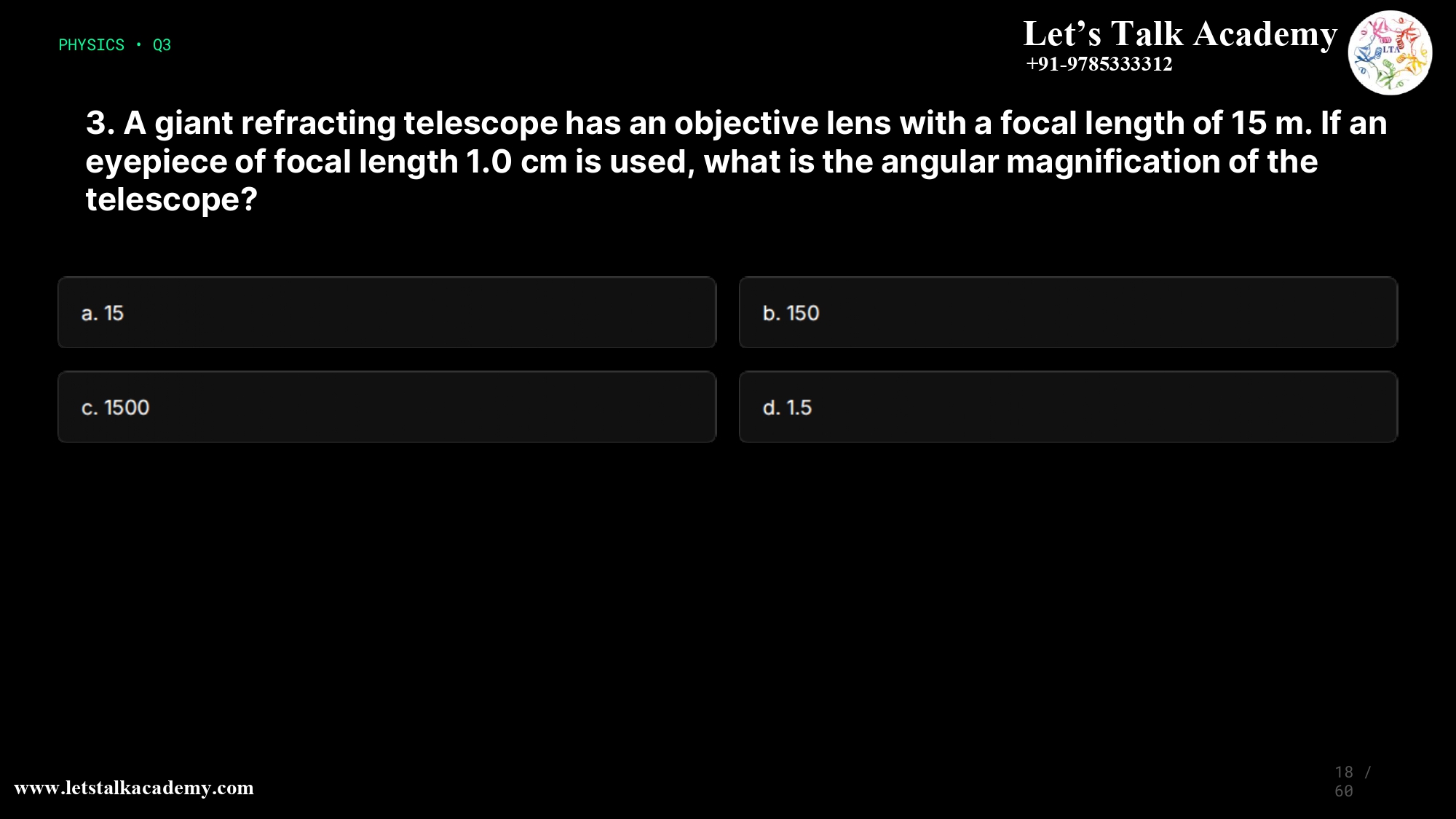
18. A giant refracting telescope has an objective lens with a focal length of 15 m. If an
eyepiece of focal length 1.0 cm is used, what is the angular magnification of the
telescope?
a. 15
b. 150
c. 1500
d. 1.5
How to Calculate Angular Magnification of a Refracting Telescope: Objective and Eyepiece Focal Length Formula
Quick Answer: The correct answer is Option C: 1500.
Using the formula M = f₀ / fₑ, where f₀ = 15 m = 1500 cm and fₑ = 1.0 cm, the angular magnification is:
M = 1500 cm ÷ 1.0 cm = 1500×
The Fundamental Formula
The angular magnification of a refracting telescope is determined by the ratio of the focal length of the objective lens to that of the eyepiece lens:
- M = Angular magnification (dimensionless)
- f₀ = Focal length of the objective lens
- fₑ = Focal length of the eyepiece lens
Step-by-Step Calculation
Step 1: Identify Given Values
- Objective focal length, f₀ = 15 m
- Eyepiece focal length, fₑ = 1.0 cm
Step 2: Convert Units (Critical Step)
Both focal lengths must be in the same unit.
Method A (Convert to cm): f₀ = 15 × 100 = 1500 cm; fₑ = 1.0 cm
Method B (Convert to m): f₀ = 15 m; fₑ = 1.0 ÷ 100 = 0.01 m
Step 3: Apply the Formula
or
M = 15 m / 0.01 m = 1500
Result: The telescope magnifies objects 1500 times larger than with the naked eye.
Comprehensive Option Analysis
| Option | Value | Assessment | Explanation |
|---|---|---|---|
| A | 15 | Incorrect | Fails to convert units properly; treats 15 m as 15 cm. |
| B | 150 | Incorrect | Partial conversion error; divides by wrong focal length. |
| C | 1500 | Correct | Applies correct formula and unit conversion; represents accurate magnification. |
| D | 1.5 | Incorrect | Severe decimal error; does not match the telescope’s scale. |
Optical Physics Background
Refracting Telescope Optics
- Objective Lens: Forms real, inverted images; gathers more light with longer focal length.
- Eyepiece Lens: Acts as a magnifier; shorter focal length increases magnification.
Why Unit Conversion Is Critical
Magnification involves a ratio, so both focal lengths must use matching units. Failure to convert introduces a scale factor error.
- Incorrect: 15/1 = 15 (ignores units)
- Correct: 1500 cm / 1 cm = 1500
- Correct: 15 m / 0.01 m = 1500
Common Student Mistakes
| Mistake | Problem | Solution |
|---|---|---|
| Unit mismatch | Used f₀ in meters, fₑ in cm | Convert both to the same unit |
| Incomplete conversion | Converted only one focal length | Always double-check both conversions |
| Formula confusion | Used lens-maker formula instead of telescope formula | Remember: M = f₀ / fₑ |
| Magnitude misunderstanding | Thought 1.5× was reasonable | Large objectives require huge magnification ratios |
| Decimal errors | Treated 0.01 m as 0.1 m | Carefully verify metric conversions |
Practical Telescope Design Implications
- At 1500× magnification, optical performance depends heavily on atmospheric stability.
- A 15 m refractor requires heavy support, a dome structure, and temperature control.
- Modern telescopes favor reflecting designs to avoid refractor size limitations.
Magnification with Different Eyepieces
| Eyepiece (fₑ) | Magnification | Application |
|---|---|---|
| 5.0 cm | 300× | Low power (wide field) |
| 2.5 cm | 600× | Medium power |
| 1.0 cm | 1500× | High detail view |
| 0.5 cm | 3000× | Extreme magnification (rarely practical) |
Useful Magnification Limits
Practical telescopes operate below:
Comparison with Other Optical Instruments
- Magnifying Glass: M = D / 4
- Compound Microscope: M = Mobjective × Meyepiece
- Telescope: M = f₀ / fₑ
Key Takeaways
- Correct Answer: 1500 (Option C)
- Formula: M = f₀ / fₑ
- Conversion: Both focal lengths in same unit.
- Magnification Principle: Long f₀ + short fₑ → high magnification.
- Physical Meaning: Objects appear 1500× larger.
In Summary: The angular magnification of this giant refracting telescope is 1500×, derived from M = f₀ / fₑ with proper unit conversion (1500 cm / 1.0 cm). This illustrates how optical engineering and correct dimensional analysis underpin astronomical instrument performance.


