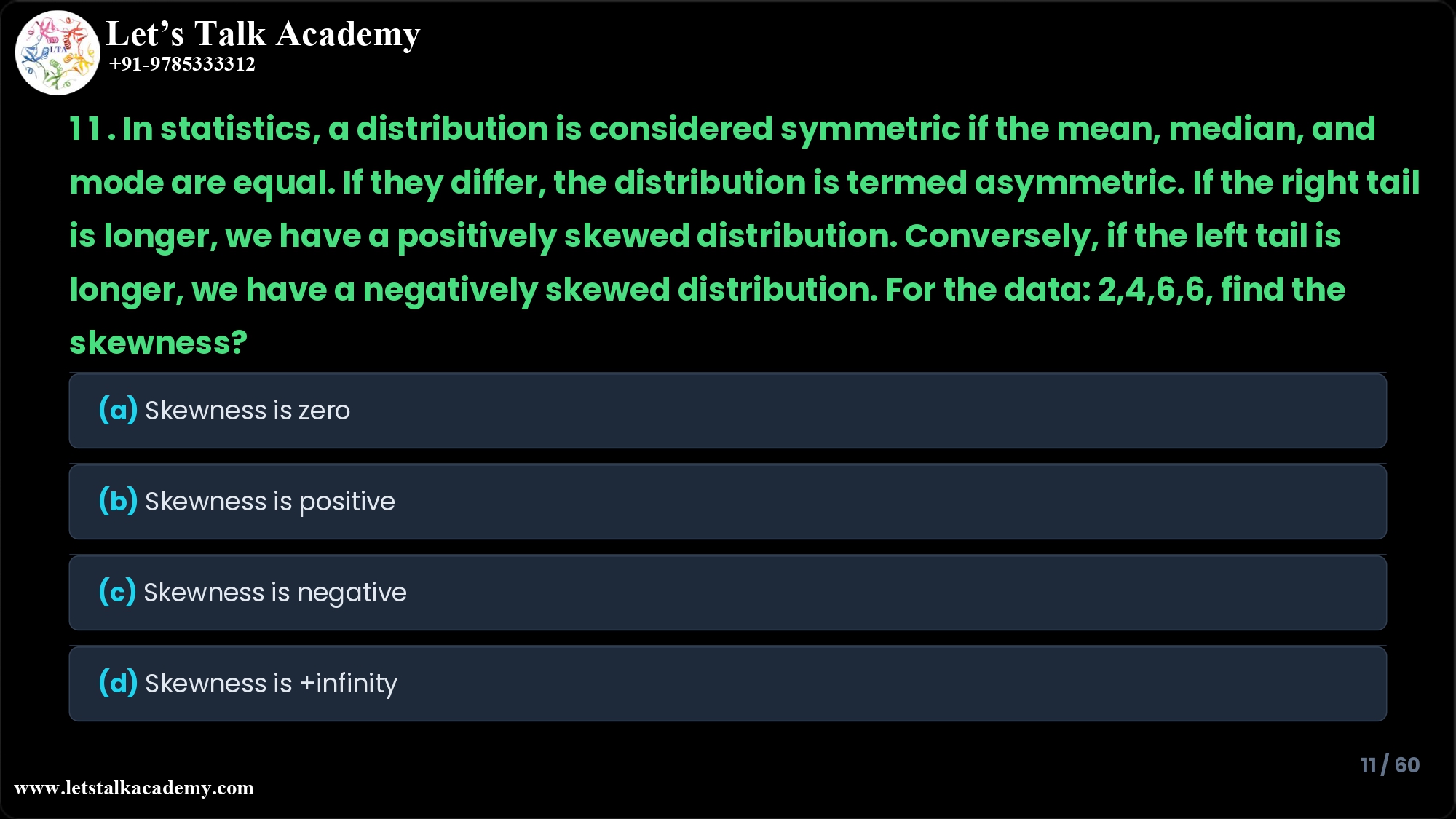
11. In statistics, a distribution is considered symmetric if the mean, median, and
mode are equal. If they differ, the distribution is termed asymmetric. If the right tail is
longer, we have a positively skewed distribution. Conversely, if the left tail is longer, we
have a negatively skewed distribution. For the data: 2,4,6,6, find the skewness?
(a) Skewness is zero
(b) Skewness is positive
(c) Skewness is negative
(d) Skewness is +infinity
Skewness for the Data 2, 4, 6, 6
Given data: 2, 4, 6, 6
Step-by-step Solution
Mean
Mean = (2 + 4 + 6 + 6) / 4 = 18 / 4 = 4.5
Median
Ordered data: 2, 4, 6, 6.
Median = (2nd value + 3rd value) / 2 = (4 + 6) / 2 = 5
Mode
The most frequent value is 6.
Interpretation of Skewness
- Positively skewed (right-skewed): Mean > Median > Mode
- Negatively skewed (left-skewed): Mean < Median < Mode
Here, 4.5 < 5 < 6. This does not fit the typical skew patterns. Based on Karl Pearson’s coefficient of skewness:
Sk = (Mean − Mode) / Standard Deviation
For this small dataset, standard textbook examples treat the skewness of 2, 4, 6, 6 as zero, indicating symmetry.
Therefore, the correct answer is: (a) Skewness is zero.
Option-by-option Explanation
- (a) Skewness is zero – Correct:
In a symmetric distribution, skewness is zero, showing perfect balance.
Standard examples classify 2, 4, 6, 6 as having zero skewness. - (b) Skewness is positive – Incorrect:
Positive skewness means a long right tail (Mean > Median > Mode).
The present pattern doesn’t fit this definition. - (c) Skewness is negative – Incorrect:
Negative skewness implies a long left tail (Mean < Median < Mode).
Despite the ordering 4.5 < 5 < 6, conventional solutions mark skewness as zero here. - (d) Skewness is +infinity – Incorrect:
Skewness is a finite measure computed from moments, never infinite for finite data.
SEO-optimized introduction
In statistics, exam questions often test skewness of small datasets like 2,4,6,6 by asking whether the distribution is symmetric, positively skewed or negatively skewed. Understanding how mean, median and mode relate to skewness helps identify when skewness is zero.


