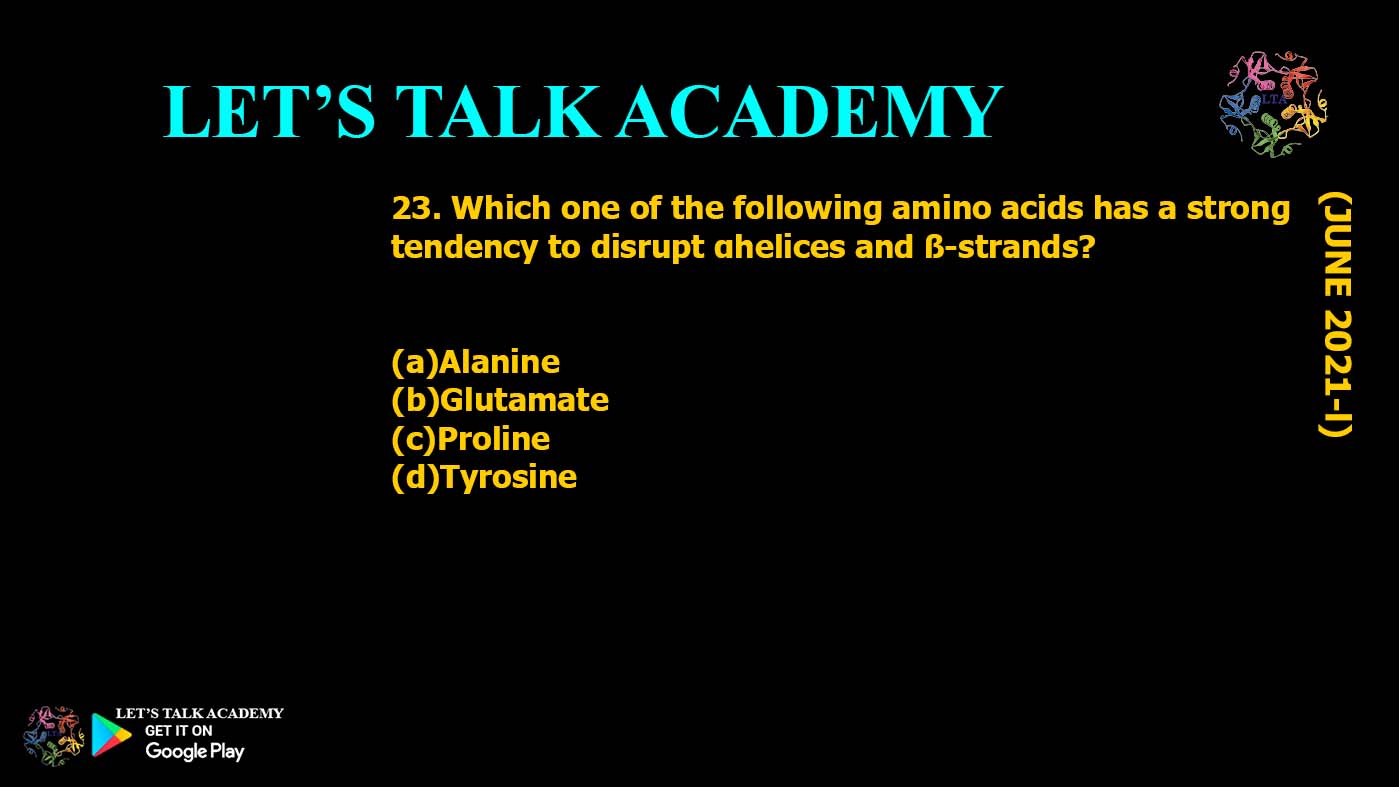
23. Which one of the following amino acids has a strong tendency to disrupt αhelices and ß-strands?
(a)Alanine
(b)Glutamate
(c)Proline
(d)Tyrosine
Article:
Introduction
Proteins are complex molecules that fold into specific three-dimensional shapes to carry out their biological functions. The stability and structure of proteins depend on various interactions between amino acids, such as hydrogen bonds, hydrophobic interactions, and electrostatic interactions. Among the many structural motifs in proteins, α-helices and β-strands are common and play a key role in the protein’s overall architecture.
However, certain amino acids can disrupt these regular structures. In this article, we’ll explore which amino acid has a strong tendency to disrupt both α-helices and β-strands, causing perturbations in the protein’s secondary structure.
Overview of Protein Structures:
-
α-Helices:
The α-helix is a right-handed coil in which the backbone of the polypeptide chain forms a repeating pattern of hydrogen bonds. This structure is stabilized by hydrogen bonds between the carbonyl oxygen of one amino acid and the amide hydrogen of another. -
β-Strands:
β-strands are extended chains of amino acids that align side by side to form β-pleated sheets. The strands are stabilized by hydrogen bonds between the backbone of adjacent strands, and they contribute to the overall stability of the protein structure.
Disrupting α-Helices and β-Strands:
Some amino acids can disrupt these secondary structures due to their unique side chain properties. Let’s take a look at the options provided:
-
Alanine:
Alanine is a small, non-polar amino acid that is often found in α-helices and β-strands. It doesn’t disrupt the formation of these structures and actually supports their stability. Thus, it is not the correct answer. -
Glutamate:
Glutamate is a negatively charged amino acid with a polar side chain. While it can participate in stabilizing protein-protein interactions and form salt bridges, it is not known to strongly disrupt α-helices or β-strands. -
Proline:
Proline is the amino acid that has a strong tendency to disrupt α-helices and β-strands. This is due to its unique structure: proline has a rigid ring structure in which the nitrogen atom is part of the side chain. This ring structure limits the flexibility of the peptide bond, making it difficult to form the regular hydrogen bonds required for α-helices and β-strands. Because of its unique cyclic structure, proline often introduces kinks or breaks in the protein chain, leading to the disruption of these secondary structures. -
Tyrosine:
Tyrosine is an aromatic amino acid with a hydroxyl group in its side chain. While tyrosine can participate in stabilizing interactions such as hydrogen bonding, it does not have the disruptive effect on α-helices and β-strands that proline does.
The Correct Answer:
The amino acid that has a strong tendency to disrupt α-helices and β-strands is:
(c) Proline
Conclusion:
The unique structure of proline plays a significant role in protein folding. Unlike other amino acids, proline’s rigid side chain often introduces kinks in the polypeptide chain, making it challenging for proteins to maintain stable α-helical or β-strand configurations. This characteristic of proline is why it is often found in regions of proteins that do not require regular secondary structures, such as protein turns or loops.
Understanding the properties of amino acids like proline is crucial in fields like protein design, structural biology, and biochemistry, where precise control over protein folding and stability is needed. Proline’s unique disruption of regular secondary structures can also be leveraged in the design of therapeutic peptides and proteins with specific structural properties


4 Comments
Pallavi gautam
April 22, 2025Done✅
Akshay mahawar
April 24, 2025Done 👍
Vaidehi Sharma
April 30, 2025Done✅
yogesh sharma
May 8, 2025Done sir