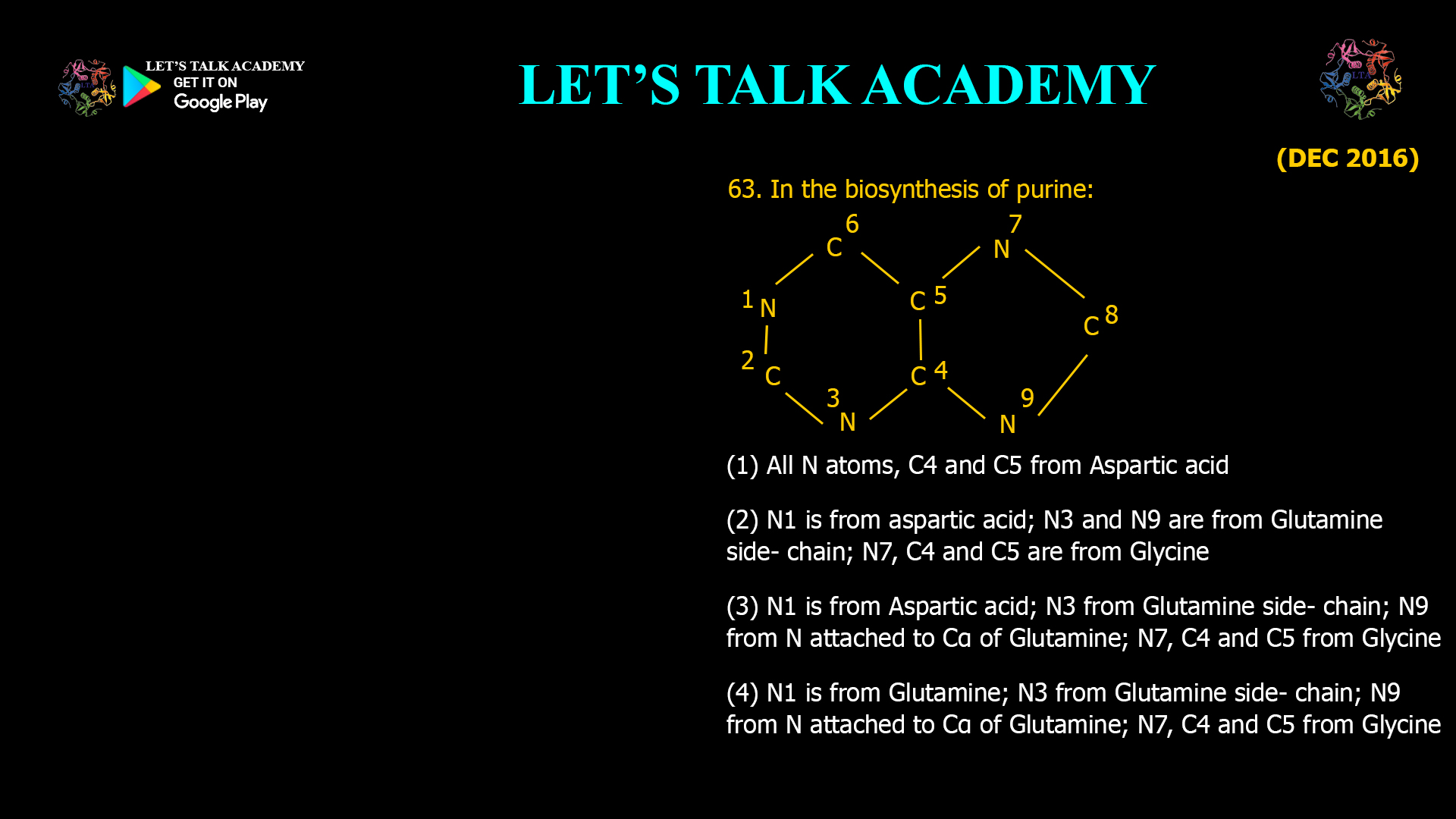
- In the biosynthesis of purine:
(1) All N atoms, C4 and C5 from Aspartic acid
(2) N1 is from aspartic acid; N3 and N9 are from Glutamine side- chain; N7, C4 and C5 are from
Glycine
(3) N1 is from Aspartic acid; N3 from Glutamine side- chain; N9 from N attached to Cα of Glutamine; N7, C4 and C5 from Glycine
(4) N1 is from Glutamine; N3 from Glutamine side- chain; N9 from N attached to Cα of Glutamine; N7, C4 and C5 from Glycine
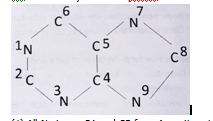
Overview of Purine Ring Structure and Atom Numbering
The purine ring is a fused bicyclic structure with nine atoms, numbered as follows:
-
Nitrogen atoms at positions N1, N3, N7, and N9.
-
Carbon atoms at positions C2, C4, C5, C6, and C8.
Each atom is derived from specific precursors during biosynthesis.
Sources of Nitrogen Atoms in Purine Biosynthesis
-
N1: Derived from the amino group of aspartic acid.
-
N3 and N9: Both nitrogen atoms come from the amide nitrogen of glutamine.
-
N7: Provided by the α-amino nitrogen of glycine.
Sources of Carbon Atoms in Purine Biosynthesis
-
C4 and C5: Supplied by the carbon atoms of glycine.
-
C2 and C8: Provided by formyl groups donated by 10-formyltetrahydrofolate (10-formyl-THF), which are derived from one-carbon metabolism involving serine, formate, and histidine.
-
C6: Comes from carbon dioxide (CO₂).
Clarifying the Nitrogen at N9 Position
-
The nitrogen at N9 is specifically from the amide nitrogen of glutamine’s side chain, not the α-amino nitrogen attached to the α-carbon (Cα).
-
This distinction is important because glutamine contains two nitrogen atoms: the α-amino nitrogen and the side-chain amide nitrogen. Only the amide nitrogen contributes to purine biosynthesis.
Evaluating the Given Options
Option Description Correctness (1) All N atoms, C4 and C5 from aspartic acid Incorrect; glycine and glutamine contribute (2) N1 from aspartic acid; N3 and N9 from glutamine side chain; N7, C4, C5 from glycine Correct; matches biochemical evidence (3) N1 from aspartic acid; N3 from glutamine side chain; N9 from N attached to Cα of glutamine; N7, C4, C5 from glycine Incorrect; N9 is from glutamine amide nitrogen, not α-amino nitrogen (4) N1 from glutamine; N3 from glutamine side chain; N9 from N attached to Cα of glutamine; N7, C4, C5 from glycine Incorrect; N1 is from aspartic acid, not glutamine Summary Table of Atom Sources
Atom Position Source Amino Acid or Molecule N1 Amino nitrogen of aspartic acid N3 Amide nitrogen of glutamine side chain N7 α-Amino nitrogen of glycine N9 Amide nitrogen of glutamine side chain C4, C5 Carbon atoms of glycine C2, C8 Formyl groups from 10-formyl-THF C6 Carbon dioxide (CO₂) Conclusion
The most accurate description of nitrogen and carbon atom sources in purine biosynthesis is:
(2) N1 is from aspartic acid; N3 and N9 are from glutamine side-chain; N7, C4, and C5 are from glycine.
This reflects the well-established biochemical pathway and isotope labeling studies confirming the origins of purine atoms.
-


10 Comments
Khushi Vaishnav
September 23, 2025N1 is from aspartic acid
N3 and N9 are from glutamine side-chain N7, C4, and C5 are from glycine.
Pallavi Ghangas
September 23, 2025N1 is from aspartic acid; N3 and N9 are from glutamine side-chain; N7, C4, and C5 are from glycine
Kirti Agarwal
September 24, 2025Opt 2
Rishita
September 24, 2025N1 is from aspartic acid
N3 and N9 are from glutamine side-chain N7, C4, and C5 are from glycine.
Aakansha sharma Sharma
September 24, 2025(2) N1 is from aspartic acid; N3 and N9 are from glutamine side-chain; N7, C4, and C5 are from glycine
Mohd juber Ali
September 25, 2025C4 and c5 carbon atom of glycin
N7 amino nitrogen of glycine
N1: Derived from the amino group of aspartic acid.
Varsha Tatla
September 27, 2025N1 -aspartic acid
N3, N 9- glutamine
N7 c3 c5 -glycine
Mahima Sharma
September 27, 2025N1 from aspartic acid; N3 and N9 from glutamine side chain; N7, C4, C5 from glycine
Kajal
September 30, 2025Option B
Sakshi Kanwar
November 27, 2025(2) N1 is from aspartic acid; N3 and N9 are from glutamine side-chain; N7, C4, and C5 are from glycine.