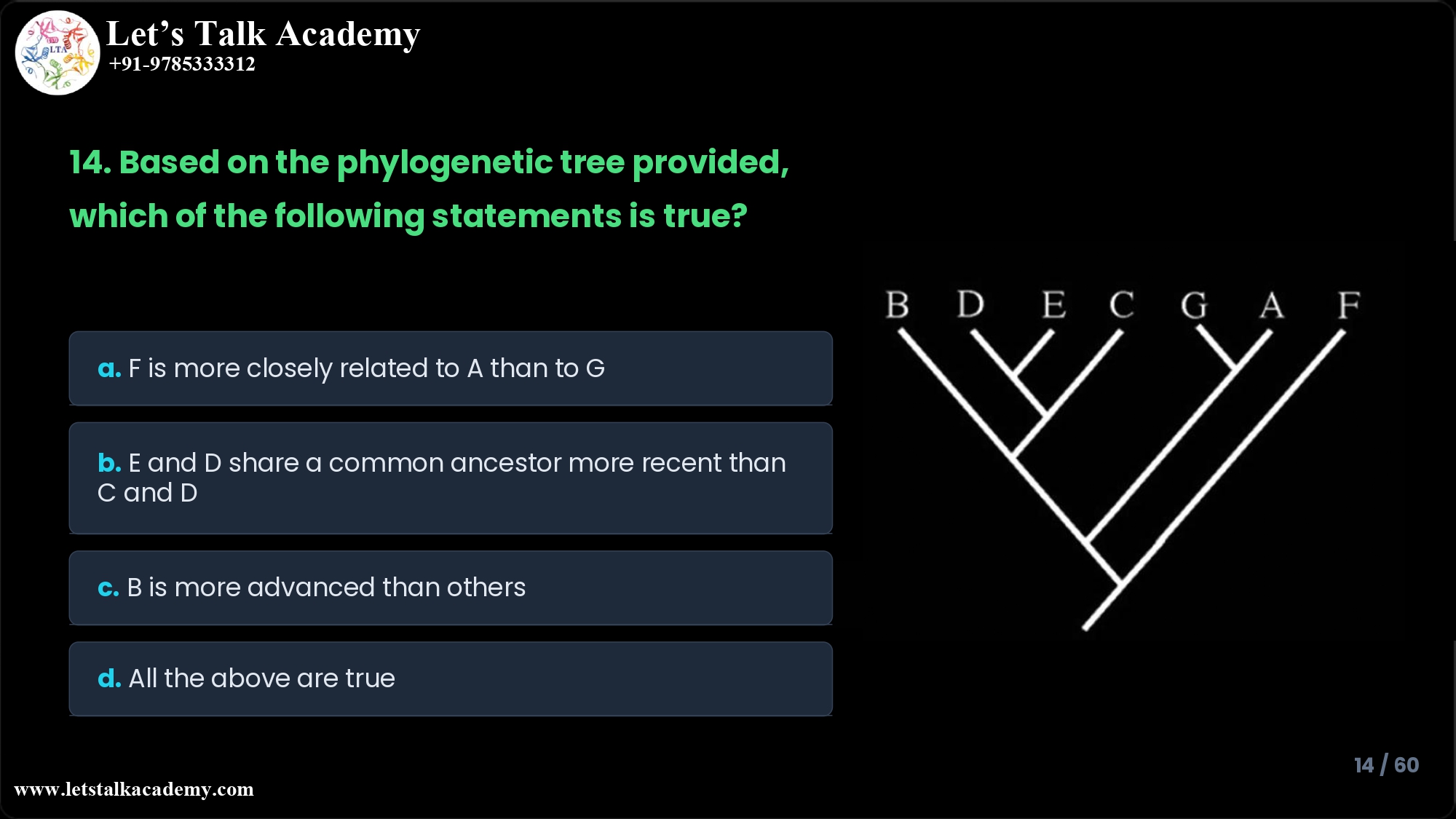
14.Based on the phylogenetic tree provided below, which of the following statements is
true?
a. F is more closely related to A than to G
b. E and D share a common ancestor who is more recent than the
ancestor of C and D
c. B is more advanced than the others as it is located on the left most
branch
d. All the above are true
The correct statement for the given phylogenetic tree is (b) E and D share a common ancestor more recent than C and D.
Reading the phylogenetic tree
In a rooted phylogenetic tree, relatedness is determined by how recently two taxa share a common node (ancestor), not by their horizontal position or by which branch is drawn higher or lower. Modern taxa (B, D, E, C, G, A, F) are all at the tips and are equally “advanced”; the only meaningful comparison is how close or deep their branching points are.
In the provided tree, D and E branch from a very recent internal node (a small “V” joining them), and that D–E clade then joins with C at a deeper node; all of these join the rest (including A, F, G, B) even deeper. This topology makes it possible to test each statement logically.
Option (a): “F is more closely related to A than to G”
To test this, identify the most recent common ancestor (MRCA) of F with A, and F with G:
-
F is attached to a basal branch that first joins with A and G in a small clade, where A and G share a recent node, and that clade then joins the lineage leading to F at an older node.
-
This means the MRCA of F and A is the same node as the MRCA of F and G; F diverged earlier, while A and G are sister taxa in that mini-clade.
Because F has the same depth of shared ancestor with A and G, it is equally related to A and G; F is not more closely related to A than to G. Therefore, option (a) is false.
Option (b): “E and D share a common ancestor more recent than C and D”
Look at the branching among C, D and E:
-
D and E meet at a very shallow node: they are sister taxa.
-
That D–E node then joins the branch leading to C at a deeper node (closer to the root).
-
Therefore, D and E share a more recent MRCA with each other than either does with C.
So the statement “E and D share a common ancestor more recent than C and D” is exactly what the tree shows, and option (b) is true.
Option (c): “B is more advanced than others”
This statement reflects a common misconception in phylogenetics:
-
Phylogenetic trees do not rank extant species as “primitive” or “advanced”; all tips represent lineages that have been evolving for the same total time from the root.
-
Saying “B is more advanced than others” has no meaning in proper evolutionary terminology and is always a wrong kind of inference from such a tree.
Therefore, option (c) is false because branches do not imply value or advancement, only patterns of common ancestry.
Option (d): “All the above are true”
Since option (a) is false and option (c) is also false, not all of the above statements can be true. Even though option (b) is correct, including incorrect statements makes option (d) false.
Thus, the only correct choice is (b) E and D share a common ancestor more recent than C and D.
SEO-focused introduction
Phylogenetic tree questions like “Based on the phylogenetic tree provided, which of the following statements is true?” for taxa B, D, E, C, G, A and F are frequent in CSIR NET and other life science exams because they test conceptual understanding of evolutionary relatedness rather than memorization. By learning to read common ancestors, sister taxa and branch points correctly, students can quickly identify which statement about relationships, such as “E and D share a more recent common ancestor than C and D,” is supported by the tree and avoid misconceptions like calling one taxon “more advanced”.


