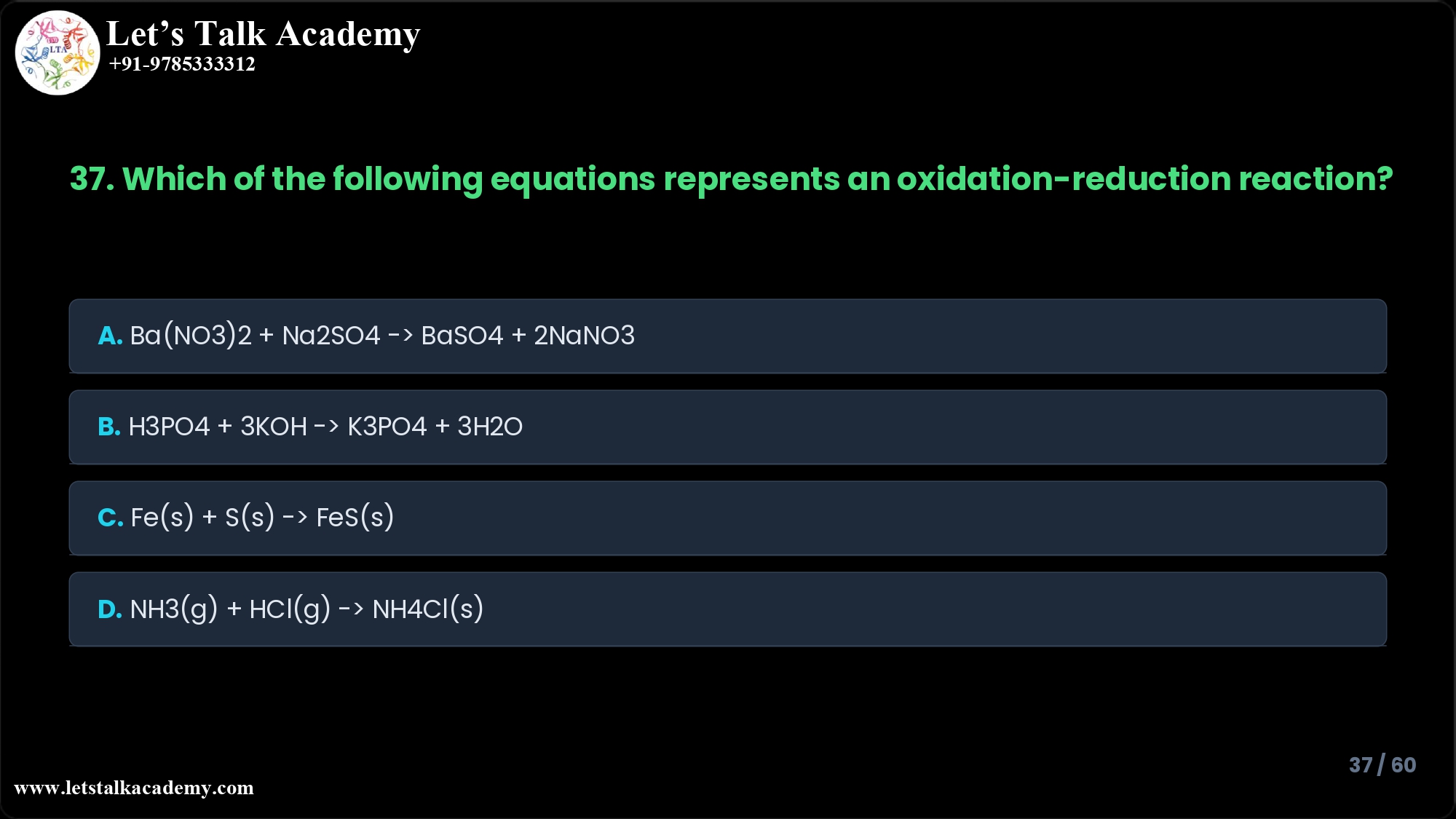
37. Which of the following equations represents an oxidation-reduction reaction?
A. Ba(NO3)2 + Na2SO4 → BaSO4 + 2NaNO3
B. H3PO4 + 3KOH → K3PO4 + 3H2O
C. Fe(s) + S(s) → FeS(s)
D. NH3(g) + HCl(g) → NH4Cl(s)
The correct answer is C. Fe(s) + S(s) → FeS(s), as it involves electron transfer where iron gets oxidized and sulfur reduced.
Option A Analysis
Ba(NO3)2 + Na2SO4 → BaSO4 + 2NaNO3 represents a double displacement (precipitation) reaction. Oxidation states remain unchanged: Ba (+2), N (+5), S (+6) throughout, with no electron transfer.
Option B Analysis
H3PO4 + 3KOH → K3PO4 + 3H2O is a neutralization (acid-base) reaction. Oxidation states stay constant: P (+5), K (+1), O (-2), H (+1), confirming no redox process.
Option C Analysis (Correct)
Fe(s) (0) oxidizes to FeS (+2 in FeS), losing electrons, while S(s) (0) reduces to S(-2 in FeS), gaining electrons. This defines a redox reaction.
Option D Analysis
NH3(g) + HCl(g) → NH4Cl(s) forms an ionic salt via acid-base neutralization. N (-3), H (+1), Cl (-1) oxidation states do not change across reactants and product.


