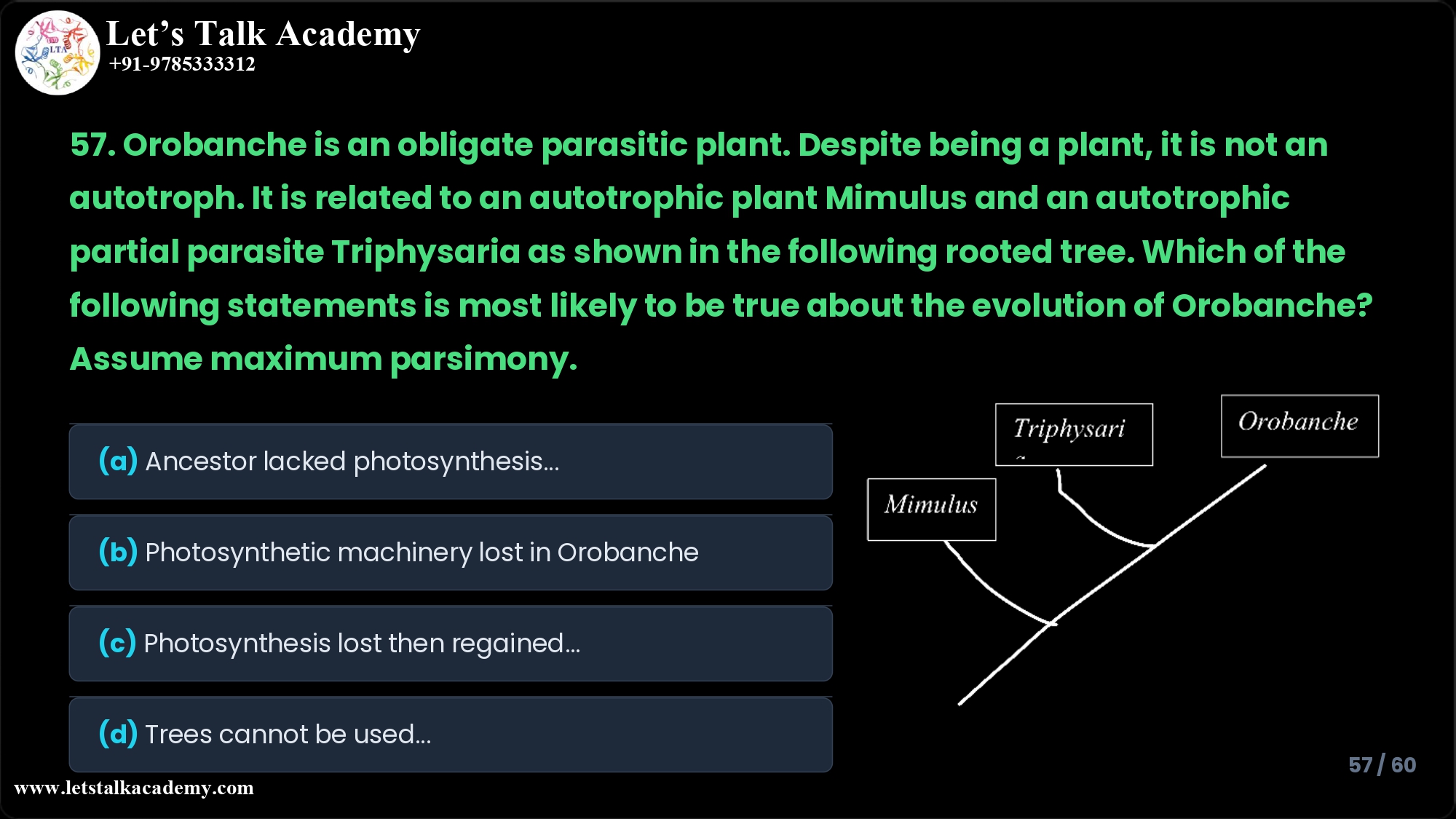
57. Orobanche is an obligate parasitic plant. Despite being a plant, it is not an autotroph.
It is related to an autotrophic plant Mimulus and an autotrophic partial parasite
Triphysaria as shown in the following rooted tree. Which of the following statements is
most likely to be true about the evolution of Orobanche? Assume maximum parsimony.
(a) The ancestor lacked photosynthetic apparatus, which was gained independently
and exclusively in the Mimulus and Triphysaria lineages
(b) Photosynthetic machinery was present in all the ancestral nodes, but lost
specifically in the terminal branch leading to Orobanche
(c) Photosynthesis was lost following the branching of Mimulus, but regained in the
terminal branch to Triphysaria.
(d) Rooted trees cannot be used to make predictions about ancestral states under
the maximum parsimony assumption.
Quick Answer
The correct answer is (b): “Photosynthetic machinery lost in Orobanche”
This option best represents the maximum parsimony principle when analyzing the phylogenetic tree showing Mimulus (autotrophic), Triphysaria (hemiparasitic with photosynthesis), and Orobanche (holoparasite without photosynthesis).
Detailed Analysis of Each Option
Option (a): “Ancestor lacked photosynthesis” ❌ INCORRECT
This violates maximum parsimony because Mimulus is clearly photosynthetic. If the ancestor lacked photosynthesis, Mimulus would have needed to RE-EVOLVE photosynthesis independently—requiring far more evolutionary steps than a single loss event. This is far more complex than necessary.
Option (b): “Photosynthetic machinery lost in Orobanche” ✓ CORRECT
This is the most parsimonious explanation. The evolutionary pathway is:
-
Ancestral state: Photosynthetic (as evidenced by Mimulus being autotrophic)
-
Intermediate state: Triphysaria retained photosynthesis while becoming parasitic
-
Derived state: Orobanche lost photosynthesis when becoming obligate holoparasite
This requires only ONE evolutionary change (loss in Orobanche lineage), satisfying maximum parsimony.
Option (c): “Photosynthesis lost then regained” ❌ INCORRECT
This would require THREE evolutionary steps: loss → regain → loss again. Maximum parsimony explicitly rejects such unnecessarily complex scenarios. Additionally, molecular evidence shows no capacity for genes to be re-evolved after complete deletion—only unidirectional loss occurs.
Option (d): “Trees cannot be used” ❌ INCORRECT
Rooted phylogenetic trees are the FUNDAMENTAL tool for maximum parsimony analysis and ancestral state reconstruction. This statement is categorically false and contradicts the entire premise of the question.
Maximum Parsimony Principle Applied
Maximum parsimony states that the simplest evolutionary explanation requiring the fewest changes is most likely true. With this rooted tree:
-
Mimulus sits as the outgroup (most basal), showing photosynthesis is ancestral
-
Triphysaria and Orobanche share a common ancestor (sister groups)
-
Since Triphysaria retained photosynthesis but Orobanche lost it, only Orobanche evolved the derived state
-
Result: Minimum evolutionary steps = ONE loss event in Orobanche only
Scientific Evidence
Molecular Genomic Data
Research shows progressive plastome (chloroplast genome) degradation:
-
Facultative hemiparasites (Triphysaria): ~200 kb intact plastome
-
Obligate hemiparasites: 150-160 kb with minor NDH gene loss
-
Obligate holoparasites (Orobanche): 40-70 kb with complete loss of photosynthetic genes
This stepwise degradation pattern indicates loss, not initial absence or regain.
Gene Loss Sequence
The ordered loss of photosynthetic genes demonstrates progressive relaxation of selection:
-
NDH genes pseudogenized first
-
Photosystem genes degraded
-
ATP synthase lost completely
-
Most translation genes retained (basic machinery)
Pseudogenes (broken remnants of genes) are frequently found, proving genes were once present and subsequently degraded—not newly lost.
Evolutionary Timeline
-
Parasitism evolution in Orobanchaceae: ~24 million years ago
-
Transition to obligate holoparasitism: ~15-20 million years ago
-
Complete photosynthesis loss: Progressive during obligate parasite evolution
Complete Article
-
Complete option-by-option analysis with molecular evidence
-
Scientific explanation of maximum parsimony reasoning
-
Evolutionary timeline and mechanisms


