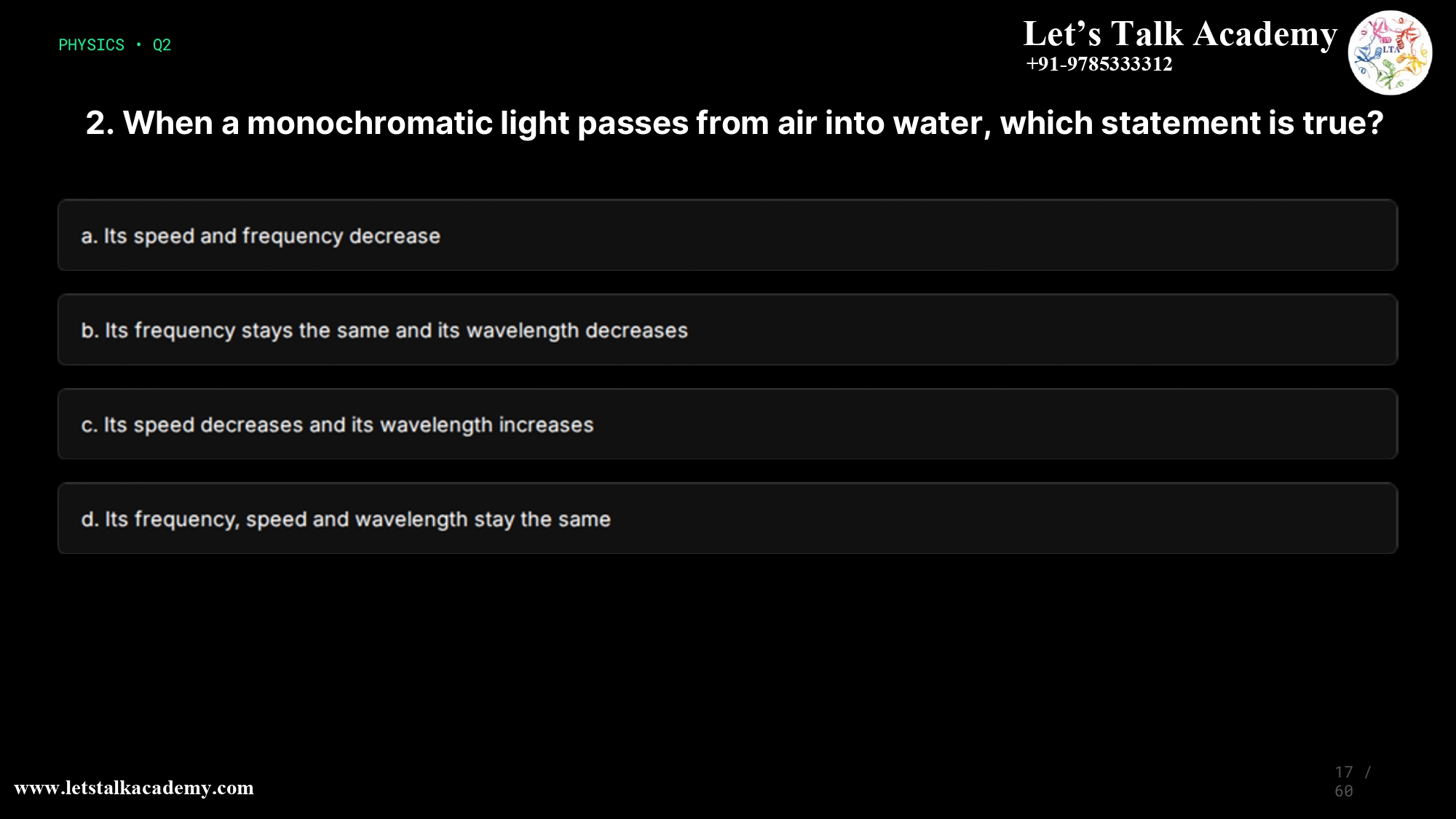
17. When a monochromatic light passes from air into water, which statement is true?
a.Its speed and frequency decrease
b.Its frequency stays the same and its wavelength decreases
c.Its speed decreases and its wavelength increases
d.Its frequency, speed and wavelength stay the same
When monochromatic light passes from air into water, its frequency remains unchanged while speed and wavelength both decrease due to the higher refractive index of water (approximately 1.33). The correct statement is: Its frequency stays the same and its wavelength decreases.
Option Analysis
-
a. Its speed and frequency decrease: Incorrect, as frequency depends on the light source and does not change across media boundaries.
-
b. Its frequency stays the same and its wavelength decreases: Correct. Speed v=cμ drops (where μ>1 for water), and since v=fλ with constant f, λ decreases.
-
c. Its speed decreases and its wavelength increases: Incorrect, as wavelength cannot increase when speed decreases under constant frequency.
-
d. Its frequency, speed and wavelength stay the same: Incorrect, as refraction alters speed and wavelength in denser media.
Key Physics Principles
Frequency f is invariant during refraction because wave crests maintain their oscillation rate. Speed reduces from c=3×10⁸ m/s in air to about 2.26×10⁸ m/s in water. Wavelength in water, for example 589 nm in air, shortens to roughly 444 nm. This follows Snell’s law and the wave relation v=fλ.


