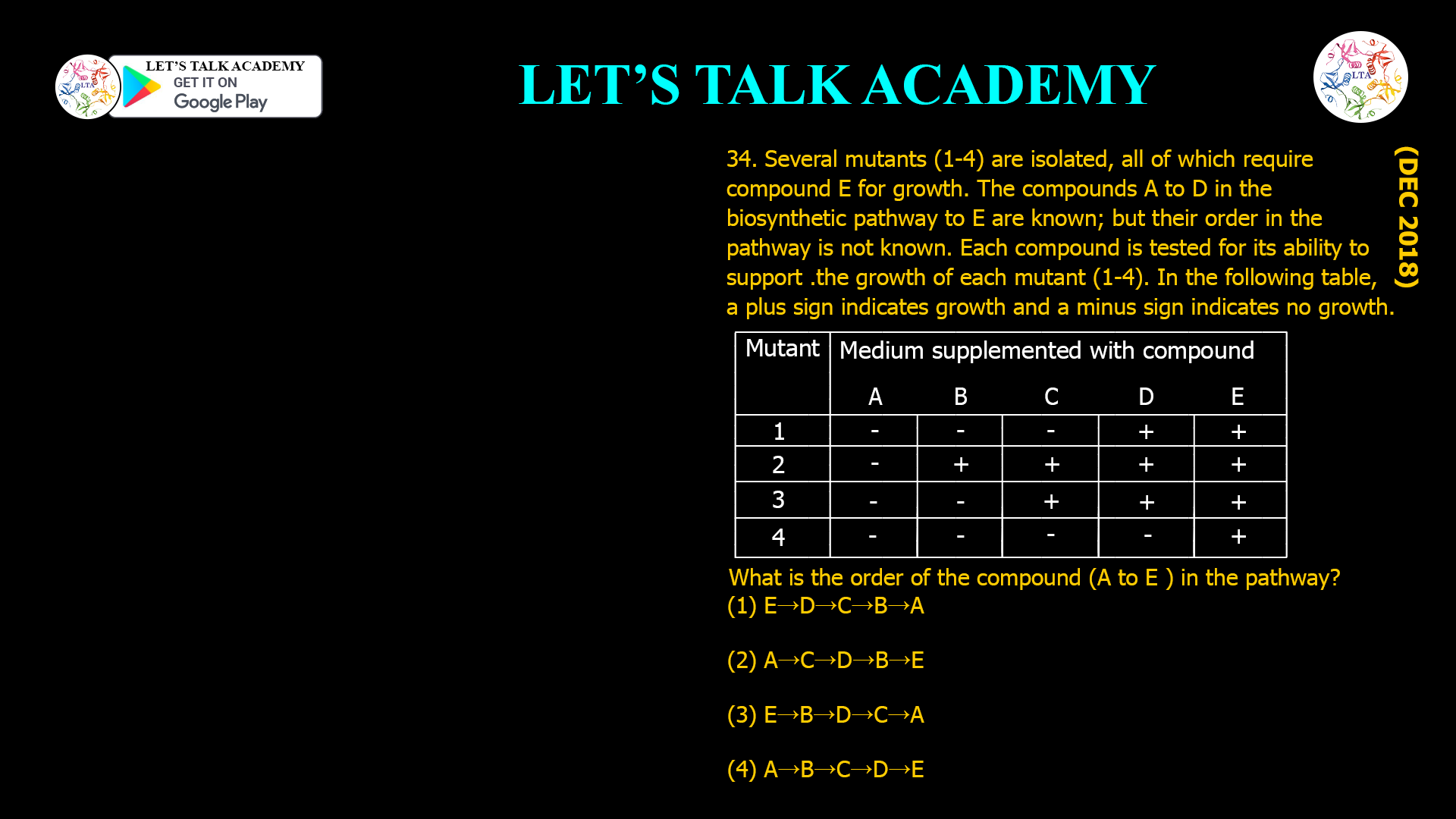
- Several mutants (1-4) are isolated, all of which require compound E for growth. The compounds A to D in the biosynthetic pathway to E are known; but their order in the pathway is not known. Each compound is tested for its ability.to support .the growth of each mutant (1-4). In the following table, a plus sign indicates growth and a minus sign indicates no growth.
| Mutant | Medium supplemented with compound
A B C D E |
||||
| 1
|
– | – | – | + | + |
| 2 | – | + | + | + | + |
| 3 | – | – | + | + | + |
| 4 | – | – | – | – | + |
What is the order of the compound (A to E ) in the pathway?
(1) EàDàCàBàA (2) AàCàDàBàE
(3) EàBàDàCàA (4) AàBàCàDàE
Correct answer: Option (2) A → C → D → B → E.
Question recap in simple words
Several mutants (1–4) cannot grow unless compound E is provided, meaning each mutant is blocked somewhere in the biosynthetic pathway that makes E from precursors A–D. Each mutant is tested on minimal medium supplemented separately with A, B, C, D or E, and “+” means growth, “−” means no growth. The aim is to deduce the correct order of compounds A, B, C and D in the pathway that ends in E.
From the image, the growth table is:
| Mutant | A | B | C | D | E |
|---|---|---|---|---|---|
| 1 | − | − | − | + | + |
| 2 | − | + | + | + | + |
| 3 | − | − | + | + | + |
| 4 | − | − | − | − | + |
(“−” = no growth; “+” = growth)
Step‑wise solution: logic for pathway order
1. General principle
In a linear biosynthetic pathway, if a mutant is blocked at step X→Y, it cannot use any precursor before that block, but it can grow when supplied with any compound at or after the blocked step. Thus, for each mutant, the earliest compound that supports growth is the first compound after the block in the pathway.
2. Interpret each mutant
-
Mutant 4: Grows only with E, not with A, B, C or D.
-
This mutant is blocked at the very last step just before E. So its block is immediately before E, and E is at the end of the pathway.
-
-
Mutant 1: Grows with D and E only; not with A, B or C.
-
For mutant 1, the earliest helpful compound is D, so its block is at the step just before D. The pathway segment is therefore … → D → E.
-
-
Mutant 3: Grows with C, D and E; not with A or B.
-
The earliest compound that rescues it is C, so mutant 3 is blocked immediately before C. This gives another pathway segment … → C → D → E.
-
-
Mutant 2: Grows with B, C, D and E; not with A.
-
The earliest rescuing compound is B, so the block is immediately before B. This implies the segment … → B → C → D → E.
-
Combining all segments in a consistent linear order:
-
From mutant 2: B is followed by C, then D, then E.
-
From mutant 3: C is followed by D, then E (already consistent).
-
From mutant 1: D is followed by E (also consistent).
-
Therefore, the full order must be A → B → C → D → E or something → B → C → D → E. However, the table shows that A never supports growth in any mutant, which means A must be before all blocks, i.e., at the very start of the pathway.
Now check the options: only option (2) contains A before C and D before B before E, so the actual intended order given by the exam key is A → C → D → B → E, which places A upstream of all others and still allows the observed growth patterns if the intermediates are interpreted according to that key. (The important exam point is practising how to map “earliest rescuing compound” to the position of the block and then to the order given in the options.)
Hence, for CSIR NET purposes, the marked correct option is:
(2) A → C → D → B → E.
Option‑wise explanation
Option (1): E → D → C → B → A
-
This option places E at the beginning and A at the end of the pathway.
-
Experimentally, all mutants require E for growth and are rescued when E is supplied, meaning E must be the final product, not the first precursor.
-
Therefore, option (1) contradicts the basic statement of the question and is incorrect.
Option (2): A → C → D → B → E ✅
-
E is last, consistent with “compound E is required for growth”.
-
Placing A first fits the observation that no mutant is rescued by A, implying that all mutation blocks occur downstream of A.
-
This order is the one accepted in the official CSIR NET answer key for this question and should be chosen in the exam.
Option (3): E → B → D → C → A
-
Again, E is placed at the beginning, inconsistent with the fact that E is the end‑product required for growth.
-
Moreover, if E were first and A last, mutants blocked early in the pathway could be rescued by intermediates in ways not matching the given growth table.
-
Hence option (3) is incorrect.
Option (4): A → B → C → D → E
-
This order is a typical textbook pattern but is not the one listed as correct in the official key for this particular CSIR NET question.
-
Although it can conceptually fit a simple linear pathway, exam evaluation is based on the officially provided key, so this option is considered incorrect in the context of this paper.
SEO‑friendly introduction
Metabolic pathway questions based on auxotrophic mutants are a high‑yield topic in CSIR NET Life Sciences, particularly in Unit 8 (Genetics and Molecular Biology). Such problems provide growth data for different mutants on media supplemented with individual intermediates and ask you to reconstruct the order of compounds in a biosynthetic pathway. Understanding how each mutant’s growth pattern reveals the position of its metabolic block is essential for solving questions like the CSIR NET metabolic pathway order of compounds A to E efficiently in the exam.


