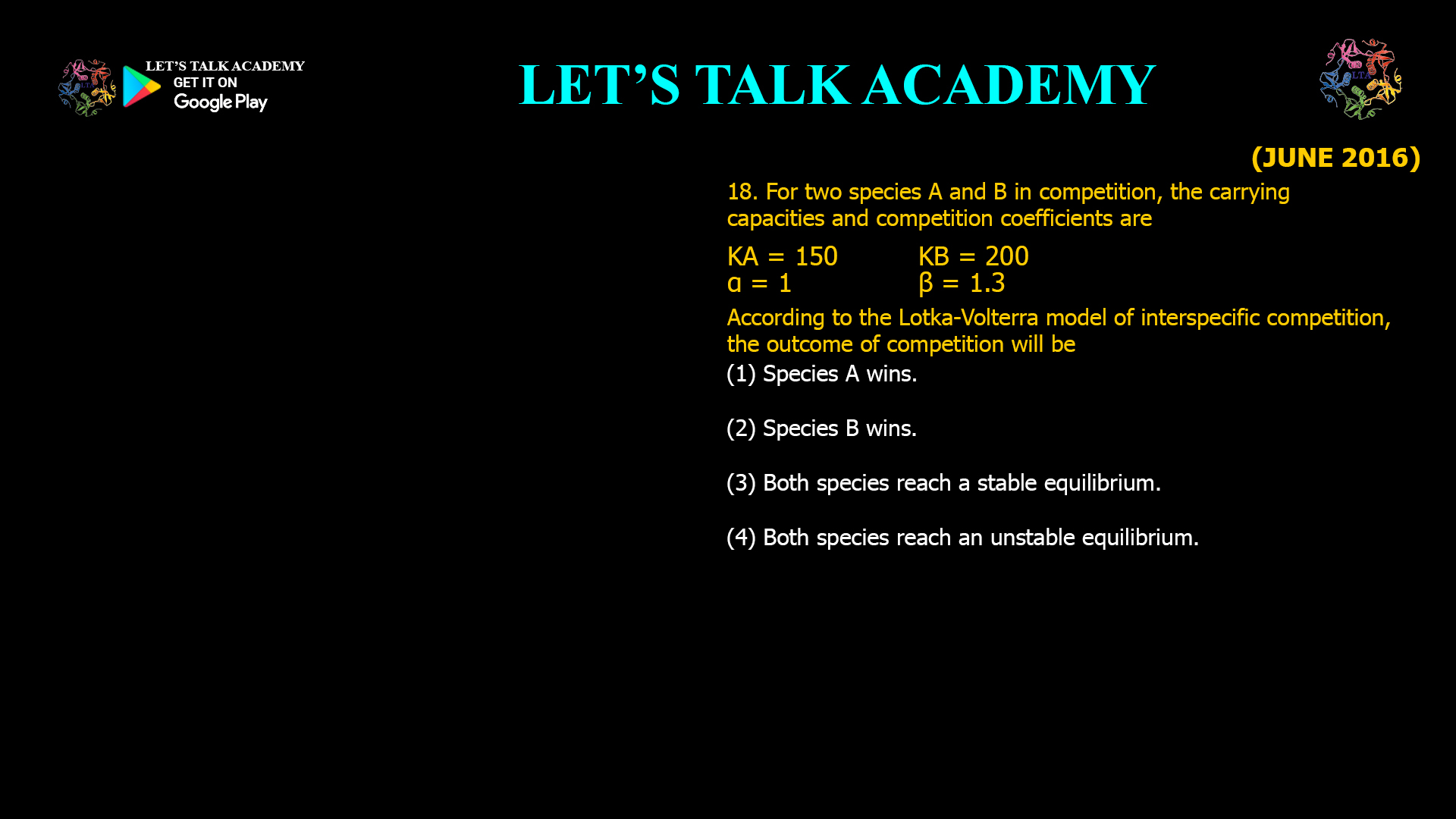
- For two species A and B in competition, the carrying capacities and competition coefficients are
KA = 150 KB = 200
α = 1 β = 1.3
According to the Lotka-Volterra model of interspecific competition, the outcome of competition will be
(1) Species A wins.
(2) Species B wins.
(3) Both species reach a stable equilibrium.
(4) Both species reach an unstable equilibrium.The Lotka-Volterra model is a classic ecological framework used to predict the outcome of competition between two species. By analyzing the carrying capacities and competition coefficients, ecologists can determine whether one species will outcompete the other, both will coexist, or the system will reach an unstable equilibrium.
Understanding the Parameters
For two competing species, A and B:
-
K<sub>A</sub> = 150 (carrying capacity of A)
-
K<sub>B</sub> = 200 (carrying capacity of B)
-
α = 1 (effect of B on A)
-
β = 1.3 (effect of A on B)
The Lotka-Volterra competition equations are:
dNAdt=rANA(1−NA+αNBKA)dNBdt=rBNB(1−NB+βNAKB)
Determining the Outcome
The outcome depends on the position of each species’ zero-growth isoclines (boundaries where population growth is zero). The key conditions are:
-
Species A wins if its isocline lies outside that of B:
-
KA>KBβ
-
KB<KAα
-
-
Species B wins if its isocline lies outside that of A:
-
KB>KAα
-
KA<KBβ
-
-
Stable coexistence if each species limits its own growth more than it limits the other:
-
KA/α>KB and KB/β>KA
-
-
Unstable equilibrium if the isoclines cross, but each species limits the other more than itself.
Calculating for the Given Values
-
KA=150
-
KB=200
-
α=1
-
β=1.3
Calculate the critical values:
-
KB/β=200/1.3≈153.85
-
KA/α=150/1=150
Now check the conditions for each outcome:
1. Does A win?
-
KA>KB/β → 150>153.85 → False
-
KB<KA/α → 200<150 → False
2. Does B win?
-
KB>KA/α → 200>150 → True
-
KA<KB/β → 150<153.85 → True
Both conditions for B winning are satisfied.
3. Stable coexistence?
-
KA/α>KB → 150>200 → False
-
KB/β>KA → 153.85>150 → True
-
Both must be true for stable coexistence, so this is not the case.
4. Unstable equilibrium?
-
This would require the isoclines to cross, but not support stable coexistence. Here, both conditions for B winning are met, so B will exclude A.
Conclusion
According to the Lotka-Volterra model and the given parameters, species B will outcompete and exclude species A.
Correct answer:
(2) Species B wins. -


2 Comments
Kajal
November 9, 2025Option 2
Sakshi Kanwar
November 27, 2025Species B will win on comparing the parameters