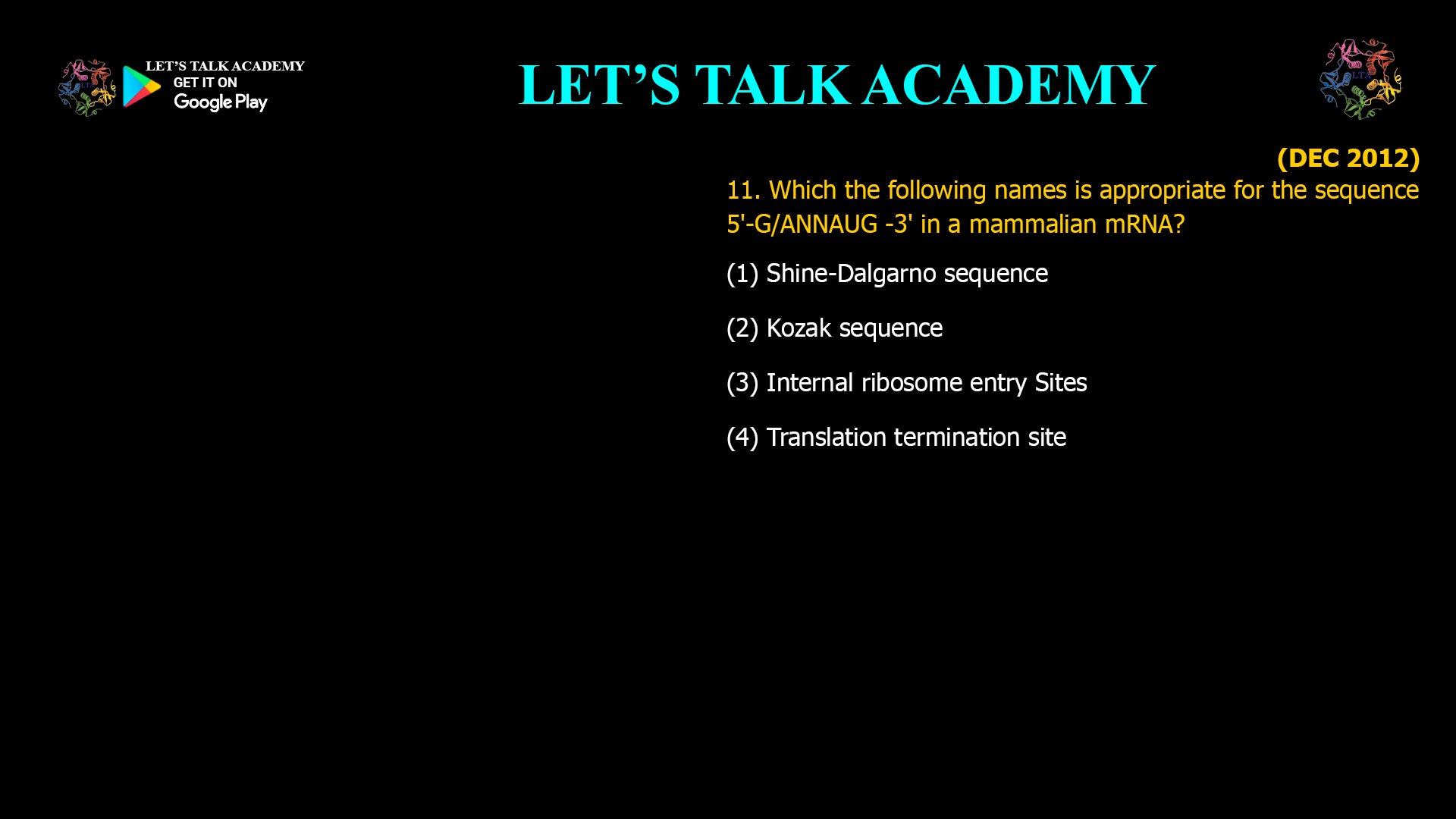
- Which the following names is appropriate for the sequence
5′-G/ANNAUG -3′ in a mammalian mRNA?
(1) Shine-Dalgarno sequence
(2) Kozak sequence
(3) Internal ribosome entry Sites
(4) Translation termination site
Introduction
The process of protein synthesis in eukaryotes is tightly regulated, and the correct identification of the translation start site on messenger RNA (mRNA) is crucial. In mammalian cells, a specific nucleotide sequence surrounding the start codon (AUG) plays a central role in this process. This article explores the appropriate name for the sequence 5′-G/ANNAUG-3′ in mammalian mRNA by clarifying the roles of the Shine-Dalgarno sequence, Kozak sequence, internal ribosome entry sites (IRES), and translation termination sites.
Understanding the Sequence Context
The sequence given, 5′-G/ANNAUG-3′, is a simplified representation of the region around the start codon (AUG) in eukaryotic mRNA. Here, “N” represents any nucleotide, and the slash (/) may indicate a separation or an arbitrary break for illustrative purposes. The core feature is the presence of the AUG codon, which is universally recognized as the translation start site in eukaryotes.
The Kozak Sequence: Definition and Function
What Is the Kozak Sequence?
The Kozak sequence is a conserved nucleotide motif found in eukaryotic mRNA, specifically surrounding the translation start codon (AUG). It was named after Marilyn Kozak, who discovered its importance in translation initiation. The consensus sequence in mammals is typically represented as 5′-(gcc)gccRccAUGG-3′, where “R” is a purine (adenine or guanine), and the underlined AUG is the start codon.
Role in Translation Initiation
The Kozak sequence serves several critical functions:
-
Guides the Ribosome: It helps the small ribosomal subunit (40S in eukaryotes) to recognize and bind to the correct start codon on the mRNA.
-
Ensures Accurate Initiation: By providing a favorable context for the AUG codon, it prevents the ribosome from initiating translation at incorrect or internal AUG codons.
-
Regulates Protein Expression: The strength of the Kozak sequence (i.e., how closely it matches the consensus) influences the efficiency of translation initiation and, consequently, the amount of protein produced.
Sequence Features
-
Conserved Bases: The most important positions are the -3 (preferably A or G) and +4 (G) nucleotides relative to the AUG start codon.
-
Variable Bases: Other positions can vary, but the overall context is crucial for optimal initiation.
-
Start Codon: The AUG within the Kozak sequence is where translation begins, with methionine as the first amino acid.
Comparison with Other Sequences
Shine-Dalgarno Sequence
-
Organism: Prokaryotes (bacteria and archaea)
-
Location: Upstream of the start codon (not overlapping)
-
Function: Serves as a ribosomal binding site by base-pairing with the 16S rRNA in the small ribosomal subunit.
-
Consensus: 5′-AGGAGGU-3′, located about 8 bases upstream of the start codon.
-
Not Found in Eukaryotes: The Shine-Dalgarno sequence is absent in mammalian and other eukaryotic mRNAs.
Internal Ribosome Entry Sites (IRES)
-
Function: Allows cap-independent translation initiation in some viral and cellular mRNAs.
-
Location: Can be located internally within the mRNA, not necessarily near the start codon.
-
Usage: Not the standard mechanism for translation initiation in mammalian mRNAs; typically used under specific conditions or by certain viruses.
Translation Termination Site
-
Function: Marks the end of the coding region and signals the ribosome to release the completed polypeptide.
-
Sequence: Typically a stop codon (UAA, UAG, or UGA).
-
Not Related to Start: The translation termination site is unrelated to the initiation context and is not involved in the start of protein synthesis.
Why Is the Kozak Sequence the Correct Answer?
Given the sequence 5′-G/ANNAUG-3′ in mammalian mRNA, the most appropriate name is the Kozak sequence. Here’s why:
-
Eukaryotic Context: The Kozak sequence is specific to eukaryotes, including mammals.
-
Start Codon Proximity: The Kozak sequence surrounds the AUG start codon, providing the necessary context for efficient initiation.
-
Function: It is directly involved in guiding the ribosome to the correct start site, ensuring accurate and efficient translation.
In contrast:
-
Shine-Dalgarno sequence is prokaryotic and not found in mammalian mRNA.
-
Internal ribosome entry sites are specialized and not the standard mechanism for initiation in mammalian mRNAs.
-
Translation termination site is unrelated to the start of translation.
The Kozak Sequence in Detail
Consensus and Variability
The mammalian Kozak consensus sequence is 5′-(gcc)gccRccAUGG-3′. The critical positions are:
-
-3: A purine (A or G), most commonly A.
-
+4: G (immediately following the AUG codon).
These positions are most important for determining the “strength” of the Kozak sequence and, therefore, the efficiency of translation initiation.
Biological Significance
-
Accuracy: The Kozak sequence ensures that translation begins at the correct AUG codon, preventing errors that could lead to nonfunctional proteins.
-
Regulation: Variations in the Kozak sequence can modulate the level of protein expression, making it a target for genetic engineering and synthetic biology.
-
Evolutionary Conservation: The Kozak sequence is highly conserved across eukaryotes, underscoring its fundamental role in gene expression.
Common Misconceptions
-
Kozak Sequence vs. Shine-Dalgarno Sequence:
-
Fact: The Kozak sequence is eukaryotic; the Shine-Dalgarno sequence is prokaryotic.
-
-
Kozak Sequence as a Ribosomal Binding Site:
-
Fact: The Kozak sequence is not a ribosomal binding site in the prokaryotic sense but provides the context for start codon recognition.
-
-
IRES as the Standard Initiation Mechanism:
-
Fact: IRES elements are exceptions, not the rule, in mammalian translation initiation.
-
Summary Table
Sequence Name Organism Location Relative to Start Codon Function Kozak sequence Eukaryotes Surrounds AUG Guides ribosome to start codon Shine-Dalgarno sequence Prokaryotes Upstream of AUG Ribosomal binding site Internal ribosome entry site Some viruses/eukaryotes Internal in mRNA Cap-independent initiation Translation termination site All Downstream of coding region Signals end of translation
Conclusion
The sequence 5′-G/ANNAUG-3′ in mammalian mRNA is appropriately called the Kozak sequence. This conserved motif is essential for the accurate and efficient initiation of protein synthesis in eukaryotes, guiding the ribosome to the correct start codon and ensuring the production of functional proteins. The Kozak sequence is distinct from the Shine-Dalgarno sequence (prokaryotic), internal ribosome entry sites (specialized), and translation termination sites (end of coding region).
Correct answer:
(2) Kozak sequence -


7 Comments
Suman bhakar
June 12, 2025Super duper explanation Sir 👍
Arushi
June 12, 2025Nice and easy explanation sir
Kirti Agarwal
November 2, 2025Kozak sequence
Deepika Sheoran
November 4, 2025Kozak sequence is eukaryotic
Heena Mahlawat
November 6, 2025Kozak sequence
Santosh Saini
November 8, 2025Kozak seq.
MOHIT AKHAND
November 14, 2025Done sir ✅