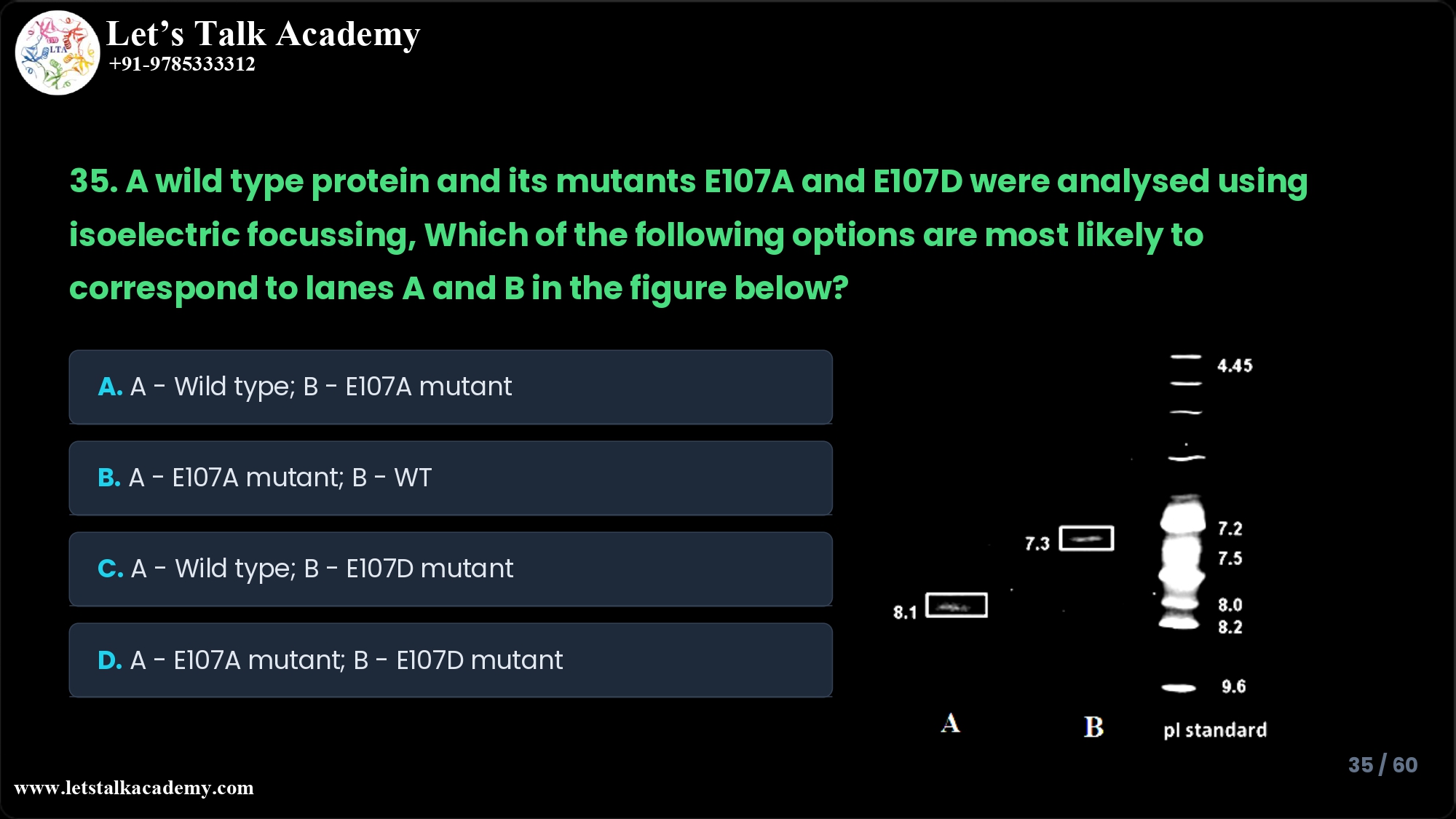
35. A wild type protein and its mutants E107A and E107D were analysed using
isoelectric focussing, Which of the following options are most likely to correspond to
lanes A and B in the figure below?
A. A – Wild type; B – E107A mutant
B. A – E107A mutant; B – WT
C. A – wild type; B – E107D mutant
D. A – E107A mutant; B – E107D mutant
The band at lane A corresponds to the E107D mutant, and the band at lane B corresponds to the wild‑type protein.
Both are more acidic than the E107A mutant, whose pI would lie still higher and is not shown among lanes A and B.
Correct answer and logic
In isoelectric focusing, proteins stop migrating at the pH that equals their isoelectric point (pI); a higher pI means the protein is more basic, and a lower pI means it is more acidic.
From the pI scale on the right, lane A focuses around pH 8.1 while lane B focuses near pH 7.3, so A has the higher pI and is therefore less acidic (more basic) than B.
Glutamate (E) and aspartate (D) carry a negative charge at neutral pH, whereas alanine (A) is neutral; replacing E with A removes a negative charge and makes the protein more basic (raises pI), while replacing E with D keeps the negative charge and leaves the pI similar or slightly changed.
Thus the E107A mutant is expected to have the highest pI (most basic), the wild type an intermediate pI, and the E107D mutant the lowest pI (most acidic); therefore the band with lowest pI (B, ~7.3) must be E107D and the more basic band (A, ~8.1) must be wild type, making option C correct.
Option‑wise analysis
-
Option A: A – Wild type; B – E107A mutant
This would require the E107A mutant to have a lower pI than the wild type, but removing a negatively charged glutamate and replacing it with neutral alanine makes the protein more basic and should increase, not decrease, its pI.
Since lane B has a lower pI than lane A, B cannot be E107A, so this option is incorrect. -
Option B: A – E107A mutant; B – Wild type
E107A indeed should be the most basic, with the highest pI, so if lanes showed three bands, the highest‑pI band would be E107A; however, here only two bands are labeled A and B, and their pIs (8.1 and 7.3) are too close together to reflect the large basic shift expected from E→A.
Moreover, one lane must be E107D, and this option does not assign E107D at all, so it cannot be correct. -
Option C: A – Wild type; B – E107D mutant (Correct)
Wild type retains the original glutamate and therefore has more negative charge than E107A but not more than E107D; it is reasonable for its pI to be moderately high, as seen for band A (~8.1).
The E107D mutant conserves a negatively charged side chain (aspartate) and is predicted to be the most acidic form with the lowest pI, consistent with band B (~7.3), so this assignment fits the chemistry and the gel, making option C correct. -
Option D: A – E107A mutant; B – E107D mutant
This implies that wild type is absent from the labeled lanes and that E107A has a slightly higher pI than E107D, but leaves the expected intermediate wild‑type band unexplained.
Since the pattern clearly shows two closely spaced bands bracketing an intermediate pI consistent with wild type, and E107A should be much more basic (highest pI), this option does not match the expected ordering and is therefore wrong.
Introduction (SEO‑optimized)
Isoelectric focusing questions on wild type proteins and their point mutants such as E107A and E107D are common in CSIR NET life science and other competitive exams.
These problems test the ability to relate amino acid charge changes to shifts in isoelectric point (pI) and to interpret band positions on a pH gradient gel, allowing precise identification of which lane corresponds to each protein variant.


