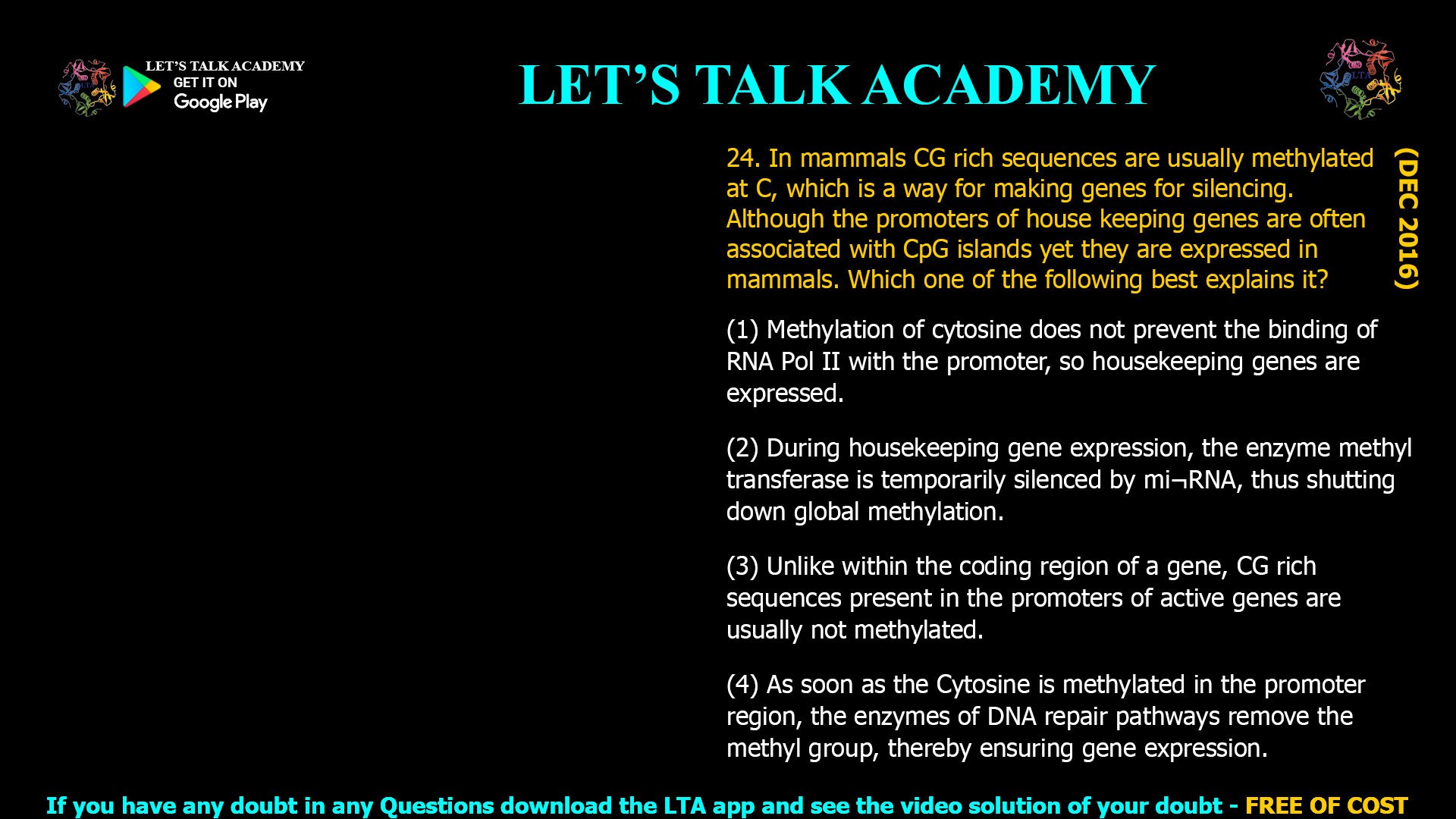
24. In mammals CG rich sequences are usually methylated at C, which is a way for making genes for silencing. Although the promoters of housekeeping genes are often associated with CpG islands yet they are expressed in mammals. Which one of the following best explains it?
(1) Methylation of cytosine does not prevent the binding of RNA Pol II with the promoter, so housekeeping genes are expressed.
(2) During housekeeping gene expression, the enzyme methyl transferase is temporarily silenced by miRNA, thus shutting down global methylation.
(3) Unlike within the coding region of a gene, CG rich sequences present in the promoters of active genes are usually not methylated.
(4) As soon as the Cytosine is methylated in the promoter region, the enzymes of DNA repair pathways remove the methyl group, thereby ensuring gene expression.
Why Housekeeping Gene Promoters with CpG Islands Remain Expressed Despite CpG Methylation in Mammals
Correct Answer:
(3) Unlike within the coding region of a gene, CG rich sequences present in the promoters of active genes are usually not methylated.
Detailed Explanation:
In mammals, DNA methylation predominantly occurs at cytosines in CpG dinucleotides and is generally associated with gene silencing. However, promoters of housekeeping genes, which are essential for basic cellular functions and are constitutively expressed, often contain CpG islands (CGIs)—regions rich in CpG sites.
-
CpG islands in promoters of housekeeping genes are usually unmethylated, which allows these genes to remain transcriptionally active despite the general tendency for CpG methylation to silence genes. This unmethylated state maintains an open chromatin structure, facilitating binding of transcription factors and RNA polymerase II, thus enabling continuous gene expression.
-
In contrast, CpG sites within gene bodies or in other genomic regions tend to be methylated, contributing to repression or regulation of gene expression.
-
The protection of CpG islands from methylation is a key epigenetic mechanism that distinguishes active housekeeping gene promoters from silenced regions.
-
This selective unmethylation explains why housekeeping genes are expressed even though their promoters are CpG rich.
Why Other Options Are Incorrect:
-
Methylation of cytosine does not prevent RNA Pol II binding
This is incorrect. Methylation of CpG sites in promoters generally inhibits transcription factor and RNA polymerase binding, leading to gene silencing. -
Temporary silencing of methyltransferase by miRNA during housekeeping gene expression
There is no evidence that global methyltransferase activity is shut down by miRNAs specifically during housekeeping gene expression. Methylation patterns are tightly regulated but not by global temporary silencing of methyltransferases. -
DNA repair enzymes remove methyl groups as soon as cytosine is methylated
DNA repair pathways do not generally remove methyl groups from cytosines in CpG islands to maintain expression. Demethylation occurs by active enzymatic processes (e.g., TET enzymes) but not by canonical DNA repair removing methylation immediately after it happens.
Summary Table
| Option | Description | Correct/Incorrect | Explanation |
|---|---|---|---|
| (1) | Methylation does not prevent RNA Pol II binding | Incorrect | Methylation typically blocks transcription factor and RNA Pol II binding, causing silencing. |
| (2) | Methyltransferase temporarily silenced by miRNA during housekeeping gene expression | Incorrect | No evidence for global methyltransferase silencing during housekeeping gene expression. |
| (3) | CpG rich sequences in promoters of active genes are usually unmethylated | Correct | CpG islands in promoters remain unmethylated, allowing active transcription of housekeeping genes. |
| (4) | DNA repair enzymes remove methyl groups immediately after methylation in promoters | Incorrect | Demethylation is regulated enzymatically, not by DNA repair pathways removing methyl groups immediately. |
Conclusion
Housekeeping gene promoters contain CpG islands that are typically unmethylated, which protects these genes from silencing and allows their consistent expression in mammals. This selective unmethylation is the key epigenetic mechanism explaining why CpG-rich housekeeping gene promoters remain active despite the general association of CpG methylation with gene repression.


3 Comments
Suman bhakar
June 2, 2025✅👍👍
Sakshi Kanwar
November 7, 2025CG rich sequences present in the promoters of active genes are usually not methylated.
Muskan Yadav
November 7, 2025Unlike within the coding region of a gene, CG rich sequences present in the promoters of active genes are usually not methylated.