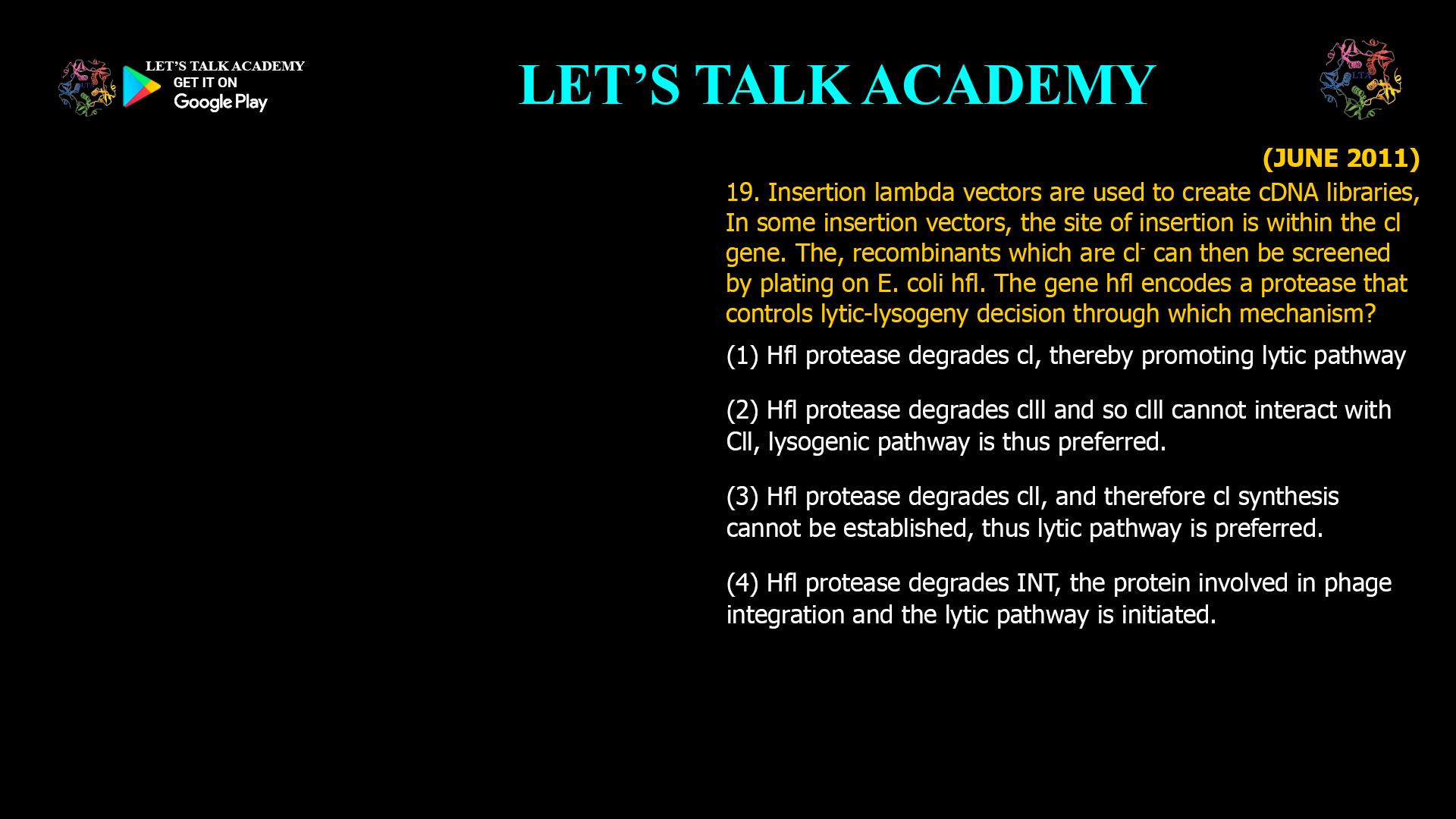
19. Insertion lambda vectors are used to create cDNA libraries, In some insertion vectors, the site of insertion is within the cl gene. The, recombinants which are cl–can then be screened by plating on E. coli hfl. The gene hfl encodes a protease that controls lytic-lysogenydecision through which mechanism?
(1) Hfl protease degrades cl, thereby promoting lytic pathway
(2) Hfl protease degrades clll and so clll cannot interact withCll, lysogenic pathway is thus preferred.
(3) Hfl protease degrades cll, and therefore cl synthesis cannot be established, thus lytic pathway is preferred.
(4) Hfl protease degrades INT, the protein involved in phage integration and the lytic pathway is initiated.
Bacteriophage lambda (λ phage) is a temperate virus that can follow two developmental pathways after infecting Escherichia coli: the lytic cycle, leading to host cell lysis and phage propagation, or the lysogenic cycle, where the phage genome integrates into the host chromosome and remains dormant. The choice between these pathways is tightly regulated by viral and host factors, with the host-encoded Hfl protease playing a pivotal role.
What is the Hfl Protease?
The Hfl protease, also known as FtsH or HflB, is an ATP-dependent membrane-bound protease in E. coli. It is involved in protein quality control and regulatory proteolysis. Importantly, Hfl protease controls the stability of the phage lambda CII protein, a key transcriptional activator that promotes lysogeny.
The Central Role of CII in the Lysis-Lysogeny Decision
-
The CII protein activates several phage promoters, including P_RE, which drives expression of the cI repressor gene essential for lysogeny.
-
CII is an unstable protein with a short half-life, making its intracellular concentration critical in determining whether lysogeny is established.
-
High CII levels favor lysogeny by promoting cI expression; low CII levels favor the lytic cycle.
How Does Hfl Protease Influence This Decision?
-
The Hfl protease degrades the CII protein, reducing its intracellular concentration.
-
When Hfl protease activity is high, CII is rapidly degraded, preventing cI repressor synthesis and pushing the phage toward the lytic pathway.
-
Conversely, when Hfl protease activity is low or inhibited, CII is stabilized, allowing cI expression and favoring lysogeny.
Supporting Evidence from Research
-
Purified Hfl protease cleaves CII into small fragments, demonstrating direct proteolytic activity on CII.
-
Mutations or deletions in the hfl genes stabilize CII and increase lysogeny frequency.
-
The phage-encoded CIII protein acts as an inhibitor of Hfl protease, protecting CII from degradation and promoting lysogeny.
Why Is This Important?
The Hfl protease-mediated degradation of CII provides a molecular mechanism by which the host cell’s physiological state influences the phage developmental decision. For example:
-
Under nutrient-rich conditions, Hfl protease activity is high, favoring lysis and phage propagation.
-
Under stress or nutrient-poor conditions, CII is stabilized, promoting lysogeny and viral dormancy.
Answer to the Query
Among the options provided, the correct mechanism is:
(3) Hfl protease degrades CII, and therefore cI synthesis cannot be established, thus the lytic pathway is preferred.
Summary Table
| Factor | Role in Lambda Phage Development |
|---|---|
| Hfl protease (FtsH) | Degrades CII protein, promoting lytic cycle |
| CII protein | Activates cI expression, promoting lysogeny |
| CIII protein | Inhibits Hfl protease, stabilizing CII |
| cI repressor | Maintains lysogeny by repressing lytic genes |
Conclusion
The Hfl protease of E. coli is a key host factor that governs the lytic-lysogeny decision in bacteriophage lambda by targeting the CII protein for degradation. This proteolytic control ensures that the phage lifecycle responds dynamically to the host’s physiological state, balancing between viral propagation and dormancy.


