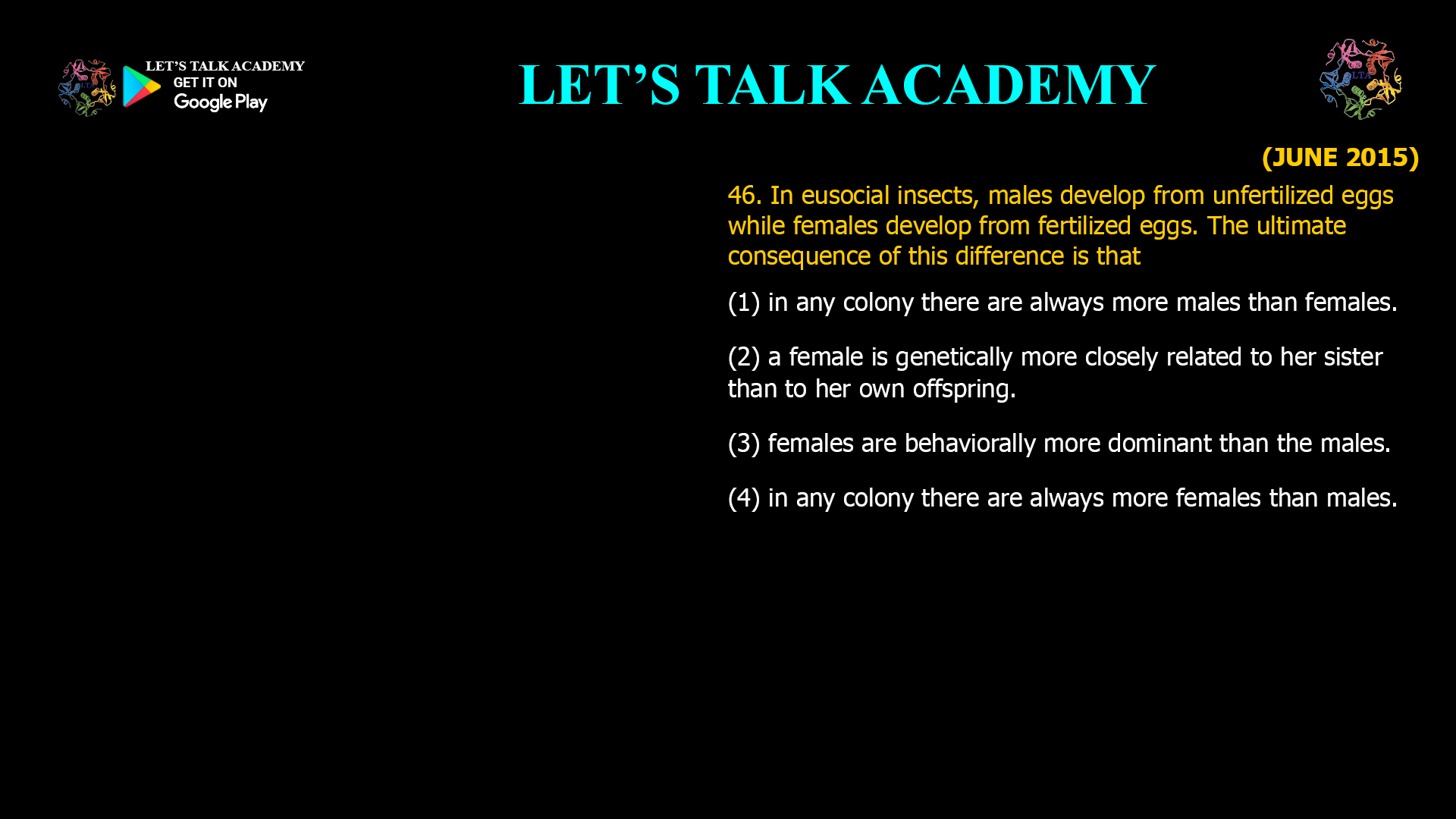
- In eusocial insects, males develop from unfertilized eggs while females develop from fertilized eggs. The ultimate consequence of this difference is that
(1) in any colony there are always more males than females.
(2) a female is genetically more closely related to her sister than to her own offspring.
(3) females are behaviorally more dominant than the males.
(4) in any colony there are always more females than males.The Key Consequence: Sister-Sister Relatedness
The ultimate consequence of haplodiploidy is that female workers are genetically more closely related to their sisters than to their own offspring. Here’s why:
-
In a colony with a single queen who has mated only once, sisters share, on average, 75% (r = 0.75) of their genes with each other, because they all receive identical genes from their haploid father and half their genes from their mother.
-
By contrast, a female is related to her own offspring by only 50% (r = 0.5), which is the typical parent-offspring relatedness in diploid organisms.
This unusually high sister-sister relatedness makes it evolutionarily advantageous for female workers to help raise their sisters (the queen’s offspring) rather than producing their own offspring. This is a key factor in the evolution of eusociality and the selfless behavior seen in worker bees and ants, where individuals forego reproduction to help the colony.
Notable Implications
-
This system does not guarantee more males than females in a colony, nor does it inherently make females behaviorally more dominant, although division of labor is common.
-
The relatedness structure is what drives kin selection and the evolution of worker sterility and cooperation.
Correct answer:
(2) a female is genetically more closely related to her sister than to her own offspring -


1 Comment
Kajal
October 15, 2025Option 2