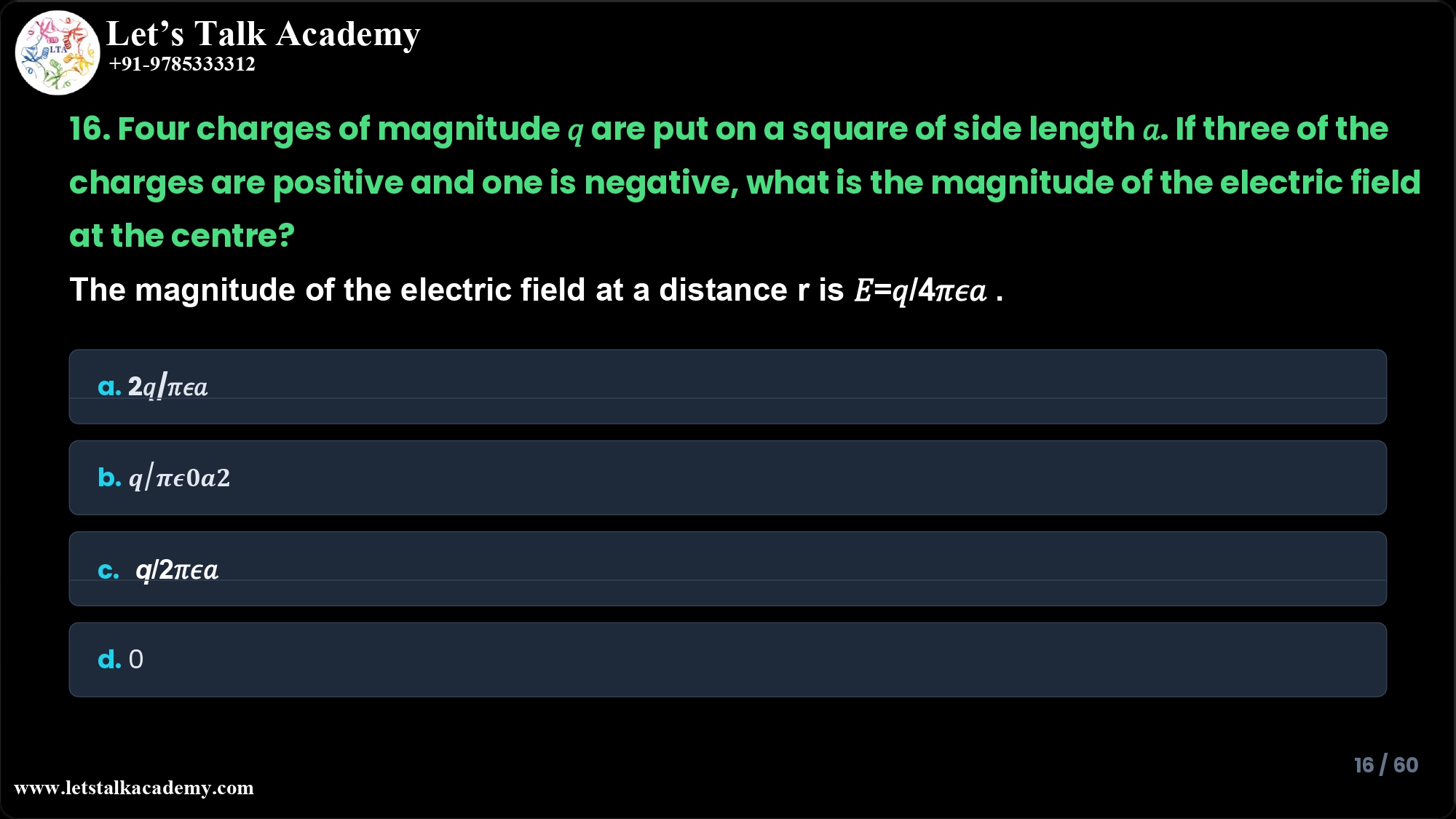
16. Four charges of magnitude 𝑞 are put on a square of side length 𝑎. If three of the
charges are positive and one is negative, what is the magnitude of the electric field at
the centre?
The magnitude of the electric field at a distance r is 𝐸=𝑞/4𝜋𝜖𝑎 .
a. 2𝑞/𝜋𝜖𝑎
b. 𝒒/𝝅𝝐𝟎𝒂𝟐
c. 𝑞/2𝜋𝜖𝑎
d. 0
Introduction
Discover how to find the electric field at the center of a square with four charges of magnitude q — three positive and one negative — on side length a.
This key CSIR NET Life Sciences physics problem uses vector superposition for precise magnitude q / (πϵ₀a²).
Problem Setup
Four charges of magnitude q are placed at the corners of a square with side length a.
Three charges are positive (+q) and one is negative (−q).
The task is to calculate the magnitude of the electric field at the square’s center using the point charge formula:
E = q / (4πϵ₀r²)
The distance from the center to each corner is r = a / √2, so r² = a² / 2.
Thus, the magnitude of the field due to each individual charge is:
E₀ = q / (2πϵ₀a²)
Vector Calculation
Let the corners be: A(0,0) +q, B(a,0) +q, C(a,a) −q, and D(0,a) +q, with the center at (a/2, a/2).
Each field vector has magnitude E₀, and unit vectors from charge positions to the center are scaled by the charge sign
(+q: field points away, −q: field points toward).
The x-components sum to:
E₀ₓ = (E₀ / √2) × (1 − 1 + 1 + 1) = 2E₀
and the y-components similarly sum to 2E₀.
Hence, net field magnitude is:
|E| = √((2E₀)² + (2E₀)²) = 2√2 E₀ = q / (πϵ₀a²).
Option Analysis
- (a) 2q / (πϵ₀a) — Incorrect; unit mismatch (field ∝ 1/a², not 1/a); overestimates by factor 2a.
- (b) q / (πϵ₀a²) — Correct; matches vector sum result (2E₀).
- (c) q / (2πϵ₀a²) — Incorrect; underestimates the net field.
- (d) 0 — Incorrect; symmetry is broken by the one negative charge, so fields add constructively along diagonals.


