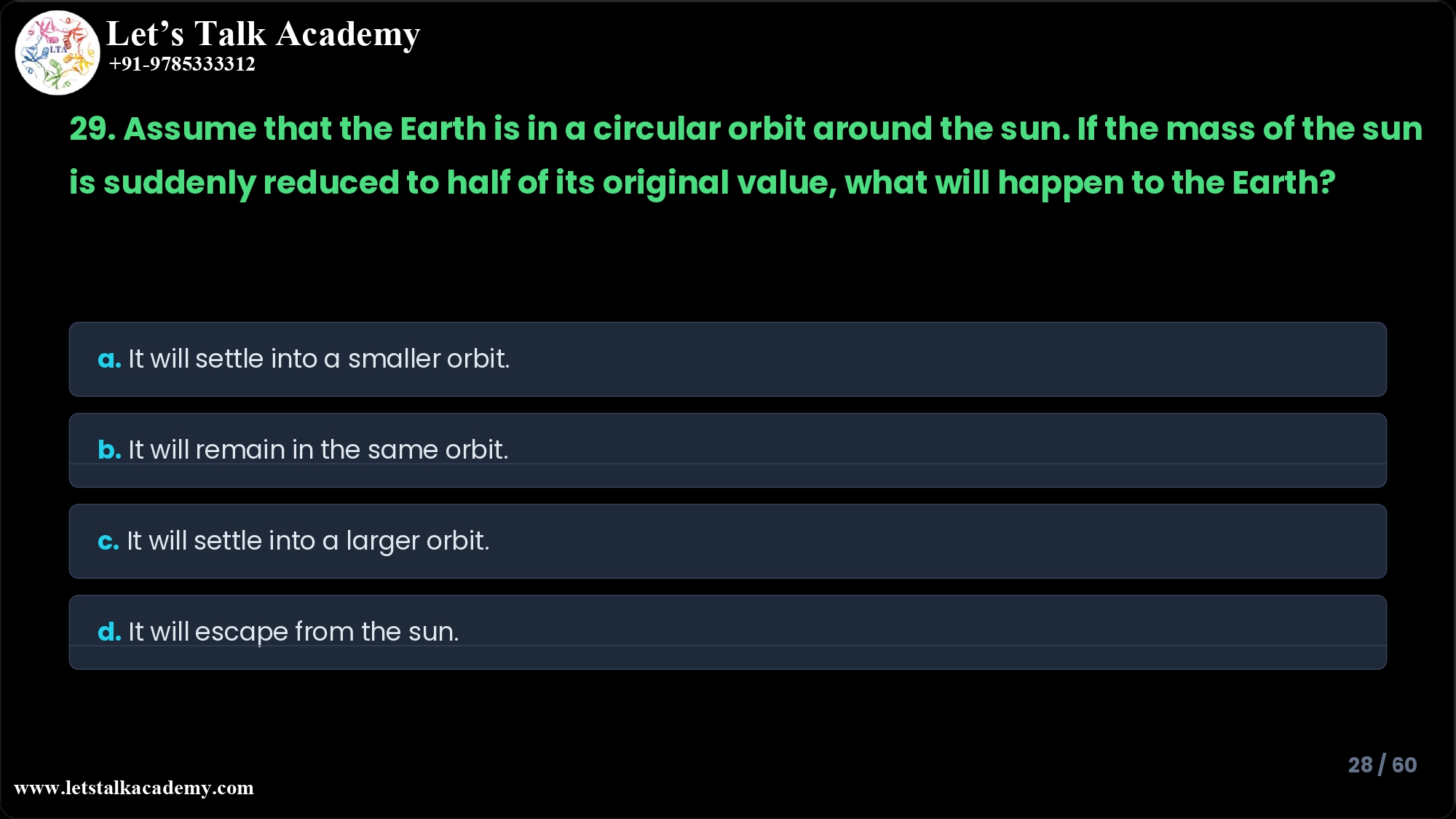
29. Assume that the Earth is in a circular orbit around the sun. If the mass of the sun is
suddenly reduced to half of its original value, what will happen to the Earth?
a. It will settle into a smaller orbit.
b. It will remain in the same orbit.
c. It will settle into a larger orbit.
d. It will escape from the sun.
Effect of Sun’s Mass Reduction on Earth’s Orbit
Initially, Earth remains in a circular orbit around the Sun, maintained by the balance between gravitational force and centripetal force:
de>GMm / r² = mv² / r
This gives the orbital speed:
de>v = √(GM / r)
The total mechanical energy of the bound circular orbit is:
de>E = -GMm / (2r) < 0
After Sun’s Mass Halves
If the Sun’s mass suddenly reduces to M/2, Earth’s instantaneous speed de>v remains unchanged. However, the gravitational potential energy changes, making the new total energy:
de>E′ = (1/2)mv² − G(M/2)m / r
Substituting the original orbital velocity de>v² = GM / r gives:
de>E′ = (1/2)m(GM / r) − G(M/2)m / r = 0
Zero total energy corresponds to a parabolic trajectory—the limiting case between bound (de>E < 0) and unbound (de>E > 0) motion.
Physical Interpretation
The escape velocity from the new solar mass de>M/2 is:
de>v_esc = √(2G(M/2)/r) = √(GM / r)
This equals Earth’s instantaneous orbital speed, meaning Earth now moves away on a parabolic path — it escapes the Sun’s gravitational field.
Option Analysis
- a) Smaller orbit – Incorrect. A weaker gravitational field (de>M → M/2) cannot sustain a tighter orbit. The centripetal balance fails at the old radius.
- b) Same orbit – Incorrect. The halved mass makes de>G(M/2)m / r² < mv² / r, producing outward motion rather than stable circular revolution.
- c) Larger orbit – Incorrect. Gradual mass loss could lead to orbital expansion, but a sudden halving gives de>E = 0 exactly—no bound elliptical orbit.
- d) Escape from Sun – Correct. Kinetic energy equals the magnitude of new potential energy, giving a parabolic (escape) trajectory.
Key Concept
This scenario tests understanding of orbital energy classification in mechanics and astrophysics.
Bound orbits: de>E < 0 → Elliptical or circular.
Parabolic path: de>E = 0 → Escape condition.
Hyperbolic path: de>E > 0 → Excess kinetic energy beyond escape speed.
In CSIR NET Physics, such problems highlight conservation principles and sudden parameter changes in orbital dynamics, aiding quick elimination of incorrect options through energy analysis.


