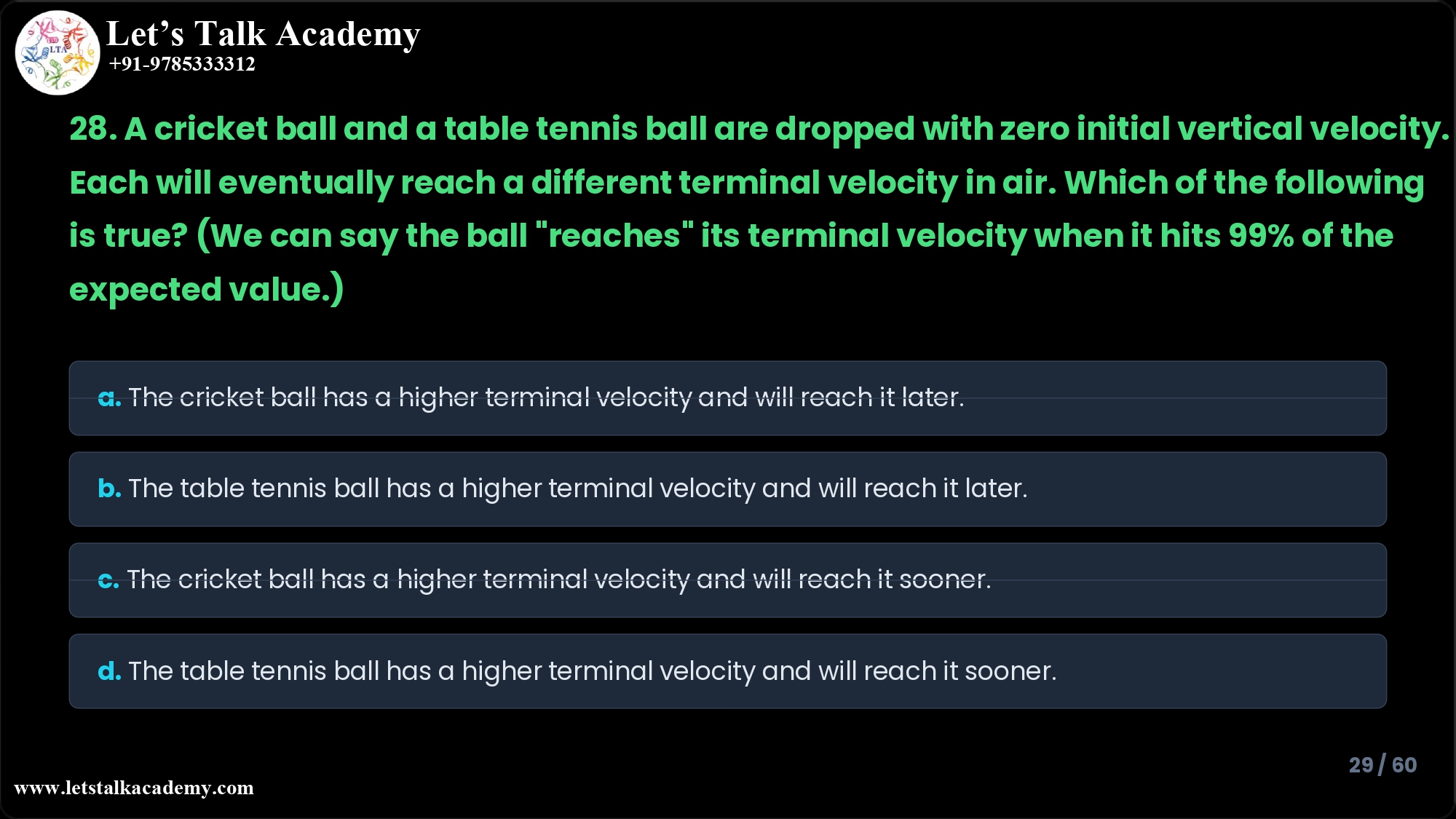
28. A cricket ball and a table tennis ball are dropped with zero initial vertical velocity.
Each will eventually reach a different terminal velocity in air. Which of the following is
true? (We can say the ball “reaches” its terminal velocity when it hits 99% of the
expected value.)
a. The cricket ball has a higher terminal velocity and will reach it later.
b. The table tennis ball has a higher terminal velocity and will reach it later.
c. The cricket ball has a higher terminal velocity and will reach it sooner.
d. The table tennis ball has a higher terminal velocity and will reach it
sooner.
Concept: Terminal velocity occurs when the gravitational force on a falling object equals the drag force opposing its motion. At this point, the net force is zero, and the object descends at a constant speed.
Example Data
- Cricket ball: Mass ≈ 156 g, Diameter ≈ 7.2 cm
- Table tennis ball: Mass ≈ 2.7 g, Diameter ≈ 4 cm
The cricket ball achieves a higher terminal velocity (~35 m/s) because of its larger mass and smaller relative drag-to-weight ratio. It takes longer (~16 s) to reach 99% of this velocity compared to the table tennis ball (~4 s).
Terminal Velocity Formula
The general expression for terminal velocity is:
de>vt = √(2mg / (ρ Cd A))
where:
- de>m – mass of the object
- ρ – air density
- de>Cd – drag coefficient (~0.5 for spheres)
- A – cross‑sectional area
Thus, terminal velocity increases with mass but decreases with higher air density, drag coefficient, or cross‑sectional area.
For typical conditions:
- Cricket ball: de>vt ≈ 35 m/s
- Table tennis ball: de>vt ≈ 9 m/s
Approach to Terminal Velocity
The velocity–time relation is:
de>v(t) = vt (1 − e−t/τ) where de>τ = vt / g
Reaching 99% of de>vt requires roughly de>4.6τ. A larger de>vt implies a longer time constant, meaning the heavier object (cricket ball) takes more time to approach its terminal velocity.
Option Analysis
- a) Cricket ball higher terminal velocity, reaches later – Correct. The cricket ball’s higher de>vt (~35 m/s) results from greater mass-to-drag ratio. However, it reaches 99% of this velocity later because of its longer time constant (~16 s).
- b) Table tennis higher terminal velocity, reaches later – Incorrect. Its lower mass and higher de>CdA/m ratio yield lower vt (~9 m/s).
- c) Cricket ball higher terminal velocity, reaches sooner – Incorrect. Though de>vt is higher, the cricket ball’s larger de>τ delays reaching 99% (~16 s vs ~4 s).
- d) Table tennis higher terminal velocity, reaches sooner – Incorrect. Its lighter mass yields lower de>vt, though it stabilizes faster due to a smaller de>τ.
Correct Answer
Option (a): The cricket ball has a higher terminal velocity (~35 m/s vs ~9 m/s) due to a superior mass‑to‑drag ratio and reaches it later. The table tennis ball, though lighter, equilibrates faster because of a smaller time constant.


