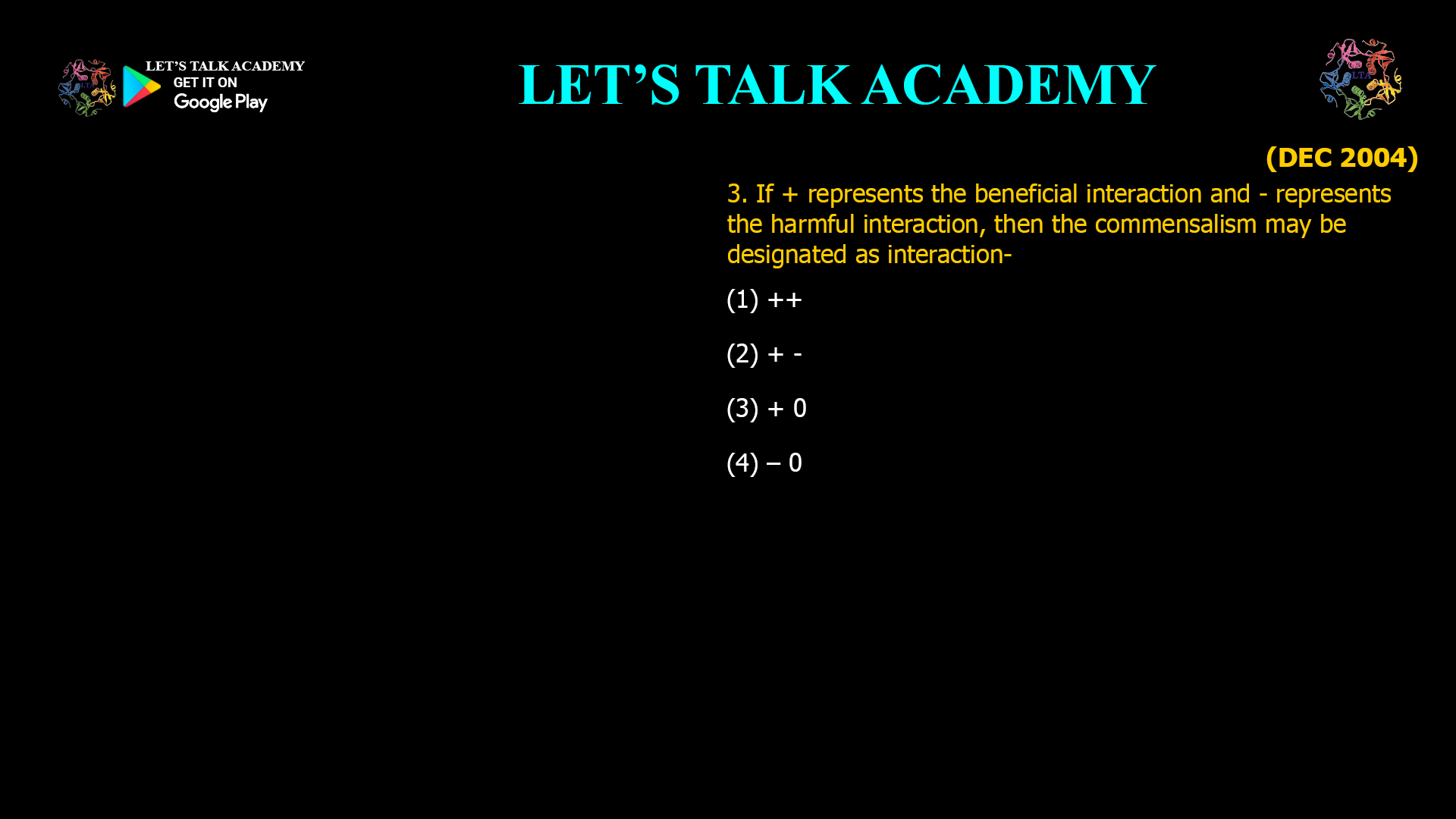
- If + represents the beneficial interaction and – represents the harmful interaction, then the
commensalism may be designated as interaction-
(1) ++ (2) + –
(3) + 0 (4) – 0In the study of ecology, understanding the different types of interactions between organisms is essential for grasping how ecosystems function. Among these interactions, commensalism holds a unique place. It is characterized by one organism benefiting from the relationship, while the other is neither helped nor harmed. This article explores why commensalism is designated as a +0 interaction, provides clear examples, and distinguishes it from other types of ecological relationships.
What Is Commensalism?
Commensalism is a type of symbiotic relationship where one species benefits from the association, and the other species is unaffected—experiencing neither benefit nor harm. This interaction is common in nature and plays a subtle but important role in the structure and dynamics of ecological communities.
Key Features of Commensalism
-
One-sided benefit: Only one organism (the commensal) gains from the relationship.
-
No impact on the host: The other organism (the host) is neither positively nor negatively affected by the interaction.
-
Long-term or short-term: The interaction can be temporary or persist throughout the life of the organisms involved.
-
Common in various ecosystems: Commensalism occurs in terrestrial, aquatic, and even anthropogenic environments.
The +0 Interaction Designation
In ecological notation:
-
“+” represents a beneficial effect on an organism.
-
“–” represents a harmful effect.
-
“0” represents no effect.
Commensalism is designated as (+ 0) because:
This is in direct contrast to:
-
Mutualism (+ +): Both organisms benefit.
-
Parasitism (+ –): One benefits, the other is harmed.
-
Amensalism (– 0): One is harmed, the other is unaffected.
Classic Examples of Commensalism
-
Barnacles on Whales:
Barnacles attach to the skin of whales, gaining mobility and access to nutrient-rich waters. The whale is not affected by their presence 2478. -
Epiphytic Plants:
Orchids or ferns grow on tree branches to access sunlight. The tree is neither helped nor harmed by the epiphyte 14. -
Remora Fish and Sharks:
Remoras attach to sharks and feed on leftover food particles. The shark is unaffected by the remora’s presence 24. -
Birds Nesting in Trees:
Birds may build nests in trees for shelter and safety, but the tree is not impacted by the nesting birds 34.
Types of Commensalism
-
Inquilinism: One organism uses another for housing (e.g., birds nesting in trees).
-
Phoresy: One organism uses another for transportation (e.g., mites on insects).
-
Metabiosis: One organism creates a habitat for another through its normal activities (e.g., hermit crabs using abandoned snail shells) 34.
Why Is the +0 Designation Important?
This notation helps ecologists quickly communicate the nature of the interaction:
-
It clarifies that commensalism is fundamentally different from mutualism and parasitism.
-
It highlights the neutrality for the host, which is essential for understanding energy flow, resource use, and evolutionary pressures in ecosystems 12578.
Conclusion
Commensalism is best described as a (+ 0) ecological interaction, where one organism benefits and the other is unaffected. This simple yet powerful concept helps explain many relationships in nature and underscores the diversity of strategies organisms use to survive and thrive. Recognizing the +0 designation for commensalism allows ecologists and students alike to better understand and study the complex web of life.
Correct answer: (3) + 0
-


4 Comments
Neelam Sharma
October 26, 2025(3) + 0
Manisha choudhary
November 6, 20253 is correct answer+0
Kajal
November 8, 2025Option 3
Sakshi Kanwar
November 27, 2025+ 0