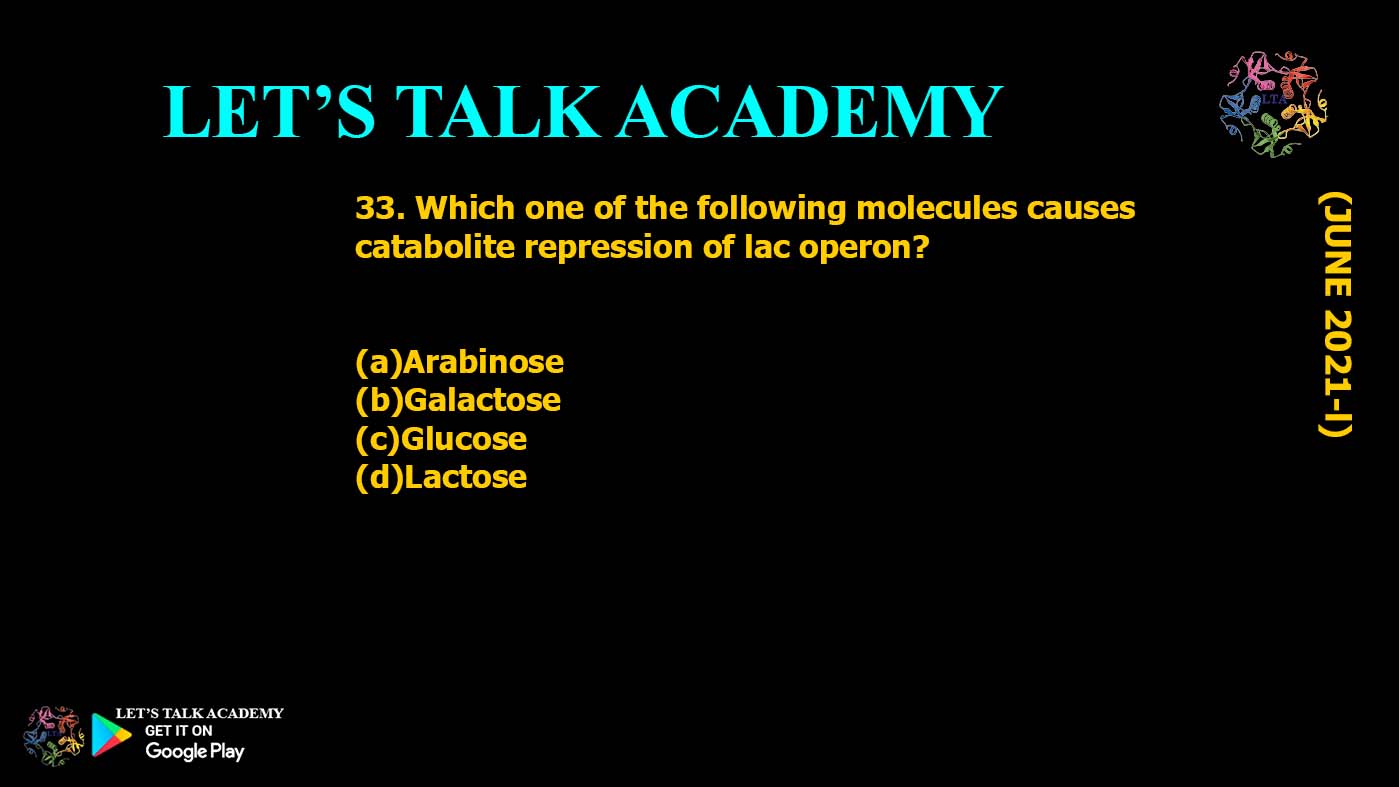
Which one of the following molecules causes catabolite repression of lac operon?
(a)Arabinose
(b)Galactose
(c)Glucose
(d)Lactose
Catabolite Repression of the lac Operon in Bacteria by Glucose
The lac operon is one of the most well-known models of gene regulation in prokaryotes, particularly Escherichia coli (E. coli). It enables bacteria to use lactose as an energy source, but only when more favorable sugars like glucose are not available. This prioritization of glucose is controlled through a regulatory mechanism known as catabolite repression.
In this article, we’ll explore which molecule causes catabolite repression of the lac operon, how the mechanism works, and why it’s critical for bacterial energy efficiency.
The lac Operon and Its Role
The lac operon includes a set of genes (lacZ, lacY, and lacA) involved in the metabolism of lactose. It is regulated by:
-
Lac repressor (LacI): Binds to the operator region to prevent transcription when lactose is absent.
-
cAMP-CAP complex: Enhances transcription of the operon when glucose is low.
Catabolite Repression Explained
Catabolite repression is a regulatory mechanism where the presence of a preferred carbon source (like glucose) inhibits the expression of genes involved in the metabolism of less preferred sources (like lactose).
When glucose levels are high, E. coli represses the lac operon—even if lactose is present—because glucose is more efficient to metabolize.
This is achieved through the following molecular pathway:
-
High glucose → Low cAMP levels
Glucose inhibits the enzyme adenylate cyclase, reducing the production of cyclic AMP (cAMP). -
Low cAMP → Inactivation of cAMP-CAP complex
The catabolite activator protein (CAP) requires cAMP to bind to the lac operon promoter and activate transcription. Without cAMP, CAP cannot bind. -
Result: Transcription of the lac operon is repressed, even if lactose is available.
Analyzing the Options
Let’s look at the given choices and determine which molecule causes catabolite repression of the lac operon:
-
(a) Arabinose:
Arabinose is a sugar, but it regulates the ara operon, not the lac operon. -
(b) Galactose:
Galactose is a breakdown product of lactose. It is not involved in repressing the lac operon and can actually induce some genes related to galactose metabolism. -
(c) Glucose:
✅ Correct Answer. Glucose causes catabolite repression of the lac operon by lowering cAMP levels and thereby preventing activation of the operon. -
(d) Lactose:
Lactose is an inducer of the lac operon, not a repressor. It inactivates the lac repressor (LacI) to allow transcription.
Correct Answer:
(c) Glucose
Conclusion
The lac operon is a beautifully regulated system that enables bacteria to optimize their energy usage. Glucose plays a key role in catabolite repression by suppressing the expression of genes needed to metabolize lactose. This ensures that E. coli consumes glucose first before switching to lactose, showcasing an efficient hierarchy in nutrient utilization.
Understanding this mechanism is foundational in molecular biology, gene regulation, and microbial physiology, and it highlights how even single-celled organisms adapt intelligently to their environment.


3 Comments
Akshay mahawar
April 24, 2025Done 👍
Vaidehi Sharma
April 30, 2025Done✅
yogesh sharma
May 8, 2025Done sir ✅