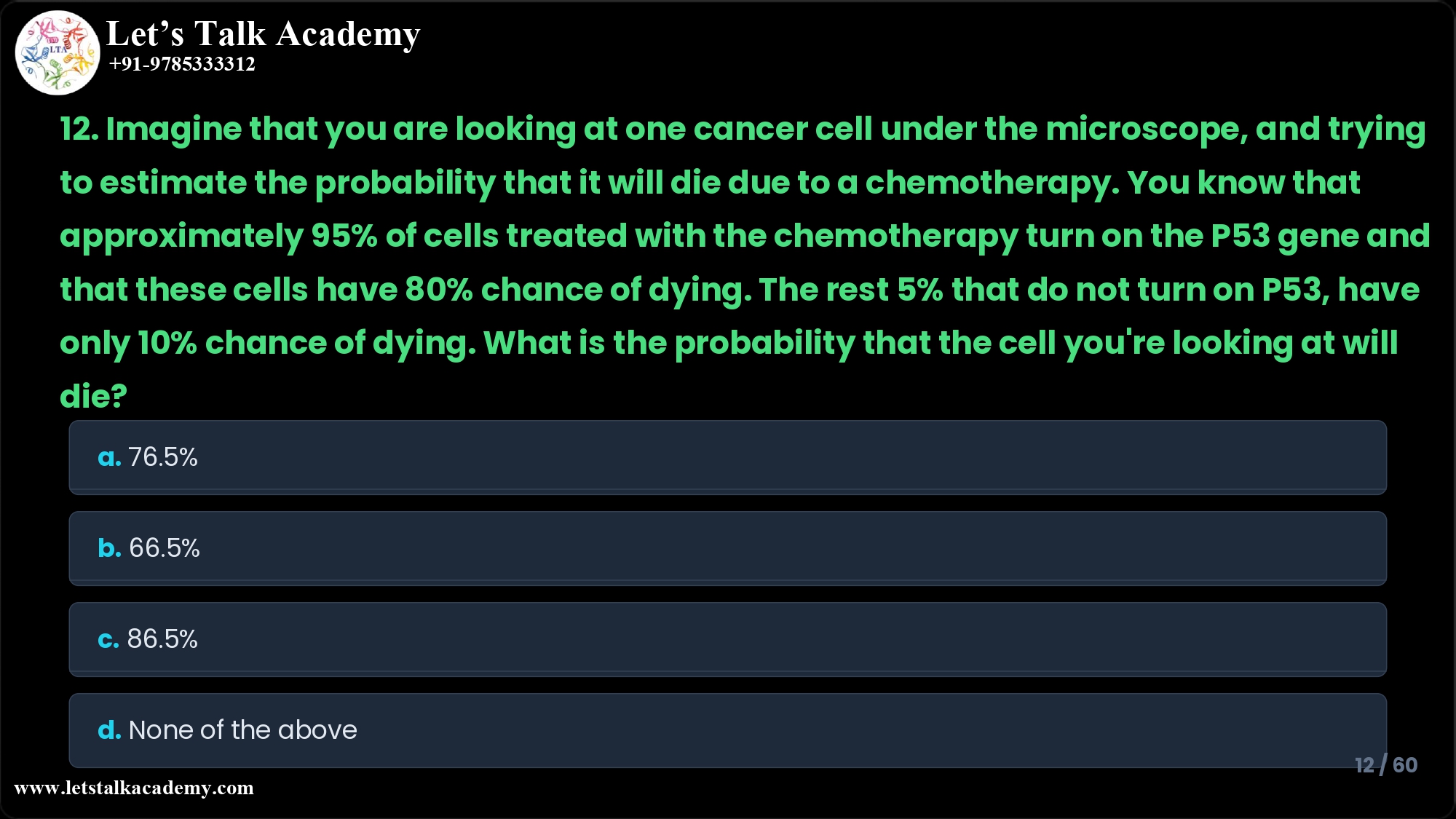
12. Imagine that you are looking at one cancer cell under the microscope, and trying to
estimate the probability that it will die due to a chemotherapy. You know that
approximately 95% of cells treated with the chemotherapy turn on the P53 gene and that
these cells have 80% chance of dying. The rest 5% that do not turn on P53, have only
10% chance of dying. What is the probability that the cell you’re looking at will die?
a. 76.5%
b. 66.5%
c. 86.5%
d. None of the above
Step-by-step calculation
This is a total probability problem with two mutually exclusive paths: P53 activation or no activation.
Let D = cell dies, P53 = P53 gene turns on.
Given:
P(P53) = 95% = 0.95, P(D|P53) = 80% = 0.80
P(no P53) = 5% = 0.05, P(D|no P53) = 10% = 0.10
Total P(D) = P(D|P53) × P(P53) + P(D|no P53) × P(no P53)
= (0.80 × 0.95) + (0.10 × 0.05)
= 0.76 + 0.005
= 0.765 = 76.5%
P53 activation dramatically boosts chemotherapy-induced apoptosis in cancer cells, making the weighted average death probability 76.5%.
Option analysis
-
(a) 76.5% – Correct
Matches exact total probability: 0.95×0.80 + 0.05×0.10 = 0.765. Standard law of total probability application for conditional death probabilities. -
(b) 66.5% – Incorrect
Possible miscalculation like averaging (80%+10%)/2=45% then something erroneous, or 0.95×0.70. Does not match data. -
(c) 86.5% – Incorrect
Might come from overestimating P53 effect like 0.95×0.90 + 0.05×0.10=0.865, but given P(D|P53)=80% exactly, so wrong. -
(d) None of the above – Incorrect
Rejected since 76.5% is option (a) and calculation confirms it precisely.


