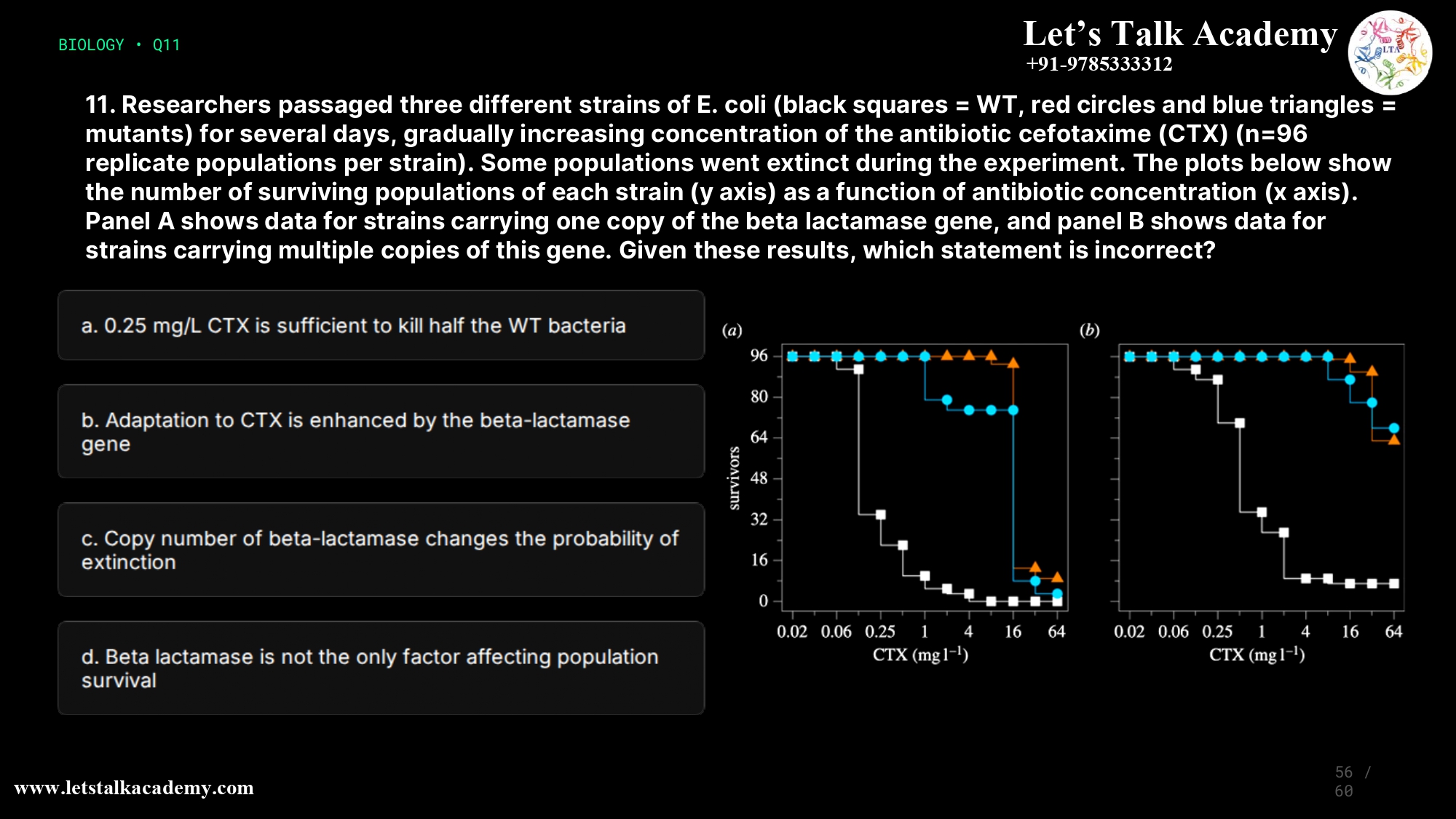
11. Researchers passaged three different strains of E. coli (black squares = WT, red circles and blue
triangles = mutants) for several days, gradually increasing concentration of the antibiotic cefotaxime
(CTX) (n=96 replicate populations per strain). Some populations went extinct during the experiment.
The plots below show the number of surviving populations of each strain (y axis) as a function of
antibiotic concentration (x axis). Panel A shows data for strains carrying one copy of the beta
lactamase gene, and panel B shows data for strains carrying multiple copies of this gene. Given these
results, which statement is incorrect?
a. 0.25 mg/L CTX is sufficient to kill half the WT bacteria
b. Adaptation to CTX is enhanced by the beta-lactamase gene
c. Copy number of beta-lactamase changes the probability of extinction
d. Beta lactamase is not the only factor affecting population survival
The incorrect statement is option a: 0.25 mg/L CTX is sufficient to kill half the WT bacteria.
Understanding the experiment
Researchers propagated three E. coli strains (wild type = black squares, two β‑lactamase mutants = red circles and blue triangles) in increasing cefotaxime (CTX) concentrations, tracking how many of 96 replicate populations of each strain survived at each CTX level. Panel A shows strains with a single β‑lactamase gene copy, and panel B shows strains with multiple copies, so curves shift to higher CTX when more enzyme is present.
Option a: 0.25 mg/L CTX kills half WT (incorrect)
The WT (black squares) curve falls gradually as CTX increases, and the point where half of the 96 WT populations are extinct lies above 0.25 mg/L (closer to about 0.5–1 mg/L CTX on the x‑axis). Therefore 0.25 mg/L CTX is not sufficient to kill half the WT populations, making statement a false.
Option b: Adaptation enhanced by β‑lactamase (correct)
Both mutant strains (red circles and blue triangles) consistently retain more surviving populations than WT at any given CTX concentration, meaning they tolerate and adapt to higher CTX levels. This shows that the presence of a β‑lactamase gene improves adaptation to CTX compared with the wild‑type lacking that resistance determinant, so statement b is supported.
Option c: Copy number changes extinction probability (correct)
Comparing panel A (one gene copy) with panel B (multiple copies), the survival curves for each genotype in panel B are shifted to higher CTX concentrations. This means populations with multiple β‑lactamase copies go extinct at higher CTX levels than those with a single copy, proving that gene copy number alters the probability of extinction; hence c is correct.
Option d: β‑lactamase not the only factor (correct)
Even at the same β‑lactamase copy number (within each panel), the two mutant strains (red and blue) show different survival profiles, and some WT populations survive to intermediate CTX levels. These differences indicate that other genetic or physiological factors besides β‑lactamase (such as additional mutations, stress responses, or population heterogeneity) also influence survival, so statement d is true.
Introduction
Understanding how the beta lactamase gene copy number in E. coli adaptation to cefotaxime affects population survival is essential for exams that test antibiotic resistance and experimental interpretation. This MCQ uses survival curves of wild‑type and β‑lactamase‑expressing strains under increasing cefotaxime (CTX) to probe concepts such as minimum inhibitory concentration, gene dosage, and extinction probability.
Experimental design and key observation
Three E. coli strains (WT, and two β‑lactamase mutants) were propagated in 96 replicate populations each, with CTX concentration gradually raised over several days while counting how many populations survived at each step. Panel A shows strains with a single β‑lactamase gene copy, while panel B shows strains with multiple copies, revealing that higher copy number shifts survival to higher CTX, consistent with increased resistance.
Correct answer and reasoning
The incorrect statement is option a, because at 0.25 mg/L CTX more than half the WT populations still survive; the 50% survival point for WT occurs at a higher CTX concentration. Options b, c, and d accurately reflect that β‑lactamase expression enhances adaptation, that gene copy number modifies extinction risk, and that other factors beyond β‑lactamase also affect survival patterns.


