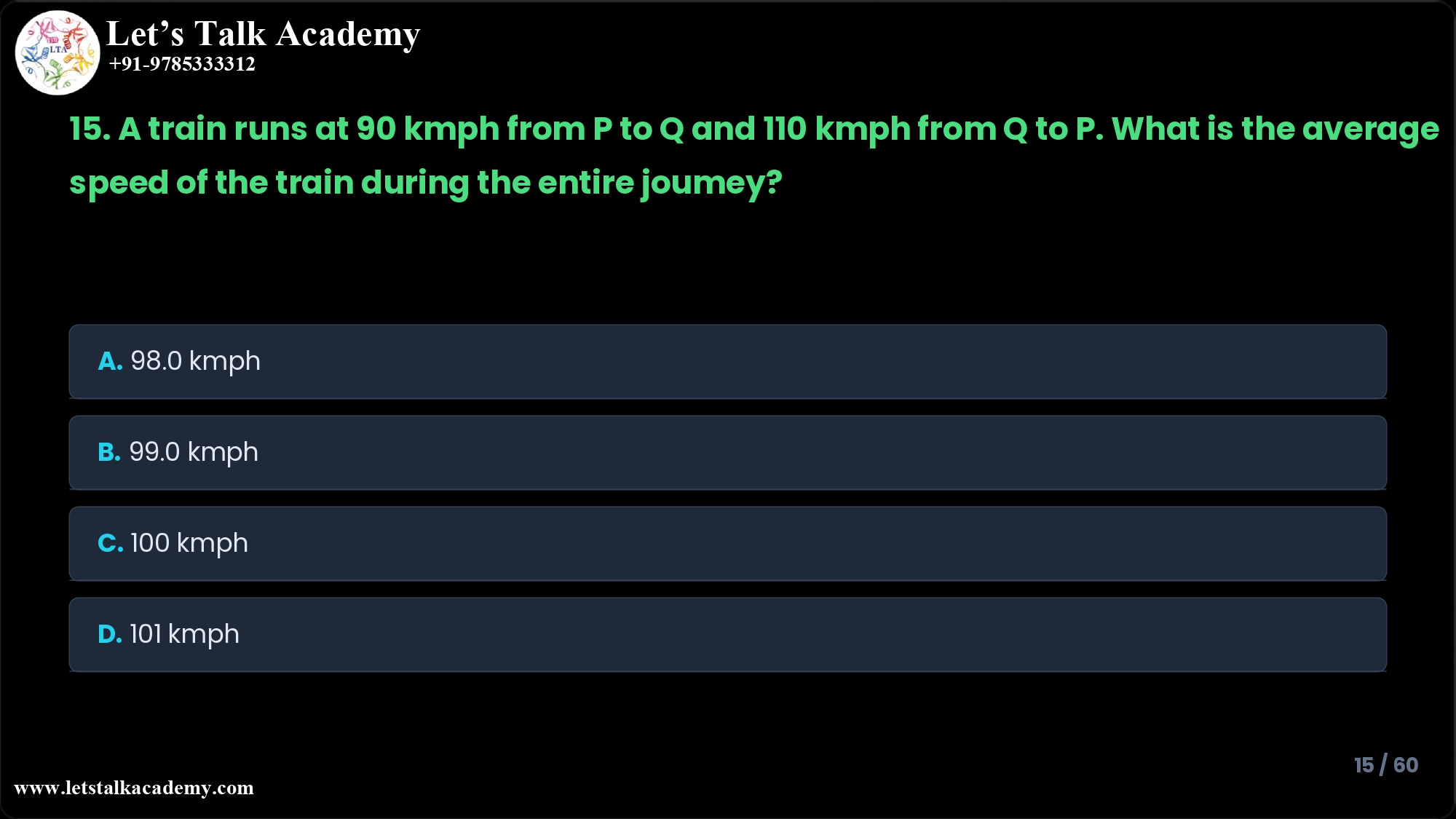
15. A train runs at a speed of 90 kmph from P to Q and 110 kmph from Q to P? What is
the average speed of the train during the entire journey?
A. 98.0 kmph
B. 99.0 kmph
C. 100 kmph
D. 101 kmph
Average Speed of Train: Why 99 kmph is Correct (Not 100 kmph)
Quick Answer: The average speed of a train traveling the same distance from P to Q at 90 kmph and back at 110 kmph is 99 kmph using the harmonic mean formula.
🔑 Core Concept: Harmonic Mean for Equal Distances
When a train covers equal distances at different speeds, use the harmonic mean formula, not arithmetic mean:
Average Speed = \(\frac{2ab}{a+b}\)
where a = 90 kmph, b = 110 kmph
where a = 90 kmph, b = 110 kmph
📊 Step-by-Step Calculation
Step 1: Apply Harmonic Mean Formula
Average Speed = \(\frac{2 \times 90 \times 110}{90 + 110}\) = \(\frac{2 \times 9900}{200}\) = \(\frac{19800}{200}\) = 99 kmph
Step 2: Time-Based Verification
Assume distance PQ = 90 km:
- Time P→Q at 90 kmph = 90/90 = 1 hour
- Time Q→P at 110 kmph = 90/110 ≈ 0.818 hours
- Total distance = 180 km, Total time ≈ 1.818 hours
- Average speed = 180/1.818 ≈ 99 kmph
✅ Correct Answer: Option B – 99.0 kmph
Matches harmonic mean exactly for equal distance travel.
Matches harmonic mean exactly for equal distance travel.
⚖️ Option-by-Option Detailed Analysis
| Option | Value | Why Correct/Incorrect | Common Mistake |
|---|---|---|---|
| B | 99.0 kmph | CORRECT – Harmonic mean \(\frac{2ab}{a+b}\) for equal distances | – |
| A | 98.0 kmph | ❌ Too low. Wrong arithmetic or distance-time mix-up | Manual averaging error |
| C | 100 kmph | ❌ Arithmetic mean (90+110)/2. Valid only for equal time, not equal distance | Most common mistake! |
| D | 101 kmph | ❌ Above arithmetic mean. Impossible for harmonic mean (always ≤ arithmetic mean) | No mathematical basis |
🎯 Key Takeaway: When to Use Which Mean?
Equal Distances: Harmonic Mean \(\frac{2ab}{a+b}\)
Equal Times: Arithmetic Mean \(\frac{a+b}{2}\)
Equal Times: Arithmetic Mean \(\frac{a+b}{2}\)
💡 Pro Tip for Competitive Exams
Always check: Equal distance → Harmonic mean | Equal time → Arithmetic mean


