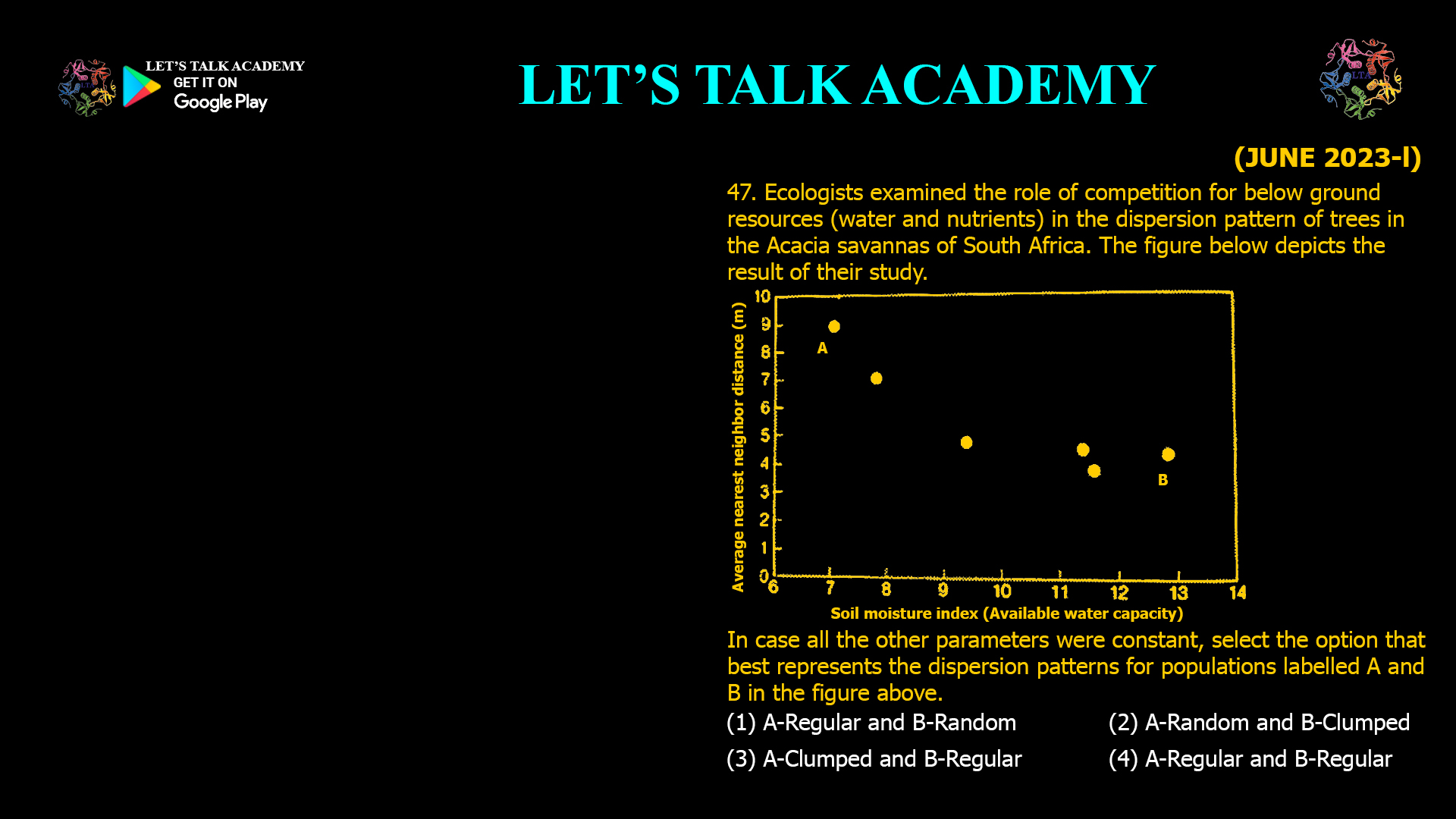
- Ecologists examined the role of competition for below ground resources (water and nutrients) in the dispersion pattern of trees in the Acacia savannas of South Africa. The figure below depicts the result of their study.
In case all the other parameters were constant, select the option that best represents the dispersion patterns for populations labelled A and B in the figure above.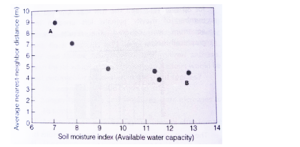
(1) A-Regular and B-Random
(2) A-Random and B-Clumped
(3) A-Clumped and B-Regular
(4) A-Regular and B-RegularIntroduction
Tree dispersion patterns in savannas are shaped by a variety of ecological factors, with competition for water and nutrients playing a central role. In the Acacia savannas of South Africa, ecologists have observed distinct spatial patterns among tree populations. Understanding these patterns helps explain how trees coexist, compete, and structure the landscape.
The Role of Competition in Tree Spacing
-
Belowground competition for water and nutrients can lead to regular (even) spacing among trees, as each individual requires a certain area to access sufficient resources.
-
When competition is strong, trees that are too close together may not survive, resulting in a pattern where individuals are spaced at relatively uniform distances.
-
In contrast, random or clumped patterns can occur when competition is weak, seeds are dispersed by animals, or environmental conditions favor aggregation.
What Do the Patterns Mean?
-
Regular (Even) Dispersion: Indicates strong competition for resources. Trees are spaced apart more or less evenly to minimize competition.
-
Clumped Dispersion: Suggests limited seed dispersal, patchy resources, or facilitation among individuals.
-
Random Dispersion: Occurs when environmental conditions and interactions are uniform and non-limiting.
Evidence from Acacia Savannas
Research on Acacia tree spacing in African savannas shows that:
-
Both regular and clumped patterns can occur, but regular patterns are most strongly associated with intense competition for belowground resources37.
-
Over time and under strong competitive conditions, tree populations tend to shift toward a more regular pattern as individuals that are too close together are outcompeted and die off3.
Interpreting the Figure
Given the study context—competition for belowground resources as the main variable—population A is best represented by a regular pattern (indicative of strong competition), while population B is best represented by a random pattern (indicative of weaker or absent competition, or perhaps early successional stages before competition has thinned the population).
Correct Option
The best answer is:
(1) A-Regular and B-Random
Conclusion
In Acacia savannas, competition for belowground resources leads to a regular dispersion pattern among trees, as individuals space themselves to maximize resource access. When such competition is absent or less intense, dispersion may be random. Understanding these patterns is essential for managing and conserving savanna ecosystems, as they reflect the underlying ecological processes shaping plant communities.
-


2 Comments
Kajal
November 9, 2025Regular and random
Sakshi Kanwar
November 27, 2025A-Regular and B-Random